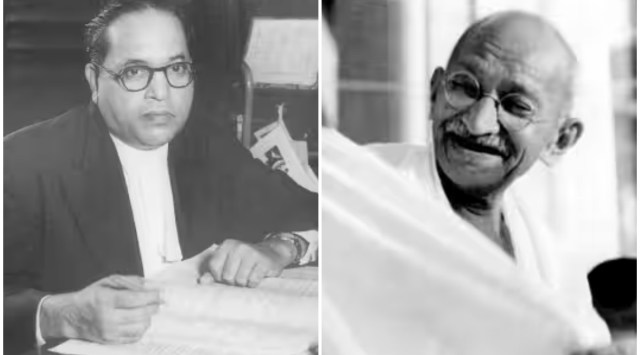

The ability of the Sangh Parivar to run with the hare and hunt with the hounds has to be discussed in political circles. Though the RSS had no role in the freedom movement, this manipulative organisation tries to appropriate the legacy of that heroic struggle. They frequently use the names of Mahatma Gandhi, Vallabhbhai Patel, Subhas Chandra Bose, B R Ambedkar and Bhagat Singh as part of this dishonest appropriation drive. Some RSS followers routinely glorify Nathuram Godse, Gandhi’s assassin. Certain others veil their contempt thinly and sing praises for Gandhi. Just the other day, a top leader from the RSS wrote in a national daily apparently to commemorate Gandhi Jayanti. Because of reasons best known to him, his focus was not on Gandhi, but on the disagreements between Gandhi and Ambedkar. The disagreements between the two national leaders were philosophical and are well-documented. In the current context of sharp polarisation in political positions, it is worth exploring the RSS’s handpicking of discord rather than unity when remembering Mahatma Gandhi.
Stating that Gandhi is indispensable, the RSS ideologue went further to say that one can love Gandhi or hate him. That statement is universally applicable to every man or woman. But in the given socio-political-ideological context, when the struggle between secularism and communal hatred gets sharper and sharper, the above statement cannot be considered innocent. In India, religious extremism is the manifestation of racial pride, which is the stepping stone for the advent of fascism. In that background, a call to equalise hate or love towards Gandhi cannot be construed as a naive statement, especially when it comes from an important leader of an organisation known for its divisive philosophy that they have named Hindutva.


While the article is quick to suggest that Gandhi should be read without ideological biases, the author seems to have done exactly that. For instance, the piece recalls Gandhi’s wish to maintain the varna system, conveniently forgetting that Gandhi himself saw flaws in it and argued for its reform. Moreover, picking a quote from 1934 and presenting it as Gandhi’s lifelong view on the varna system is misleading. Any endeavour to brand Gandhi as the guardian of Hindutva by contrasting him with Ambedkar is not only historically inaccurate but also an assault on Gandhi’s teachings. The essence of Gandhian philosophy is truth, non-violence, and universal brotherhood. Its opposite, Hindutva, is more preoccupied with forging and consolidating a political-religious identity than promoting inclusiveness and harmony.
Through the article, the RSS’s portrayal of Gandhi-Ambedkar dynamics as those of “arch-rivals” is another distortion. While it is true that both leaders had differences in their approach to social reforms and caste disparities, it’s an oversimplification to label them adversaries. It serves only to polarise and misunderstand the debates that shaped our nation. Our freedom movement was characterised by myriad views, and diversity of thought was its strength, not weakness. Several viewpoints within the Indian National Congress, communists, armed revolutionaries, socialists, followers of Ambedkar, etc. enriched the freedom struggle with lively debate. Both Gandhi and Ambedkar understood and recognised this. Gandhi once remarked, “Dr Ambedkar has every right to be bitter. His bitter experience should be an eye-opener for us.” This suggests understanding rather than antagonism. Ambedkar, on his part, acknowledged, “Gandhi is sincere but misguided.” Their dialogues should be seen as collaborative efforts in nation-building rather than confrontations. Philosophical differences have always been the crux of a thriving democracy. This is, of course. unacceptable to the RSS which does not recognise differences due to its monolithic approach.
The RSS’s focus on Gandhi’s advocacy for varna over caste, juxtaposed with Ambedkar’s views, conveniently overlooks the Mahatma’s evolving perspective. Gandhi never shielded the vices of Hinduism and attacked social discrimination to sculpt an inclusive society. By stressing that Ambedkar was initially against the Poona Pact, the said article tries to paint him as confrontational. However, Ambedkar’s objective was to secure the best possible deal for the oppressed classes. His agreement to the pact underlines his pragmatic approach rather than capitulation to Gandhi’s fast. What is often sidelined due to polarisation is the influence Gandhi and Ambedkar had on each other. Their interactions led to introspection and reassessment of their standpoints. Branding them as adversaries negates the essence of democracy itself where differing opinions are not antagonisms but essential for a thriving society.
While the article attempts to contrast the views of Gandhi and Ambedkar on the caste question, it conveniently omits RSS’s historical position on the issue. It is well documented that the RSS was silent on the question of untouchability in its formative years. K B Hedgewar, the founder of the RSS, while being a part of the Congress in the 1920s, never actively participated in any anti-untouchability campaigns. The RSS’s ideological pinning is formed on the Manusmriti, not on any inclusive vision for society. RSS stands against Gandhi and Ambedkar’s shared dream of an egalitarian India. Gandhi and Ambedkar, despite their differences, envisioned an India that was united in its diversity, where every individual, irrespective of caste, creed, or religion, had equal opportunities — the things RSS cannot tolerate.
To cherry-pick historical narratives, especially of figures as pivotal as Gandhi and Ambedkar, is not just academic oversight but an intentional misdirection. It becomes particularly alarming when such distorted narratives emerge in times when the nation is experiencing heightened socio-political tensions. The intention behind such selective retellings is to manufacture a past to align with the vision of exclusionary hyper-nationalism of the RSS brand. It serves the interests of a very small specific group rather than a collective India. Both Gandhi and Ambedkar were leaders who envisioned a progressive, inclusive India. As we navigate today’s complexities, let their philosophies guide, not divide us. Let’s cherish their legacy by understanding their multifaceted personas and resisting the attempts to reduce them to mere tokens to polarise contemporary political discourse.
The writer is leader of CPI Parliamentary Party and Secretary, National Council


