
Opinion In times of climate change, India and Pakistan need to update the Indus Waters Treaty
IWT was signed in 1960, when threats like heatwaves, glacier melt, and sea level rise were not recognised. Both countries must decide how to negotiate a treaty which should have built-in mechanisms for adjustments
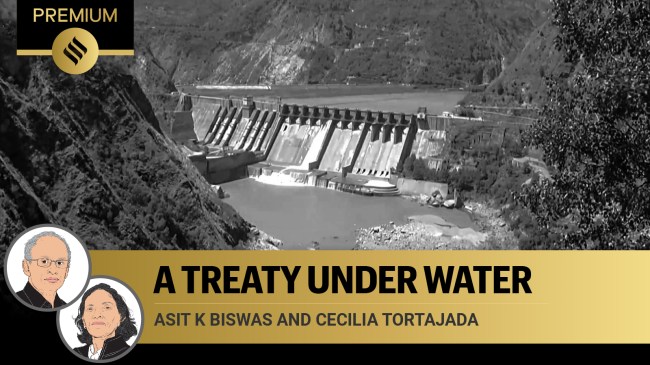 A dam on the Indus river system, in Jammu and Kashmir's Reasi. (Photo: PTI)


On April 24, Debashree Mukherjee, Secretary, Jal Shakti Ministry, formally informed her Pakistani counterpart, Syed Ali Murtaza, that the Government of India had sent several notices to the Pakistani Government to seek modifications to the Indus Waters Treaty (IWT) of 1960. This is because fundamental changes have taken place since the pact was inked some 65 years ago, which “require a reassessment of obligations under the various articles of the Treaty”. She went on to point out that there have been “sustained cross-border terrorism by Pakistan,” targeting Jammu and Kashmir, and these events “have directly impeded India’s full utilisation of rights under the Treaty”. The Government of India, therefore, decided to keep the Treaty “in abeyance with immediate effect”.
The decision was a direct result of terrorists killing 26 innocent tourists in Pahalgam. The terrorists selectively targeted Hindus. Following this attack, India’s Prime Minister Narendra Modi vowed to “identify, track and punish every terrorist and their backers.” The more than three-day-long hostilities between the neighbours ended with a ceasefire on May 17.

There has been much rhetoric in both countries about what may happen to the flows of the Indus, Jhelum, Chenab and their tributaries, which were allocated to Pakistan under the Treaty. Rhetoric aside, the simple fact is that if it decides to stop water flowing to Pakistan, India does not have the infrastructure to store the flows for a few days — let alone, a long period. Construction of such an infrastructure will take at least a decade, if not more.
It’s a miracle that IWT has lasted some 65 years, even though, over the past three decades, there have been increasing signs that the pact was becoming less and less relevant to both countries. During the last decade, it was evident to any objective observer that the Treaty needed major modifications to become relevant to both countries in the post-2025 period.
This is due to many reasons. India and Pakistan were very different countries in 1960, compared to now. In 1960, India’s population was 445 million. It is now 1.46 billion, an increase of nearly 3.25 times. In 1960, 17.94 per cent of Indians lived in urban areas. Today, urban areas are home 36 per cent of the population – and this proportion is increasing rapidly.
Similarly, Pakistan’s population in 1960 was 45.7 million. It is now 255 million, an increase of nearly 5.5 times. In 1960, well under 20 per cent of Pakistanis lived in urban areas. Now it is nearly double that figure. In 1960, India’s per capita GDP was significantly lower than Pakistan’s — $312.78 to $411.16, almost 31 per cent less. Sixty-four years later, in 2024, India’s per capita GDP was $2,698, against Pakistan’s $1,647, almost 40 per cent higher. India’s economic performance during the past 65 years has been significantly better than Pakistan’s.
Increases in population, urbanisation and economic activities and improvement in living standards have led to a very significant escalation in water demands. Poor management practices have exacerbated the water problems of both countries. Neither country has given much attention to managing demand and maintaining water quality. The main focus has been to increase supply availability, which is no longer possible in an arid dry region.
In addition, the Green Revolution started in Punjab, both in India and Pakistan, after the Treaty was signed. One of the main impacts of this Revolution was that while food production increased significantly, water demands in Indian and Pakistani Punjab went up concomitantly. Water tables in both Indian and Pakistani Punjab have been declining by over 50 cm per year. In many areas of Punjab in both countries, water levels have been declining by over one metre each year.
Such unsustainable practices cannot continue, especially as around 85 per cent of water requirements in India, and 90 per cent in Pakistan, are accounted for by the agricultural sector. Not only in the Indus Basin, but all over India and Pakistan, water and farm practices have to be re-imagined. Water use in the agricultural sector needs to be significantly reduced but at the same time, food production needs to be substantially increased. China has achieved similar objectives. Between 1975 and 2005, it reduced irrigation water use per hectare by 40 per cent, and increased agricultural production 12 times. During this period, agricultural water use in China declined from 84 per cent of total water use to 61 per cent. Since 2005, it has made more progress. India and Pakistan, too, do not have much choice.
The Indus treaty addressed only surface water. It ignored critical issues like groundwater, water quality, and water demand management.
IWT was signed in 1960, when threats like climate change, heatwaves, glacier melt, and sea level rise were not recognised. The water management practices of that time have become outdated. There was little understanding of the complex linkages between water, food, energy, and environmental securities.
Himalayan glaciers, which feed the Indus River system, have been melting for several years, leading to increased river flows during spring and summer. This trend could reverse after 2050, when most glaciers are likely to have melted. Droughts and floods in the Basin are becoming more frequent and intense. Meanwhile, the northern Indian Subcontinent is experiencing unprecedented heat waves. This year, Jaipur has already touched 44 degrees Celsius, while Shaheed Benazirabad in Sindh, Pakistan, recorded 50 degrees Celsius, 8.5 degrees above the April average. From May 1 to June 10, 2024, Delhi experienced 32 days when temperatures were above 40 degrees, with 28 consecutive days of temperatures above 40 degrees from May 14 to June 10. Extreme temperatures have caused a surge in electricity demand to run air conditioners and fans. Since thermal and nuclear power plants require significant quantities of water for cooling, water demand for electricity generation has also increased. This situation is expected to worsen after 2030, as global warming continues to intensify. The IWT does not include such important considerations.
The Treaty was on the sickbed by 2000. Both countries must decide how to negotiate a treaty which should have built-in mechanisms for adjustments when they become necessary. Unfortunately, not a single institution in either country is conducting serious research as to how such a living treaty could be negotiated. Now, Pakistan has belatedly indicated that it’s open to re-discussing India’s concern about the IWT.
Irrespective of what happens to the treaty, both countries will need to address serious water problems. They have to re-imagine the management of water needs, including in the Indus River Basin.
Biswas is a leading international authority on water. He is a winner of the Stockholm Water Prize. Tortajada is honorary professor at the University of Glasgow. Both are Visiting Research Professors at the Centre for Policy Research, New Delhi

 Share
Share


