

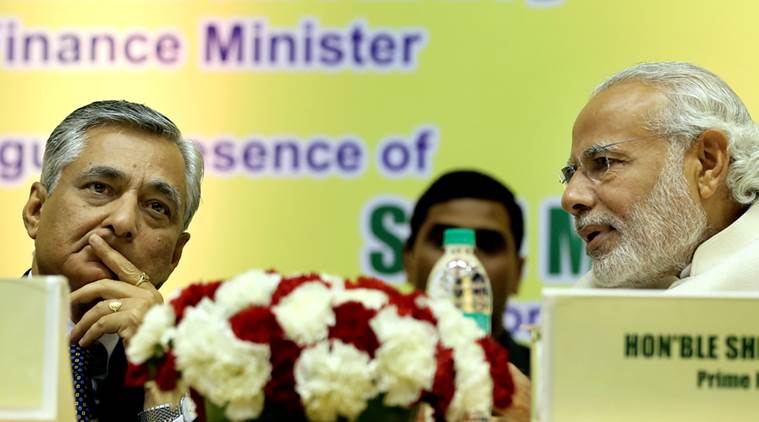
On April 24, while speaking at the joint conference of chief ministers and chief justices of high courts in Delhi, Chief Justice of India (CJI) T.S. Thakur almost broke down in the presence of the prime minister bemoaning the inaction of governments in the appointment of judges. It was disturbing to see the head of the judiciary so helpless. Most commentary on it waxed eloquent about the backlog of cases and the overload on judges but no one noticed in it constitutional irony or tried to see its root cause.
The constitutional irony lay in the claim that our democracy has intrinsic checks and balances in terms of its three independent pillars, that is, the legislature, executive and judiciary. The legislature and executive actually have never been separate. While they collapse formally into each other at the level of ministers who head the executive, this can be seen to cascade down the governance structure to the panchayat level. The executive has always been subservient to the politicians. As a matter of fact, politicians, irrespective of being in power or not, conduct themselves with this assumption. Thus, structurally or in process, the bureaucracy has never been independent of the legislature.


With regard to the huge backlog of cases in courts, data available for the 24 high courts and lower courts up to the year ending 2013 showed a pendency of 44.5 lakh and a whopping 2.6 crore cases, respectively. According to data available with the apex court, the number of pending cases with the Supreme Court was 64,919 as on December 1, 2014. The situation, no doubt, is grim. But what is causing this situation? Justice Thakur, before he became the chief justice had given the answer while delivering his keynote address in the Asia Pacific International Mediation Summit on February 12 2015 in Delhi. He had accused the government of being “the biggest litigant in the country”. In the government, one can see, it is the police that contributes most to the cases, particularly the criminal ones.
While on the one hand the police are known to artificially subdue the incidence of crime by not registering complaints against the rich and powerful, they often harass the poor by slapping false cases against them. Of the 4,20,000 individuals in prison in the country, the undertrials are about 68 per cent and of those 53 per cent belong to Dalit, Adivasi and Muslim communities. The recent acquittal of the eight Muslim youth accused in the 2006 Malegaon blasts case illustrates it. In many such terror cases, young Muslim men were arrested and tortured to confess the crime by the police with impunity. A similar modus operandi is followed in cases of Naxalites/Maoists by arresting Dalit and Adivasi youth and incarcerating them for years in jail before they are acquitted due to lack of evidence. There are hundreds of thousands of such innocent poor people in Indian jails and the cases against them constitute the backlog for the courts. An unaccountable police force is responsible. It is time the CJI took note of this fact too.


