
Opinion Alaska summit: Putin hoodwinks Trump, yet again
Where are we left after a whirlwind summit that achieved absolutely nothing? Exactly where we were beforehand, but with a few illusions stripped away
 What, Indians may ask, does Trump even want? If he’s trying to stop the war in Ukraine, why doesn’t he crack down on the nation that’s actually causing it? Why strong-arm a friend and partner like India as a roundabout way to (maybe) put some indirect pressure on Russia, while putting no pressure whatsoever on Russia itself?

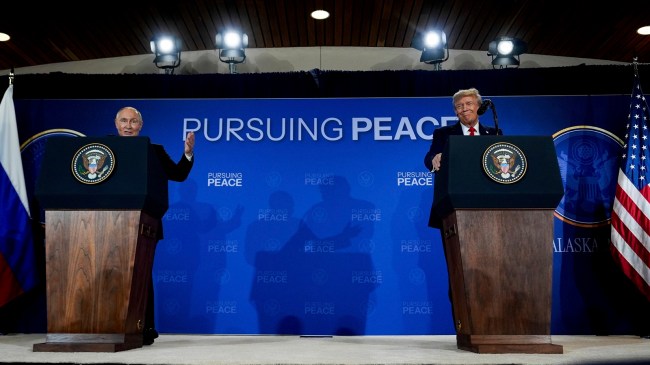
Russian President Vladimir Putin had a broad smile on his face when the two leaders appeared before cameras. And well he might: He bamboozled his American counterpart — as anyone observing their relationship over the past two decades knew he would.
Putin scored a victory the moment his feet touched American soil: With a warrant outstanding from the International Criminal Court, he can’t travel to 124 of the 193 UN member nations without risking arrest. By inviting him to the US and literally rolling out a red carpet for him, Trump granted Putin a level of legitimacy denied to him by two-thirds of the world.

The most important welcome gift, however, was a replay of the Russo-American deal of 1867. In those 19th-century negotiations, the indigenous people who’d lived on the land for 15,000 years were not at the table. This weekend’s talks were similarly closed to the people whose fate the negotiations were meant to determine: The citizens of Ukraine, whose president was pointedly excluded from the meeting.
The good news from the summit is that no deal was announced: Any such “agreement” would simply have been another case of two foreign powers divvying up land over which they had no rightful claim, against the wishes of people who resided there. But lack of such a document is cold comfort for the Ukrainians: Trump had preemptively surrendered to Putin’s most important conditions long before reaching Alaska.
Barely three weeks into his second term, Trump granted Putin’s greatest demand: Denial to Ukraine of the possibility of joining NATO. After the dissolution of the USSR, 14 European nations, which had been under de facto Soviet control, joined the world’s most powerful military alliance, and Russia hasn’t dared to invade any of them since. Ukraine was never part of NATO — and Putin has explicitly demanded that it never be offered membership.
That might have been part of a deal ending the war: Russia might give up all (or at least some) of the Ukrainian territory it has seized, and in return, Ukraine might agree to set aside hopes of joining NATO. But Trump offered that up proactively, without getting anything in return: On February 12, his Secretary of Defence said, “The United States does not believe that NATO membership for Ukraine is a realistic outcome of a negotiated settlement.” One rule of negotiations is to avoid tossing away one’s most valuable chip before sitting down at the table.
A second key Russian demand was an end to US military aid for Ukraine, and Trump capitulated on that as well. Under President Joe Biden, the US provided more aid to Ukraine than any other nation did: 175 billion dollars’ worth, the lion’s share of which was military-related. Without this aid, Ukraine might not have been able to withstand the full impact of Putin’s assault. In March, Trump cut off military aid cold, then played a back-and-forth game for months. In July, he permitted European nations to buy US armaments (to the financial benefit of American military contractors) and donate the weapons to Ukraine. That’s somewhat better than a complete arms embargo — but nowhere near the support necessary to hold Russia off for long.
While running for his current term, Trump often vowed that he’d end the Ukraine war in 24 hours. When the Alaska summit began, he’d been in office for nearly 5,000 hours; it ended with him unable to achieve a ceasefire, let alone a permanent end to the conflict.
This all must come as a shock to the citizens of India. Just two weeks ago, Trump walloped them with the highest tariff rate of any nation on Earth: 25 per cent across the board, and an additional 25 per cent as punishment for buying oil from Russia. “They don’t care how many people in Ukraine are being killed by the Russian War Machine,” he said, in purported explanation of his action. “Because of this, I will be substantially raising the tariff paid by India to the USA.” A war machine whose commander he welcomed warmly, and then gave his tacit blessing to carry right on?
What, Indians may ask, does Trump even want? If he’s trying to stop the war in Ukraine, why doesn’t he crack down on the nation that’s actually causing it? Why strong-arm a friend and partner like India as a roundabout way to (maybe) put some indirect pressure on Russia, while putting no pressure whatsoever on Russia itself? While India labours under a 50 per cent tariff, the rate imposed on Russia is half that (perhaps even less — it’s impossible to tell for sure). What does it all mean?
Trump’s goal here is simple: He’s trying to bully his way into a Nobel Peace Prize. Reportedly, he even called up the Prime Minister of Norway (whose nation administers the award), likely to demand he knuckle under. That isn’t how Mother Teresa, the Dalai Lama, Martin Luther King Jr, or Nelson Mandela got their wreaths. Trump believes that if he can slap his name on as many bogus peace treaties as possible, he’ll be able to intimidate the committee in Oslo — hence his claim to have brokered a May ceasefire between India and Pakistan, which India has made clear was arranged without his interference.
Where are we left after a whirlwind summit that achieved absolutely nothing? Exactly where we were beforehand, but with a few illusions stripped away. The first illusion was that Putin had any interest in ending his invasion of Ukraine with a deal rather than a no-terms surrender. The second was that Trump had any intention of stopping him.
The writer is author of Arrow of the Blue-Skinned God: Tracing the Ramayana Through India and Mullahs on the Mainframe: Islam and Modernity Among the Daudi Bohras

 Share
Share


