
Opinion A better way to clean up the electoral roll — use Aadhaar
The ECI is not averse to technology. It is natural to ask: If we can vote electronically, why maintain the voters’ list largely with 19th-century tools?
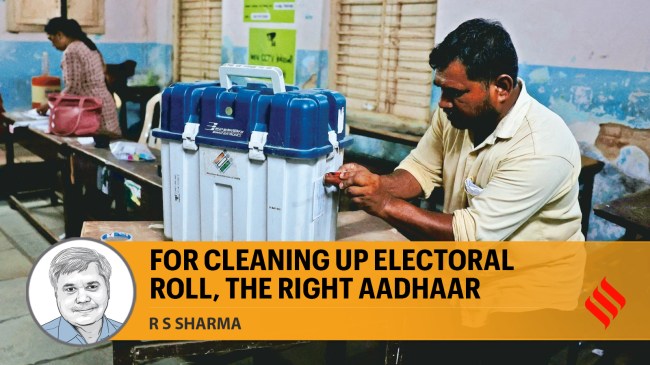 The legitimacy of a democracy depends on clean electoral rolls and the shared conviction that the rolls are clean.


Every few years, India rediscovers how hard it is to keep its electoral rolls worthy of its democracy. Migration, urban growth, and human error make it difficult to ensure that every eligible citizen appears only once and in the correct place.
The legitimacy of a democracy depends on clean electoral rolls and the shared conviction that the rolls are clean. The Election Commission of India is not averse to technology. It has already taken bold steps in introducing Electronic Voting Machines and later, VVPATs. It is natural to ask: If we can vote electronically, why maintain the voters’ list largely with 19th-century tools?

Over the last decade and a half, Aadhaar and a layer of digital public infrastructure around it have quietly become the backbone of many public services. Aadhaar gives each resident a unique, biometrically verified identity. Together with mobile phones, simple apps, and shared platforms such as DigiLocker, Aadhaar allows the state to answer three administrative questions at scale: Is this a real person, is this person unique in the system, and is this record current?
Consider the CoWIN platform. Its task was demanding: To track, for each individual, which vaccines they received, on which dates, at which centres, and when they were due for booster doses. It had to work for a billion people, many with limited digital skills, and it had to be rolled out in months, not years. CoWIN did not send officials door-to-door to verify each beneficiary. It created a secure, digital “single source of truth” and allowed people to register themselves, while providing assisted channels at vaccination centres.
The Supreme Court has already ruled — in the context of the SIR in Bihar — that Aadhaar is a valid identity document (distinct from proof of citizenship) for updating electoral rolls. For those already on the rolls, citizenship may be presumed unless there are reasons for doubt, in which case the prescribed adjudication process should be invoked. The practical objectives for the EC are more manageable: Delete deceased voters, add new 18-year-olds, include genuine but previously omitted voters, and remove duplicates and bogus entries. Aadhaar can assist with each.
Voters could choose to link their Aadhaar with their EPIC. The EC would not need to store Aadhaar numbers. It could use anonymised reference keys to detect cases where the same person appears multiple times in the rolls, across booths or constituencies.
For accurate deletions due to death, citizens may be offered the facility of Aadhaar authentication, ideally face-based, via a smartphone or with assistance at a common service centre . Those who authenticate are automatically marked as “verified alive”; only the remainder would require field verification. A secure portal or app could allow a new 18-year-old to authenticate with Aadhaar and submit the equivalent of Form 6 digitally. Those who find it a challenge can visit an assisted kiosk. Anomalies in addresses, such as tens of voters at a non-existent house number, or clearly fictitious entries, can be algorithmically flagged by cross-checking electoral addresses against Aadhaar address fields. Booth level officers would then investigate a much smaller and more meaningful list of suspect entries.
For a one-time-plus-ongoing exercise of this sort, the initial deduplication and verification can be executed over a few months. Then, roll maintenance becomes a continuous, low-friction process. We can transform roll revision from a periodic controversy into continuous care of the most important register in the republic: The list that says who, in the end, counts.
The writer is founding DG of UIDAI and former Secretary, Government of India. Views are personal

 Share
Share


