4 min read
© The Indian Express Pvt Ltd



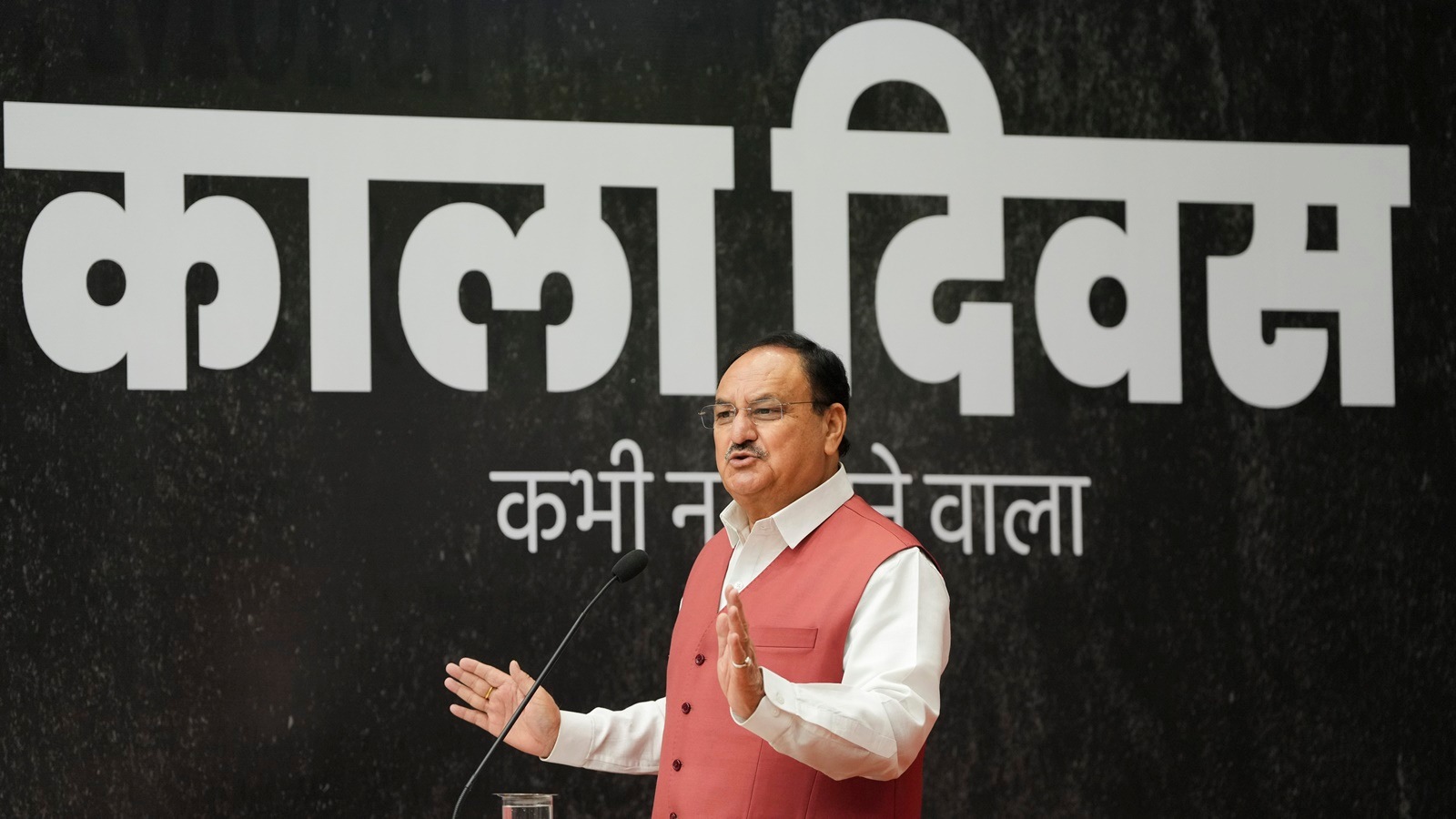 Union Minister and BJP National President Jagat Prakash Nadda speaks during a programme organised to mark the anniversary of the Emergency imposed in 1975 by the then prime minister Indira Gandhi, at party headquarters, in New Delhi, Tuesday, June 25, 2024. (PTI Photo)
The BJP on Tuesday organised protest rallies in different parts of Northeast India, including Tripura, Assam, Manipur, Arunachal Pradesh etc, as part of the nationwide ‘black day’ event to voice protest against the proclamation of Emergency by former prime minister Indira Gandhi in 1975.
As part of the agitations, the BJP Sadar district committee held a rally with placards, boards, and banners in Tripura’s Agartala city. Ashim Bhattacharjee, BJP Sadar district president, said the saffron party is observing the day as a black day against the atrocities meted out on democratic institutions.
“June 25 marks the 50th anniversary of Emergency and is a blotch on democracy. It evokes a deep-seated fear in the mind of people,” a Bharatiya Janata Party worker said during the rally.
In another event, Assam BJP president Bhabesh Kalita criticised Indira Gandhi for imposing Emergency and said it curtailed the fundamental rights of the people. A discussion on Emergency was also held at the BJP Assam headquarters in Guwahati.
Assam Chief Minister and senior BJP leader Himanta Biswa Sarma took to X and wrote, “On this day in 1975, our democracy witnessed its darkest hour. We salute all those greats who fiercely and fearlessly resisted the dark days of emergency despite the excesses committed. Our democratic ethos successfully prevailed over an authoritarian mindset.”
Tripura Chief Minister Dr Manik Saha posted on X, “It’s 50 years of Emergency but nothing has changed in the Congress Party. They misuse the Constitution. They still appreciate slavery than empowering values. No one has the right to speak against them. And the biggest dilemma is that they talk of protecting the constitution when they reflect the biggest disrespect to it during Emergency”.
Manipur Chief Minister N Biren Singh said on X, “The two-year-long emergency, which started on June 25, 1975, and lasted till March 21, 1977, is considered the darkest period in the history of Independent and democratic India.”
Singh also said that imposing Emergency was an attempt of the erstwhile Congress government to consolidate power undemocratically.
Today marks 50 years since a dark chapter was written in India's democracy. The Emergency was a blot, a sordid tale when the country was turned into a prison, freedom was attacked, the press was shackled and the sacred Constitution was disregarded.
LET US NEVER FORGET THIS BLACK… pic.twitter.com/tODpHvVisu
— Pema Khandu པདྨ་མཁའ་འགྲོ་། (@PemaKhanduBJP) June 25, 2024
Arunachal Pradesh Chief Minister Pema Khandu said Emergency is a blot in the history of the country. “Today marks 50 years since a dark chapter was written in India’s democracy. The Emergency was a blot, a sordid tale when the country was turned into a prison, freedom was attacked, the press was shackled and the sacred Constitution was disregarded. Let us never forget this black day…” he posted on X.
Khandu also took potshots at the Congress and said that despite its “disgraceful story” of Emergency, it is crying hoarse over the protection of the Constitution. “The party with ‘Emergency DNA’ has never felt ashamed to deride and attack the press or assault the intellectuals who raise their voices against injustice. The Royal Dynast’s mentality of looking down upon others must end if the values enshrined in the Constitution are to be protected. We must resolve that such travesty will never happen again in the country. We respect the Constitution and cherish the values established in it,” he said.
Indira Gandhi imposed Emergency in India on June 25, 1975, via an announcement on All India Radio. The announcement came soon after the Supreme Court granted a conditional stay on a verdict of the Allahabad High Court verdict which had earlier declared her election to the Lok Sabha null and void due to irregularities.
Emergency, which lasted 21 months, was replete with forced mass sterilisations, media censorship and centralisation of power.


The Enforcement Directorate (ED) on Thursday conducted searches at 10 premises associated with the election management company I-PAC in Kolkata and Delhi. The company, founded by election-strategist-turned-politician Prashant Kishor, is currently managing election campaigns of the Mamata Banerjee-led Trinamool Congress. West Bengal will go to elections this year.