Premium
This is an archive article published on October 15, 1998

Tears no longer flow

Reporting in Kashmir is an adventure. There is so much action that there is hardly a lean day for a lively reporter. It is said that the ...

.

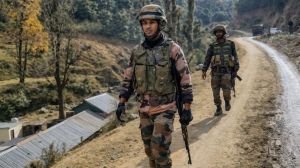
Reporting in Kashmir is an adventure. There is so much action that there is hardly a lean day for a lively reporter. It is said that the Valley is a news pasture. One can graze anywhere and come up with a unique story idea. While death and destruction cause widespread sorrow and fear, the journalist quite thrives on the thrill of it all.

It was August 23, 1992. My first day in journalism. I was assigned to visit a city police station and collect information regarding some dead bodies lying there. I accompanied a few local photographers to the police station. Six bodies. The photographers clicked away as I stared at the bullet-riddled bodies. It was very depressing to see so many corpses and, that too, in such a condition. That evening, I could not eat my dinner. The picture of those bodies lying in a pool of blood haunted me and even the colour of the water reminded me of blood. I couldn8217;t sleep for days, bodies haunted my dreams.

Little did I know that this was just a prelude to an unending tryst withdeath, destruction and bloodshed. Gradually I got used to not only witnessing such incidents but also writing about them.

Violence here, violence there, violence everywhere. For years, there is nothing else to write or think about in the Valley. If I avoid writing about the gory details of death, I would land up writing about orphans or widows. When violence rules the roost, there is nothing one can do but try and reduce readers to tears.

Nothing better recalls the scribe8217;s penchant for destruction than the image of vultures patiently waiting for death to befall the victim. Nietzsche once in a fit of rage at journalists compared the breed to crows alighting from a wire one by one to swoop down on a hapless victim, the killing fields of Kashmir conjure up the image of the most gluttonous among these birds of prey.

In the evening, you cannot think of leaving the office without scanning through the police bulletin, known as Situation Report8217;, on the day8217;s toll and other tidbits of violence. This is ourdaily bread and butter and editors make it a point to keep up with this bulletin.

The classroom definition of news8217; 8212; 8220;killing of a human being makes news because human life is precious8221; 8212; has also changed. The standard definition holds no relevance anymore. In 1995, I remember a lead story we did, 8220;No one killed in Valley today.8221; It was as if the journalistic community was lamenting the fact. Human life is no longer precious the more the bodies, the better the news. Now only massacres make it to the front pages.

Story continues below this ad

I now became a regular witness to this unending dance of death and get the most satisfaction in writing about it. Since this has become something of a routine for me, my reactions to such incidents also changed. Now killings meant stories and bylines. And the most disturbing aspect of it is that we reporters here always wait for such tragedies to happen, although unconsciously. Bijbehara, Sopore, Wandhama or Chapnari 8212; they all made front page stories and we always desire to be on pageone.

A time came when I lost one of my close friends in the violence and felt ashamed that I couldn8217;t react to his death normally. I couldn8217;t cry despite wanting to. Tears had dried up in my eyes. The tragic death of my friend from my school days could not move me any more, since it became just one more of the routine 20 deaths that occurred that day. I was unable to mourn such a close friend.

What has happened to me? Have I lost normal human feelings in the pursuit of the perfect story? Yes, I am now immune to this most pathetic side of human life. I have developed the inability to mourn. I am immune to death that is my tragedy as a reporter in the killing fields of Kashmir.

Muzamil Jaleel is a Deputy Editor at The Indian Express and is widely recognized as one of India’s most authoritative voices on Jammu & Kashmir, national security, and internal affairs. With a career spanning over 30 years, he has provided definitive on-the-ground reportage from the heart of the Kashmir conflict, bearing witness to historic political transitions and constitutional shifts. Expertise and Investigative Depth Muzamil’s work is characterized by a rare combination of ground-level immersion and high-level constitutional analysis. His expertise includes: Conflict & Geopolitics: Decades of reporting on the evolution of the Kashmir conflict, the Indo-Pak peace process, and the socio-political dynamics of the Himalayan region. Constitutional Law: Deep-dive analysis of Article 370 and Article 35A, providing clarity on the legal and demographic implications of their abrogation in 2019. Human Rights & Accountability: A relentless investigator of state and non-state actors, uncovering systemic abuses including fake encounters and the custodial death of political workers. International War Reporting: Beyond South Asia, he provided on-the-spot coverage of the final, decisive phase of the Sri Lankan Civil War in 2009. Landmark Exposés & Impact Muzamil’s reporting has repeatedly forced institutional accountability and shaped national discourse: The Kashmir Sex Scandal (2006): His investigative series exposed a high-profile exploitation nexus involving top politicians, bureaucrats, and police officers, leading to the sacking and arrest of several senior officials. Fake Encounters: His reports blew the lid off cases where innocent civilians were passed off as "foreign terrorists" by security forces for gallantry awards. SIMI Investigations: He conducted a massive deep-dive into the arrests of SIMI members, using public records to show how innocuous religious gatherings were often labeled as incriminating activities by investigative agencies. The Amarnath Land Row: Provided critical context to the 2008 agitation that polarized the region and altered its political trajectory. Over the years, Muzamil has also covered 2002 Gujarat riots, Bhuj earthquake, assembly elections in Bihar for Indian Express. He has also reported the peace process in Northern Ireland, war in Sri Lanka and national elections in Pakistan for the paper. Awards and Fellowships His "Journalism of Courage" has been honored with the industry's most prestigious accolades: Four Ramnath Goenka Awards: Recognized for J&K Reportage (2007), On-the-Spot Reporting (2009), and Reporting on Politics and Government (2012, 2017). Kurt Schork Award: From Columbia University for international journalism. Sanskriti Award: For excellence in Indian journalism and literature. IFJ Tolerance Prize: For his empathetic and nuanced reporting in South Asia. International Fellowships: Served as a visiting scholar at UC Berkeley and worked with The Guardian, The Observer, and The Times in London. He has also received Chevening fellowship and a fellowship at the Institute of Social Studies, Hague, Netherlands. Professional Presence Current Location: New Delhi (formerly Bureau Chief, Srinagar). Education: Master’s in Journalism from Kashmir University. Social Media: Follow him for field insights and rigorous analysis on X (Twitter) @MuzamilJALEEL. ... Read More

 

Latest Comment
Post Comment
Read Comments
Advertisement
Advertisement
Advertisement
Advertisement