Journalism of Courage
 2 min read



Maharashtra is witness to the fastest fruit revolution in the country with its orchards and vineyards bursting with new varieties, now magically available all year round, reports
|
Did you know8230; Horticulture crop covers about 8 per cent of the total area and contributes nearly 20 per cent of the gross agricultural output of the country India is number one in mango production: 44.13 per cent |
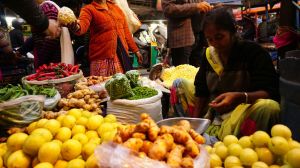
ANY morning, enter Crawford Market and you have probably reached the top of the country8217;s fruit chain. Sunbeams burst from cracks in the high ceiling and highlight clouds of fine straw as one wooden crate after the other is opened. The aroma of the Alphonso floods the senses8230;. But it is to be a short-lived experience 8212; after all, first rain, last mango, right?
Wrong, says Hari Prasad, who deals exclusively in Alphonsos. 8216;8216;The King of Mangoes will be here right up to August. It may not be from Ratnagiri 8212; those orchards have let us down this year 8212; but Junnar8217;s crop begins with the rain.8217;8217; Those brave enough to drive in Mumbai will remember the first box of Alphonsos being thrust at them at traffic signals way back in the last week of January. In the last six years, the Alphonso season has doubled: From the traditional April-June to February-August now.
The stretched season is just one of the symptoms of the fastest fruit revolution in the country. In 10 years, Maharashtra8217;s rural landscape has changed. Barren patches of land and fields of jowar, bajra and cotton have given way to orchards and vineyards bursting with the best fruit in the world. The area under fruit cultivation 8212; it crossed one million hectares in 1998 8212; has increased fourfold in eight years. And the fruits of the labour no pun intended 8212; Mandarin oranges from Nagpur, an astounding variety of grapes from Nashik and Baramati, Alphonsos from Ratnagiri, pomegranates from Solapur and sweet limes from Jalna 8212; hog shelf space round the year. New, improved varieties, competitive prices and timing have all helped the state defeat imports, except for those of apples.
POMEGRANATES
Some five km from Shirdi, Rajendra Chaudhury8217;s 35-acre farm, has seen many changes over the past 10 years. From growing cane, which gave him around Rs 15,000 an acre, to growing grapes which give him Rs 1 to 1.5 lakh an acre, he has moved on to pomegranates. Reason? 8216;8216;Grape is sensitive and besides there is water shortage. With pomegranate, the comfort level is enhanced.8217;8217;
Twenty-two acres of pomegranates, eight acres of grapes, three acres of lemons and two acres of guavas: Chaudhury is a horticulturist8217;s dream. By switching from grape to pomegranate, the subsidy 8212; so long limited to drip irrigation for his vineyards 8212; expanded. The government put in Rs 8,000 of the Rs 50,000 he spent on every acre annually.
ORANGES
Year 1990: 1.8 lakh tonnes from 29,941 hectares; year 2000: 7.6 lakh tonnes from 85,000 hectares. That, in short, is the story of the Nagpur Mandarin. The Employment Guarantee Scheme EGS provides farmers with Rs 26,000 per hectare for three years for seedling, pits, manure and fertilisers. Today, farmers like the Pethe brothers of Morshi and Shelar of Paratwada, both in Amravati district, have between 20,000 and 40,000 trees each, with each tree yielding 500 fruits on an average.
But despite the glut, the statistics still reflect poorly on the economics. 8216;8216;Against the Rs 150 cost of production per tree in a water-scarcity area likes ours, the price per 1,000 fruits comes to the break-even level of Rs 300,8217;8217; says Dilip Yavalkar, a trained agriculturist from Warud.
Criminally, up to 40 per cent of the yield goes waste due to bad packaging and handling. 8216;8216;Basically a table fruit, the Nagpur orange8217;s juice turns bitter in a short time. Moreover, its soft peel makes it unsuitable for transportation,8217;8217; says B S Chimurkar, retired professor from Punjabrao Krishi Vidyapeeth. It is also the reason why only five per cent of the total produce is exported.
MANGOES
The mango belt presents a very different picture to last year, when the markets were flooded with Alphonsos and Hapus. Climatic fluctuations have seen the yield in the first half plummeting to as low as 30 per cent; mango growers pin their hopes of recovery on the second half of the season, when rain plays a decisive role.
|
Fruit Area under cultivation in hectares in Story continues below this ad
|
The Konkan region produces over 1.80 lakh ton of the 2.5 lakh ton mangoes produced by Maharashtra annually. 8216;8216;Between 1990 and 1999, the area under mango cultivation rose dramatically from 35,890 hectares to 87,673 hectares in four districts of the Konkan,8217;8217; says Dr N D Jambhale, director of research at Konkan Vidyapeeth.
The one factor responsible for the mango8217;s transformation into a lucrative cash-crop: The EGS, under which the state government started extending huge subsidies to promote greater cultivation of the fruit.
FIGS
The agricultural university in Rahuri, one of the four in the state, supplies the tricks of the trade, besides the saplings. How to space the plants, growth regulators, the works. A brand new information centre sits on the main road of the 500-acre campus; 12,400 farmers 8212; an average of 30-40 each day 8212; have had their queries answered here.
Vitthal Ramchandra Khedekar, 48, is one of them. He comes to Rahuri all the way from a village near Pune, where 200 farmers and 700 acres grow figs. During peak season, the village manages to send a truck 900 boxes to Mumbai each day.
In the silence of the valley, Shivaji Khedekar peels the velvety green fruit like a banana and beams at the soft, pink, grainy inside. Fresh figs are as rare as early monsoons and this tiny village has realised its potential. Teetering on the edge of poverty when they grew jowar, the farmers now get as much as Rs 190 per box in January. Few think twice before hiring water tankers for their orchards to supplement the sinking water table.
GRAPES
If you heard it on the grapevine, chances are you belong to Ozar, a small town near Nashik. It all began when Jayant Gaekwad8217;s father visited the Nawab of Hyderabad and came back with four cuttings of the Annadesai. He planted it in his backyard. Two survived and, in the third year, they produced 2,700 kilos of grapes.
Praveen, Jayant8217;s 40-year-old son, handles the 60-acre farm now. An engineer from Bangalore, he is the epitome of Maharashtra8217;s gentleman farmer. As he sits in his swivel chair, an International World Fruit map hangs on the wall behind him. Growing grapes is dicey, he says. 8216;8216;It is a very sensitive crop. Last year was an absolute disaster because of the rains in May.8217;8217; His jackpot year was 1996. The Peugeot parked outside came from that.
The 75-acre vineyard of Brahmecha Farms is an oasis in barren land. The vines sag with red, black and green grapes. Bunches of Vijay Chaman, Brahmechas8217; own variety, which is green and almost two inches long, are waiting to be picked. With Thompson Seedless, black Sharad Seedless and Flame Seedless, Mohanlal and Rajendra Brahmecha are the grapelords of Nashik. Around 60 workers are trying to finish packing a container-load for the UK8217;s Sainsbury chain. Pre-cooling, a layer of anti-fungal grape guard and the container will be fine in the cold storage for two months.
8216;8216;From the first week of March to April 25. That is the slot for Indian grape, sandwiched between the Chilean and the Mexican grape,8217;8217; says Rajendra Brahmecha. He is obsessive about quality 8212; the 18mm length, the halt to the pesticide spraying. Even then, upto 15 of the 100 containers they send to the UK go bad.
Grapes may need a lot of water, but in Baramati, Sharad Pawar8217;s pampered constituency, it is the least of problems. The grape story began here in 1975 with 50 acres; today, the Baramati Grape Industries alone absorbs 6,000 tonnes of grape annually. V K Garware, who reluctantly shifted from sugarcane which got him Rs 20-25,000 per acre to grapes Rs 1 lakh on four acres of his 10 acre plot, sits on Fulton Road behind a table heaped with Thompson Seedless. He regrets he cannot convert the rest of his land to the crop because of unsuitable soil.
STRAWBERRIES
South of the state, up in Mahabaleshwar, drip-lined beds of strawberry fields are another success story. From the first plants brought by the British for their summer retreat, the fruit has become the hill station8217;s prime industry, next only to tourism. What does not reach the table finds its way to the Mapro and Mala fruit processing plants. Tourists pick up the Rs 15-cheaper bottles of strawberry crushes and squashes by the dozen. Iqbal, as he sits in his small tent and lovingly wraps 12 jumbo strawberries in a box and layers it with Hirda leaves, however, says he would die before he sells his produce to them. This will get him Rs 40 per box, double of what the Mapro factory offers them.
Back in Mumbai, walking through Crawford Market, you could be forgiven for thinking you are at a Zaveri showroom when a worker at Vilas Doble8217;s 107-year-old stall shows you Alphonsos. Gently, he picks up one with the tips of his fingers, hands it over, and a heartbeat after you have brought it to your nose, his hand snakes out asking for it back. Rs 800 a dozen.
|
Thinkers and Planners Story continues below this ad Along with the tasty fruits, the critics can eat their words too. The fruit revolution has proved that Maharashtra8217;s farming community can change if provided the right support. The state government8217;s Employment Guarantee Scheme played a major role in the turnaround. Its inherent flaws notwithstanding, the 1990-91 scheme provided the financial and material support necessary for the success. As recently as 1981, Maharashtra was a food-deficit state. Says N B Patil, former state director of agriculture and one of the prime figures behind the turnaround, 8216;8216;For years we knew the state was agroclimatically suitable for horticulture. But nothing was happening as we didn8217;t have the expertise. There was an urgent need to do something.8217;8217; It was then that a core group of horticulturists, led by Sharad Pawar, stepped in. As an informal group, they toured the farms and markets in Brazil the largest fruit producer in the world, Spain, the Netherlands and Israel and they brought home the knowledge. 8216;8216;The need was a foolproof scheme that would be with the farmer while he switched from growing jowar to, say, grapes or pomegranates,8217;8217; says Patil. 8216;8216;We had to see wasteland being converted to the use of horticulture,8217;8217; adds Pawar. Thus was born the EGS. 8216;8216;For four-five years, the state footed a major portion of the farmer8217;s bill as he waited for his trees to grow. Fertilisers, drip irrigation system, weeding8230; we wanted to provide help at every stage,8217;8217; says Pawar. 8216;8216;Success has been ours. Now the question is of marketing. Thirty per cent of our produce gets spoilt. We have to focus on processing. While Australia, Philippines and Thailand process 85 to 93 per cent of their crop, our figures are less than two per cent.8217;8217; Story continues below this ad |
With Vivek Deshpande in Nagpur and Vishwas Kothari in Pune