Journalism of Courage
 3 min read



This is with regard to Shashi Tharoor8217;s piece, 8216;Indian identity is forged in diversity8217;, first published in the Guardian, and excerpted by The Indian Express in the column 8216;Printline8217; IE, August 16. By blowing up the trivial, if not the non-existent, and smothering the obvious, it causes dismay. Having gone through pages and pages of what was earlier called the Manchester Guardian, and then the Guardian, in the British Newspaper Library, Colindale, and also having gone through the private papers of Sir Charles Prestwich Scott 1846-1932, its legendary editor 1871-1929, I may make a few observations about the changing values of the British press and the unchanging attitude of the Indian intelligentsia.
If Tharoor was genuinely interested in celebrating the vibrancy of India8217;s pluralism, he perhaps should not have missed out, in all fairness, the only exclusivist, intolerant and violent strand which has posed the biggest threat to this country over the millennia. A quick look at the recent history of Kerala and parts of southern India, with whose history and politics he should have a greater familiarity, might show that it is not the hydra-headed 8220;sectarian Hindu chauvinists8221; but others who have been playing havoc. Many incidents of sectarianism 8212; right from the forced conversions carried out by the 8216;nationalist8217; Tipu Sultan and the pogroms against the Hindus of Kerala by the 8216;progressive8217; Moplahs, right down to the latest blasts in Hyderabad 8212; have been the handiwork of groups whose comrades are reasonably active in places as distant as New York and Bali, Glasgow and New Delhi. The potential secretary-general of the UN, either because he is oblivious of the facts or is reticent about setting them down, may be seen on the wrong side of the civilisational clash.
While Tharoor can indulge in suppressio veri and suggestio falsi in bashing the non-existent while covering up the real source of danger in the contemporary world, he might remember that Scott8217;s paper was very much against this kind of subjective and blatant propagandist writing. The piece should have been published in the Daily Mail and the Morning Post, both of which are rabidly conservative and unsympathetic to Indian sensibilities.
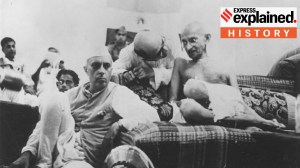
Tharoor, a potential minister in the Government of India, has every right to be a Nehruvian. But as for the origins of 8220;modern Indian nationalism8221;, one may have to go back to the days of Surendranath Banerjee and Dadabhai Naoroji, Bankim Chatterjee, Swami Dayanand and Swami Vivekananda. One feels even Jawaharlal Nehru himself never visualised himself as the 8220;prime exponent of modern Indian nationalism8221;.
Long before India8217;s Constitution was conceived, long before India was pulverised by invaders, an overwhelmingly Hindu India had given shelter to Zoroastrians, the Jews and the likes of St Thomas 8212; and that without being subjected to sermons from outside India.
The writer teaches history at Hansraj College, University of Delhi