Journalism of Courage
 4 min read



The Last Thousand Days of the British Empire
Peter Clarke
Penguin, Rs 750
The british Empire, at its zenith in 1939, was the largest and the most widely flung that the world had ever seen. Yet, by 1945, two of its most important components, India and Palestine, were on the road to independence, signalling the empire was now in its death throes.
How did this come about? How did Britain, supposedly the most powerful country in the world, suddenly find itself once again an island, minus its vast possessions? This is the question that Cambridge University historian Peter Clarke 8212; best known for the vivid life of Labour Party millionaire maverick Sir Stafford Cripps 8212; inquires in a book based on rock-solid research including diaries and letters of protagonists and written with his customary fluency of style.
In a legendary statement in 1942, British prime minister Winston Churchill had proclaimed, 8220;I have not become the King8217;s First Minister in order to preside over the liquidation of the British Empire.8221; Yet, as Clarke shows, Churchill8217;s actions, in many ways, opened the way for the liquidation to take place. At the time Churchill made his statement, the war against the Axis powers was still very much in the balance. He had only recently seen his hope 8212; that the US would be on Britain8217;s side in the war 8212; materialise. He had also put aside his decades-long antipathy to Soviet Russia, and joined hands with Stalin when Hitler attacked the world8217;s only communist state.
Churchill8217;s aim was a single-point one 8212; the preservation of Britain and its empire. In the first he succeeded; in the second he failed miserably. The conditions that kept Britain afloat were precisely those which ended its empire. Time and again, Churchill was forced to defer before the Great White Chief, US President Franklin Roosevelt. With much of his empire under enemy control, Churchill was dependent on American goodwill, men and material, in order to pursue his war.
The result was that the US gained the upper hand in all possible areas. It was the US that set the war agenda and controlled it. It was the US that held the financial reins, and used it to create a post-war Bretton Woods system favourable to it. It was the US that set the agenda for a post-war political system, by forcing the British to tinker with their empire, and treating the British as an appendage when it came to dealing with Stalin. As the war proceeded to its end in victory for the Allies, it weakened the British. Camouflaged by war, it became a sharp reality at its end. Clarke notes that Churchill really had no other avenue. In the end, he preserved his country, at the cost, ironically, of its empire.
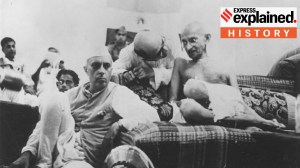
Clarke has shown how the US gained the upper hand diplomatically in Palestine, paving the way for the creation of Israel. He makes it crystal clear that Churchill had no idea what to do here, thus helping to create a situation which remains unresolved 60 years later. In the case of India, he shows that Churchill allowed negotiations to take place with Indian leaders under US pressure, and only because he was satisfied that any solution would be rejected in India. Clarke, however, lays the blame for the failure of the Grouping Plan on Gandhi8217;s shoulders, without appreciating that the unity so achieved would have been doomed to failure 8212; to coin a phrase, it would have been a unity of disunity. He is also a little too sanguine about the British role in the eventual parting of ways in India. They did their best, certainly 8212; to get out as fast as possible. If Churchill had taken realistic measures during the war, and faced up to the decline of the British power taking place before his eyes, and behaved like the statesman he is supposed to have been, the beginning of the liquidation of the empire need not have been as bloody.