Journalism of Courage
 6 min read



At yet another 8216;summit8217; on corporate governance last week, capital market regulator M. Damodaran said the debate needs to move away from the arithmetic of board composition to issues of compliance, transparency, better understanding of corporate governance messages down the line and sharing information with stakeholders. The summit threw up the usual talk about 8216;governance being equal to trust creation8217;, changing corporate culture and raising the 8216;ethical bar8217;.
At almost the same time in the US, IT major Hewlett Packard HP has been reinterpreting the rules so fast, it can easily be a case study on corporate ethics versus self-righteousness, or how swiftly governance rules are abandoned to save the company.
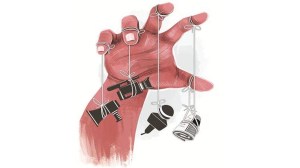
Last week, I wrote about HP8217;s paranoid investigation covering nine journalists, several board directors and some employees to track down which director was leaking information to the press. Its controversial methods included physical surveillance, pretexting impersonation or false claims and use of tracer software.
HPs actions became public when Tom Perkins, the director heading its Corporate Governance Committee resigned in protest, especially on discovering the hacking of his own phone records. Significantly, Perkins had advised Dunn against such an investigation; but she went ahead with it and later presented the findings to the board, which identified director George Keyworth as 8216;the leak8217;.
Keyworth was asked to resign, but refused at that stage. Instead an angry Perkins quit when it was clear he too was investigated.
At this stage all the smug self-satisfaction of HP8217;s actions began to evaporate. For starters, it did not honestly report the reason for Perkins8217; exit. This prompted Perkins to write seeking confirmation from the telecom provider AT038;T and then report the issue to the Securities Exchange Commission SEC. An inquiry followed. It is pertinent to note that there is no record of independent directors in India taking such an action even when they have quit on ethical grounds. An infamous example is that of Global Trust Bank, where a little spine on the part of the independent directors may have saved some shareholders money.
Once the HP sting became public, it was bound to snowball into a mega controversy, especially when nine journalists had been under HP8217;s scanner. Good governance went out of the window at the first sign of trouble and there was worse to follow. What is not clear to us is whether the information 8216;leaked8217; by the director had harmed HP at all.
If the witch-hunt was only a matter of principle, then HP8217;s subsequent actions are not justifiable. HP probably hoped to staunch trouble by getting Dunn to resign earlier than planned. Dunn made a cordial exit, especially with CEO Mark Hurd, whose own role in the issue is still under a shadow. But as soon as she was out, HP sought to deflect the entire blame on her saying she had interacted with the security firm hired for the investigation. This caused Dunn to hire her own lawyers to defend and clarify her side of the issue. In the process she has fired several curious salvos and only added to the haze of confusion.
For instance, while Dunn has vehemently defended her actions, her lawyer issued a written statement saying, the 8220;first phase of the leak investigation started before Dunn became chairman. The former chairman and CEO initiated the first inquiry into the leaks8221;. For an investigation that began in a burst of self-righteousness, the blame game was turning ludicrous.
Then, at the US Congressional hearings on 28 September, Hurd and Dunn took a completely divergent stand. Hurd played the good guy and was profusely apologetic. He acknowledged that HPs actions had turned into a 8220;rogue investigation that violated our own principles and values8221;.
Dunn, on the other hand continued to deny any knowledge about the use of illegal methods is obtaining information. The obvious question to this is how on earth did she think her investigators would get the information? Surely she knew there would be surveillance involved when she ignored the Corporate Governance committee chairman8217;s suggestion to simply ask the directors who was talking to the media and accept an admission or apology if it were proffered.
At the Congressional Committee hearings, Dunn not only defended her actions, but also urged Congress to create 8220;an effective legal framework to protect companies like HP from leaks8221;.
She also wanted 8220;legitimate and sanctioned ways8221; for companies to pursue their 8220;responsibilities to protect their intellectual property and confidentiality.8221; A simple interpretation of this suggestion would be that Dunn now wants legislative sanction for companies to encroach on the State8217;s turf by launching their own investigation against real or imagined leaks.
While Dunn made this preposterous demand, HP8217;s behaviour continued to be shadowy. For instance, its general counsel, who directed the sting operation resigned on the very day of the Congressional hearings and refused to testify invoking the Fifth Amendment which offers protection against incriminating oneself. It is reported that she walked away with a golden parachute of 3.6 million, which suggests that HP does not really condemn her actions or lapses. This is hardly consistent with the high moral stance in launching the investigation.
HP8217;s action also creates a basic conflict between the role of a journalist to try and break news before the company is ready make a press announcement and the company8217;s need to keep information confidential. Corporate governance rules need to be debated in this context, as companies conveniently hide behind media leaks orchestrated by themselves, or as in HPs case, use financial muscle to launch a witch-hunt when the leaks are against their interest.