Journalism of Courage
 4 min read



Copying piracy is a violation of intellectual property rights IPR and, therefore, is treated world-wide as a crime because it not only deprives the right holders the earnings from the property but also denies the government its dues. Millionnaire businessmen had emerged in India overnight either by openly violating the anti-piracy laws or cleverly exploiting its loopholes.
Enforcement of anti-piracy law varies widely across the countries and depends on, among others, capability and commitment of the enforcement machinery, public awareness, especially among the consumers of the final product, and also co-operation from the right holders who are either the creators of the property or their legally valid assignees. India ranks comparatively low in all these factors and hence the degree of enforcement of anti-piracy law is also rather low, although by no means, the country could be treated as one with very high incidence of copyright violations.
The International Federation of Phonographic Industry IFPI placed India eighth, according to the value of pirated sales of sound recordings, the ratio of pirated sales to total sales being a moderate 23 per cent. This ratio is as high as 94 per cent in Pakistan, 62 per cent in Russia, 48 per cent in China and 29 per cent in USA. Although India is one of the largest music producers in the world, it accounted for only 4 per cent of the world8217;s pirated sales of recordings, the share of Russia being as high as 17 per cent, USA 13 per cent and China 8 per cent.
In terms of the number of pirated units sold in the market, however, India is ranked the third in the world, accounting for about 30 per cent of the country8217;s total sales, and 13 per cent of the world8217;s pirated sales with only Russia and China ahead of it. While Russia8217;s pirated sales accounted for 73 per cent of that country8217;s total sales, 23 per cent of world8217;s pirated sales, China8217;s is 54 per cent of its total sales 15 per cent of world8217;s pirated sales.
As in many other instances, simple economics explains this thriving illegal business in India, as it is elsewhere. For instance, in India compact discs CD are sold at prices anywhere between Rs 150 and Rs 550 a piece, which seems to be unaffordable to the common man. Cassettes, on the other hand, are cheaper. Unfortunately, for unexplainable reasons, Government policy placed music industry in the small scale sector with production restriction up to 30,000 units per manufacturer per year. Given the inbuilt constraints on the part of small scale sector, there emerged a wide gap in the supply of and demand for music cassettes in the country which is being bridged by the pirates.
At least in the case of home video rights, there exists a collusion of interests between the violater the video producer and the victim the film producer or the distributor. Neither of the parties normally discloses to the public whether the rights are sold or bought and under what terms and conditions, leaving the enforcement authorities with no reliable clues or evidences. This collusion originates, probably, in the tax laws and is aimed at denying the government its dues. In this case, the violator goes scot free while the victim chooses either to connive with him through under the table deals or silently suffer the losses. After all, the right holder should know it better that the law is not something to be complied with by convenience alone.
The author is director research at the National Productivity Council and the views are personal.

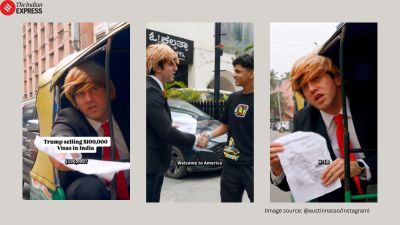
A satirical video by a US-based comedian has been making the rounds online after it showed a spoof version of US President Donald Trump apparently “selling H1-B visas” on the streets of India for a hefty price. The clip, posted by Instagram creator Austin Nasso—who has close to a million followers—features him fully leaning into a Trump impersonation.