Journalism of Courage
 7 min read



The Indo-US agreement on civil nuclear cooperation reached during President George Bush8217;s recent visit to India deserves to be broadly welcomed. It has partially addressed the needs of India8217;s energy security, without overly affecting our sovereign control over our strategic nuclear programme. In short, it8217;s not a sell-out.
Nevertheless, the devil, as they say, is in details. And in this case the devil lay in an ominous omission. In the surfeit of official talk in New Delhi and Washington on matters nuclear before, during and after Bush8217;s visit, did you hear the word 8216;Disarmament8217; even once? I scoured the Indo-US joint statement on March 2. I tooth-combed Prime Minister Manmohan Singh8217;s two statements in Parliament on February 27 and March 7. I searched for it in his speech at the lunch in Bush8217;s honour on March 2. I re-visited the transcript of their pre-lunch joint press conference at Hyderabad House. No, the 8216;D8217; word was nowhere to be found.
So what, some might ask. It8217;s just that India8217;s silence on the issue of nuclear disarmament is inexplicable in the context of our own consistent and spirited espousal of this cause since the dawn of the nuclear age in 1945. In particular, it marks the abandonment of, or at least a significant deviation from, a key plank in the foreign policy pursued by Rajiv Gandhi. It also lends credence to the assessment that India8217;s independent and universalist thinking on the imperative of global nuclear disarmament is being compromised by the American establishment8217;s limited and self-serving concern on nuclear proliferation.
Look what the Indo-US joint statement of March 2 says under the section 8216;For Global Safety and Security8217;: 8216;8216;The two leaders Reiterated their commitment to international efforts to prevent the proliferation of weapons of mass destruction.8217;8217; But what about the commitment to move towards reduction and eventual elimination of the WMDs that have already been stockpiled? It may be George Bush8217;s understanding that 8216;Global Safety and Security8217; can be guaranteed merely by preventing nuclear proliferation8212;that is, stopping new countries from gatecrashing into the exclusive club of Nuclear Weapon States NWSs. But is it Singh8217;s understanding too?
The joint statement begins by declaring that 8216;8216;The two leaders today expressed satisfaction with the great progress the United States and India have made in advancing our strategic partnership to meet the global challenges of the 21st century.8217;8217; Now, anyone with a modicum of knowledge of 8216;8216;the global challenges of the 21st century8217;8217; would concede that one such challenge is the total elimination of all the nuclear weapons possessed by all the overt and covert NWSs.
In his famous June 1988 address before the UN General Assembly8217;s special session on disarmament, Rajiv Gandhi had said: 8216;8216;We are approaching the close of the twentieth century. It has been the most bloodstained century in history. In the last nine decades, the ravenous machines of war have devoured nearly one hundred million people. The appetite of these monstrous machines grows on what they feed. Nuclear war will not mean the death of a hundred million people. Or even a thousand million. It will mean the end of life as we know it on our planet Earth. We have come to the United Nations to seek your support to put a stop to this madness.8217;8217;
What has so drastically changed between 1988 and 2006 that another Congress Prime Minister did not even mildly utter the 8216;D8217; word when the leader of the country that possesses the largest stockpile of nuclear weapons, and hence has the greatest obligation to begin their elimination, visited India? It might be argued that a joint statement between two countries is always a compromise document, which contains only such formulations as are mutually acceptable. This, however, begets the question: 8216;8216;Did the Indian side even bring up the issue of time-bound universal nuclear disarmament as a point of India8217;s concern for inclusion in the joint statement?8217;8217; Seems unlikely, because Dr Singh made no mention of it in any of his other pronouncements outside the framework of the joint statement.
Take, for instance, his speech at the banquet in Bush8217;s honour. He said: 8216;8216;India seeks a neighbourhood of peace and prosperity.8217;8217; No mention of world peace. Does India seek peace only in her neighbourhood? Have we stopped seeking world peace? And have we stopped speaking about the goal of global nuclear disarmament, which is one of the preconditions for world peace?
The Prime Minister could have reiterated this commitment at least in his statement before Parliament, where the question of accommodating Bush administration8217;s anathema for the 8216;D8217; word would not have arisen. He didn8217;t do it there either.
Am I quibbling over a small matter? By no means. The Prime Minister8217;s silence constitutes betrayal of a specific promise made by his government in its Common Minimum Programme, which clearly states that the UPA would 8216;8216;take a leadership role in promoting universal, nuclear disarmament and working for a nuclear weapons-free world8217;8217;. It can be construed as a trivial matter only if the Congress and the Communists hold that what8217;s said in the CMP need not be taken literally8212;that is, seriously.
However, the difference between non-proliferation and disarmament is a highly serious one. Experts have warned that the world is 8216;8216;nearing a fork in the road8217;8217;, with two stark choices. One, made by the American establishment, is only to prevent further additions to the elite club of NWSs. The other choice, voiced powerfully by the peace-loving international community, is to compel members of this club to move decisively toward the elimination of nuclear weapons within an agreed time-frame, while simultaneously ensuring that new countries do not join this club.
For decades India had been protesting against the Non-Proliferation Treaty NPT for its discriminatory character and also for its failure to enforce its own Article VI disarmament obligations on NWSs to effect deep cuts in their nuclear arsenals. True, India was forced to become an NWS in 1998 in response to the manifest threats to our own national security. But our joining the N-club does not suddenly make the rules of this club non-discriminatory and its obduracy on disarmament defensible.
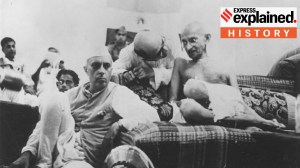
To think so is to behave like those selfish passengers on a railway platform who angrily bang on the closed door of a crowded compartment to get in and, once they are in, slam the door shut on others. Such behaviour does not befit the land of Mahatma Gandhi and Pandit Nehru. If India8217;s voice for nuclear disarmament becomes muted, because of too close an embrace with Washington, what hope can the rest of the world have?
write to sudheen.kulkarniexpressindia.com