Journalism of Courage
 6 min read



Bureaucrats, we think, are masters of drafting. Not so. I would say instead that a lot of what generates political and legal controversy is simply the result of shoddy drafting of laws by the bureaucracy, which then get passed by our law-makers without spending too much time or quality thought on the same.
Let us consider one of the early conflicts. The bank nationalisation ordinance was struck down by the courts primarily on two grounds. First, it was held that by ignoring goodwill, the compensation formula was inappropriate. Second, there was an unnecessary clause in the ordinance prohibiting the shareholders of nationalised banks from entering into the banking business. This was deemed a violation of citizens8217; rights to conduct business, earn livelihoods, etc. To start a bank one anyway needs a licence, which only the Reserve Bank of India can grant. Those were the days before central bank autonomy. Licences could easily have been withheld by the government. This clause was superfluous and silly. In fact in the subsequent legislation it was dropped and the law passed the scrutiny of the courts. One can hardly blame Indira Gandhi for the poor drafts, unnecessary clauses, etc. The fault clearly lay with the civil servants whom she depended upon.
Similarly, when she lost her proposed constitutional amendment on privy purses, Indira Gandhi tried to get around it by 8220;derecognising8221; through an ordinance all the maharajas and nawabs. The courts again struck down this ill-conceived and ill-worded ordinance. The power to recognise or 8220;derecognise8221; was never meant to be exercised against 600-odd princes by a stroke of the pen. Even if she were in a peeved and frustrated mood, it was the duty of her advisors to guide her towards a resolution that would have stood the test of scrutiny, not come up overnight with an ill-thought-out scheme that was bound to fail.
Throughout the seventies, we witnessed the ongoing claims by the so-called left-liberal lobbies that the courts were holding up progressive legislation and were thwarting the intent of the legislature. None of them wanted to examine the extent to which they created problems for themselves by laws written in haste and almost invariably full of clumsy, unnecessary excesses, which forced the courts to react the way they did.
Today, reservations have become the focus of attention. Anyone who has read the Constitution should know that 8220;equality of all citizens irrespective of caste or religion8221; is a fundamental feature. No court can afford to ignore this. If, for some reason, elected leaders are unaware of this very central constitutional precept, it is the duty and obligation of the concerned civil servants to remind their political bosses of the same in no uncertain terms. It is true that the Constitution does provide for special remedial action favouring disadvantaged sections of the population. But the tenet of equality is so overwhelmingly important, that the rationale and the methodology for helping the underprivileged targets need to be really sharp and credible for the judiciary to be in a position to hold that equality of citizens can be set aside in a special circumstance in a specific manner. The courts have given enough signals and a sufficient number of messages, both direct and indirect, in this regard. And yet, when a new law is drafted, it is simplistic beyond belief and blithely ignores the need for carefully building up the argument and, more importantly, the methodology for implementing something that in effect violates the equality provision. If there had been even a minimalist obeisance to the principle that benefits accruing to the so-called 8216;creamy layer8217; would have amounted to a gross violation of the equality principle and therefore was being somewhat controlled, the courts would have the elbow room to go along with the wishes of the legislature. But there has been no such attempt. Instead we get a bland number with vague and untenable arguments behind them. The 8216;creamy layer8217; concern of the judiciary which has been earlier expressed by a full bench in emphatic terms is ignored with an imperceptible shrug. No wonder, the government of the day finds itself in an embarrassing gridlock. I would argue that our politicians are being ill-served by their civil servants whose job it is a la Appleby to ensure that ministers present the public with solutions that will pass muster of the various review processes.
The fact of the matter is that reservations for OBCs in educational institutions have to be accepted as a necessary political response to the social situation in our country. The votaries of 8216;pure merit8217; may feel good and sanctimonious in resisting this. But it is unlikely that they will succeed. Among other things, reservation is perceived by our politicians to be a vote-winner. Against this argument, there is precious little one can do in a democracy! It is however possible and even desirable to implement this policy in a rational way that among other things will let our judges who are sworn to protect a constitution committed to equality of citizens to allow reservations to meet the other constitutional provision of helping underprivileged classes which too they are sworn to uphold. Incidentally, the Indian state is going to find it even more difficult to push through reservations in minority-run institutions. The Constitution has strong provisions protecting their autonomy, provisions that cannot be easily violated. The Kerala government is already grappling with this, admittedly not very efficiently.
Unless the drafting of these laws are done with the greatest care this is likely to become the next case of the so-called legislature-judiciary stand-off. Intelligent, well-thought-out legislation should be in a position to deal with the creative tension arising from two seemingly contradictory constitutional positions. Casual, shoddy, hasty laws will simply not do the work. And to make up for poor drafting by exaggerating a legislature-judiciary conflict does not do justice to the Republic, which we all wish well.
The writer is chairman, Mphasis
These are his personal views

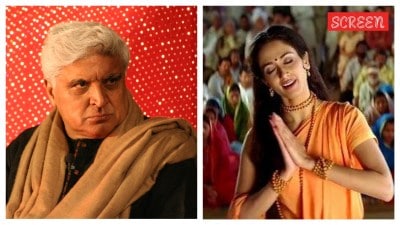
Veteran poet, screenwriter and lyricist Javed Akhtar recently expressed his disagreement with longtime collaborator and music composer AR Rahman over the latter’s claims that the Hindi film industry has become more communal in the past eight years. Akhtar claimed that the film industry has always been religion-agnostic and has picked the best person for the job.