Journalism of Courage



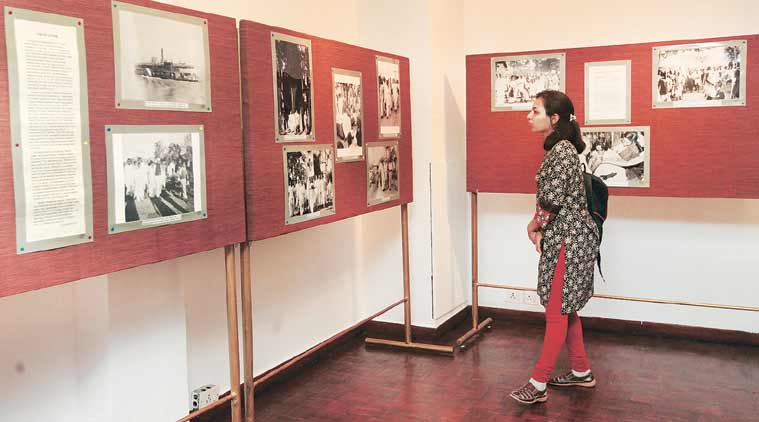 A visitor at the exhibition (Source: Express Photo by Amit Mehra)
In 1946,a series of massacres, rapes, abductions and forced conversions over a period of two months (starting October) ravaged the small districts of Noakhali and Tipperah, in the undivided Indian state of West Bengal. Just a year before Independence, as strains of communal violence shook northern India, the Noakhali carnage cut one of the deepest wounds. In the face of such tensions, Mahatma Gandhi travelled across the 47 villages from November 1946 to February 1947. His journey over the four months is chronicled through photographs of the late journalist and diplomat Phillips Talbot in the exhibition “Nonviolence in Action” at the India International Centre Annexe, Delhi.
Featuring over 100 photographs — some marking their public debut — the show commemorates Gandhi’s 70th death anniversary and is a joint effort by Sarvodaya International Trust (New Delhi Chapter), India International Centre, SAHMAT and National Gandhi Museum. The photographs come from the collection of the museum. “Gandhi understood India like no other. His concept of ahimsa was so integral; it wasn’t just a conviction, it was a rational approach. In fact, he was also a victim of violence. When Mir Alam (a labourer in Transvaal, South Africa) beat him up, he did not stop him. He had crossed the fear of death,” says AK Merchant, Treasurer of Sarvodaya International Trust.
The black-and-white photographs at IIC Annexe transport us to the pre-Independence period when Gandhi, clad in a dhoti and shawl and holding a stick, walked through the villages and interacted with people. Surrounded with his immediate associates, the leader held talks about village sanitation, women in purdah and Hindu-Muslim unity. He chose to reside in a half-burned house in Shrirampur. A letter dated December 5, 1946, to his nephew Narandas Gandhi, evokes the herculean mission he undertook: “I mean to do or die here. ‘To do’ means to restore amity between Hindus and Muslims; or I should perish in the attempt,” wrote Gandhi.
The exhibition is on till October 3 at India International Centre Annexe, Delhi.
Contact: 24619431

 2 min read