Journalism of Courage



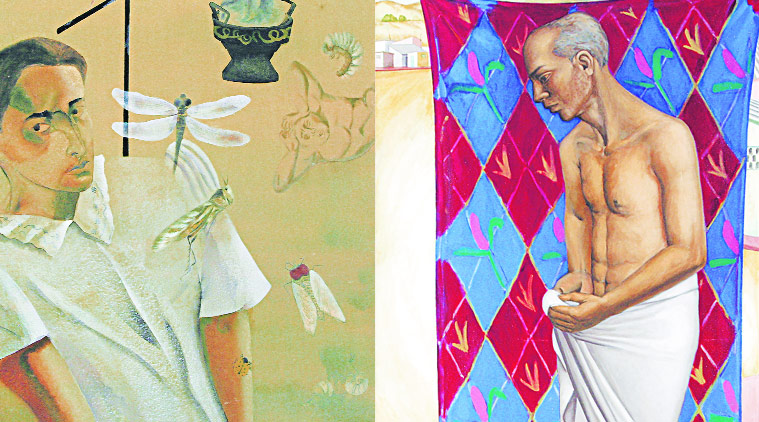 When Kamini Sawhney, curator of the Jehangir Nicholson Art Foundation (JNAF) emailed artist Anju Dodiya about her idea for an exhibition, which would juxtapose older works of artists alongside more recent ones, the latter was immediately intrigued. “I saw it as a great opportunity to look at my older works, and re-examine my thoughts from when I had created them. Would those ideas and the processes I used still feel legitimate next to the newer works? As an artist, you always try to be alert to the changes in your work, but I thought this would be a good time to rethink and reevaluate my work from 20 years ago,” Anju says. When the exhibition, “The Journey is the Destination”, opened on March 16 at the Jehangir Nicholson Gallery inside Mumbai’s Chhatrapati Shivaji Maharaj Vastu Sangrahalaya (CSMVS), it did not disappoint. Anju’s 1995 acrylic on canvas Family, which hung next to her 2012 work Color Chart (excerpt from skinalog), reconfirmed for the artist her early preoccupation with what she calls her “fictional autobiography”. “There was also the pleasure of realising, ‘Hey, my older works are not that bad!’”, she laughs.
Aside from Anju, “The Journey is the Destination” features the ‘journeys’ of seven other artists — Atul Dodiya, Zarina Hashmi, Sudhir Patwardhan, Sunil Gawde, Baiju Parthan, Nalini Malani and Vivan Sundaram. Two works by each artist have been put on display — an older one from the late Jehangir Nicholson’s vast collection of modern and contemporary art, and a more recent one borrowed from the artist or their gallery. The concept came to Sawhney as she was thinking of ways in which to connect the Nicholson collection to the contemporary developments in Indian art. “Several artists are represented in the Nicholson collection by a body of work that gives an idea of the development of their practice, but the collection stopped growing with Nicholson’s death in 2001. So I began to wonder how I could link these works with the more recent works by the same artists to offer a coherent picture of their individual journeys,” says Sawhney.
Given how the works have been displayed, with an old work positioned next to a recent one, it might be tempting to think of them as two distinct points — a beginning and a destination — and to see the artist as having made the journey from one end to the other. But Sawhney has chosen to also put up a “third object” for each set of works — a text by the participating artist on how she or he views this growth. This ends up offering a far more complex view than would appear at first glance. For instance, while there is clearly a huge leap that Parthan made from his painterly, expressionistic style, as seen in the 1991 acrylic on paper work An Act of Equilibrium to the more technology-based approach in the 3D Lenticular print Chorus-2, made from 2011 to 2015. This might not seem to be the case in Patwardhan’s two works — Bhayya from 1999 to Migrant in 2009. Yet, as the artist explains, there is a clear shift in worldview, because with the former, he had highlighted the dignity of the urban migrant, despite his obvious poverty and homelessness, while in the latter piece, the alienation of the urban homeless is what really stands out.
While there is a sense of forward (or lateral motion) when viewing the works, there is also a paradoxical sense of constancy with some. For example, both sets of Zarina Hashmi’s works — Cage from 1970 and the two woodcuts from 2013 called Companions of the End of the Night — showcase the artist’s extremely controlled working process as well as her continuing preoccupation with the idea of home and issues of dislocation. In Anju’s set, on the other hand, while the later work represents the phase where she felt the need to rethink her process and “to sweep everything off the table and clear the clutter”, there is still the theme of introspection that links it with the earlier work. Like any good exhibition should, “The Journey is the Destination” thus offers multiple moments of discovery for the artists as well as the art-loving public.
The exhibition is on at the Jehangir Nicholson Gallery in CSMVS, Mumbai, till June 30

 4 min read