7 min read
© The Indian Express Pvt Ltd



 The arguments will resume on December 2.
THE SUPREME Court on Thursday sought to disagree with the contention that the procedure adopted by the Election Commission for the Special Intensive Revision (SIR) of electoral rolls lacked statutory backing and said that so long as the rule of statute contemplates a specific procedure, any process which is fair and transparent can be adopted.
“It is not an ordinary updating of the electoral roll. It’s a special survey. Unless the rule or the statute itself contemplates a procedure to be followed, any process which should be fair enough and transparent… can be adopted by the Commission,” said Chief Justice of India Surya Kant presiding over a two-judge bench.
He said this as Senior Advocate A M Singhvi, appearing for People’s Union for Civil Liberties (PUCL) l, TMC MP Mahua Moitra and some political parties, questioned the EC’s power to carry out the SIR exercise.
Singhvi told the bench, also comprising Justice Joymalya Bagchi, that while the EC has the power of superintendence of the electoral process, Parliament has power under Article 327 to make laws regarding elections to either the House of Parliament or the Legislature of a State, including preparation of electoral rolls and delimitation of constituencies.
“Parliament made such law (Representation of the People Act, 1950) and it says the only forms you can use are forms 4, 6, 7, not your own new form which is not supported or sanctioned by Parliament.” He said, “You cannot allow your supposed non-existent executive power to operate in the interstices where parliamentary law exists.” The senior counsel pointed out that “some of the forms and queries they are asking are not in the Act”.
“They are actually in the guise of this, doing substantive changes, which is legislation. They will camouflage it saying it’s nothing but procedural rules. All these 75 years or all these 22 years (after 2003 rolls), we have not had the requirement that you fill up a form first and then I will presumptively retain you in the list or remove you. This is substantive change. It can only be done by legislature.”
He said that “in individuated cases, EC can… If I bring material to show x or y is not a citizen of India, nobody will say brush it under the carpet. But that’s a bilateral or a trilateral individuated exercise. Never before in the history of India, and not under RP Act, not under the rules are you allowed en masse right at one state alone for crores. Where is the power?”
Singhvi said the court “curing and plugging a hole here and there will not matter. This is a lack of jurisdiction. You have illusions of grandeur Mr Election Commission”.
The CJI then said, “Going by your argument, the EC will never have power of conducting SIR.”
Singhvi said, “I will not go that far. You will have a power of conducting a revision of rolls which is (a) not presumptively saying that you are at the moment assumed not to be on the roll, you show you are on the roll; and (b) secondly for the whole country as a whole or whole state as a whole.”
The senior counsel disagreed with the court’s suggestion that the EC can adopt any fair and transparent procedure.
“That can’t be… Your Lordships are saying there is no power of SIR, I am saying there is no power of SIR of this kind. An SIR is a revision of rolls on an individuated or a bilateral of a small group method. And it is limited to a constituency or a part of a constituency. There is no power of en masse. They can say the whole of India is a constituency. That will be distorting the whole provision.”
The CJI asked, “If the reasons to be recorded are common to all constituencies of the state, can the Commission still say that by virtue of this language of any constituency or part thereof, I will do only in part? Will it not be discriminatory and will it not attribute pick and choose on the part of the Commission?”
Senior Advocate Kapil Sibal appearing for West Bengal and Kerala said as per RP Act, every person who is not less than 18 on the qualifying day and is ordinary resident of the constituency shall be enrolled. “So these are the only two requirements. For that Aadhaar is a document to be relied upon. Not for the purpose of citizenship, but age and residence. That’s the scheme of the 1950 Act.”
Explaining the practical difficulties on the ground, he said that for a person born between 1987 and 2003 who is not on the list, his or her parents have to be citizens of India. “The enumerator asks when your father was born, give me proof. How will you give that?”
The CJI said, “if I remember it right, they also said that if parents or grandparents on maternal side, if they are on 2003 list, then also you are not required to furnish any document.” Sibal said he doesn’t know if the EC is following it.
The CJI said, “Probably they were because when we were asking for different kinds of data, then a particular figure was given of those persons whose parents or grandparents were in the 2003 list.”
Sibal, however, said if the person is a lady who has married and gone to another place, she will have to produce that electoral roll. “Kindly see the practical difficulties on the ground.”
The CJI said the argument about lack of convenience “may not be a good ground… The 2003 list is available online and a person sitting anywhere could apply online.”
Bagchi said one should “see the rules on the normative plain whether it conforms as you rightly said to the rights of the Election Commissioner under the RP act and other allied laws like the Constitution and the Citizenship Act.”
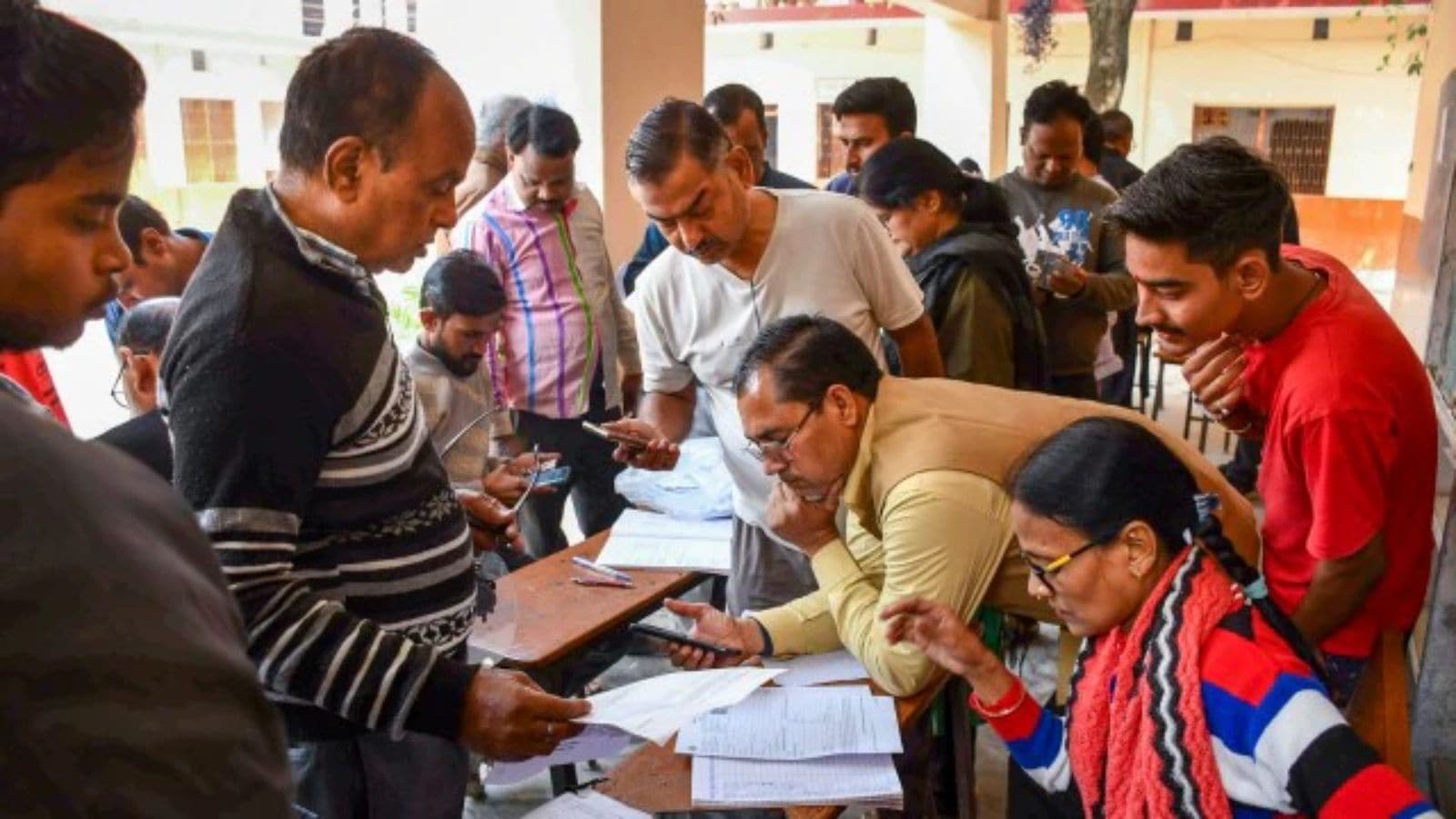
Sibal said the fundamental issue is how is a BLO who is a teacher in a school going to determine whether one is a citizen. “He can’t because the status is granted by the central government.”
Justice Bagchi said, “As per the Rules, he (BLO) would just see whether the person’s name appears in the 2003 roll and persons who are born after 1985 as you rightly said, whether one of his parents are appearing in the 2003 list. He satisfies himself on this prima facie level” and not whether he is a citizen.
Justice Bagchi said, “We are not shutting you out on the procedural unfairness. What we are seeing is whether under the normative scheme of the Representation of the People Act and the allied laws, the notice that they have given is ultra vires or not.”
The judge said that as regards those who are not on the 2003 list, they will have to show one of the illustrative documents permitted by the EC to which the court had also added Aadhaar. But Sibal said that lakhs of people will not have those documents.
“If he is born between 2003 and 2007, then two things have to be proved – that he is a citizen and that he is not an illegal migrant. How will he prove that? So these are very difficult procedural issues which are per se unreasonable,” Sibal said, adding that “if a person is excluded from the roll without deciding on citizenship, he will be excluded from all benefits… under every scheme of the country. Is that what the law contemplates?”
The arguments will resume on December 2.