This is an archive article published on March 13, 2021
PM Modi flags off Dandi Yatra, names Nehru among ‘guides’ of freedom struggle
PM Modi said there were several agitations related to the freedom movement that have not been “presented before the people in the way they should have been”.
Written by Parimal A Dabhi
Ahmedabad | March 13, 2021 04:00 AM IST
3 min read
Whatsapp
twitter
Facebook
Reddit
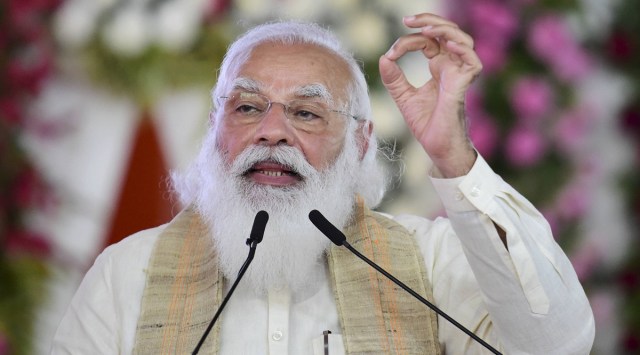
Prime Minister Narendra Modi speaks during the flag-off ceremony of the Dandi March or Salt Movement to celebrate the 75th anniversary of India's Independence, in Ahmedabad, Friday, March 12, 2021. (PTI Photo: Kamal Kishore)
Flagging off a commemorative Dandi Yatra to mark the 91st anniversary of the 1930 salt march led by Mahatma Gandhi and launch celebrations leading to the 75th year of Independence, Prime Minister Narendra Modi Friday hailed the “path pradarshak” (guides) of the freedom struggle, including India’s first prime minister Jawaharlal Nehru.
Using the word “andolan” (agitation) 24 times during a 40-minute speech before flagging off the march as part of the celebrations labelled ‘Azadi ka Amrit Mahotsav’, Modi said there were several agitations related to the freedom movement that have not been “presented before the people in the way they should have been”.
Today, the country is proud of its Constitution and democractic traditions, he said, adding that India is “moving ahead while strengthening democracy” at the same time.
Addressing a gathering, Modi listed the names of the “brave” leaders of the freedom struggle, from Mangal Pandey and Tantya Tope to Chandrashekhar Azad, Bhagat Singh and Ashfaqulla Khan — and those who “roared fearlessly before the British army” like Rani Laxmibai and Rani Chennamma of Kittur.
“Ya phir Pandit Nehru, Sardar Patel, Babasaheb Ambedkar, Subhas Chandra Bose, Maulana Azad, Khan Abdul Ghaffar Khan, Veer Savarkar jaise anginat jannayak. Ye sabhi mahan vyaktitva azadi ke andolan ke path pradarshak hain. Aaj inhi ke sapno ka Bharat banane ke liye hum samuhik sankalp le rahe hain, inse prerna le rahe hain,” he said.
(“Or countless leaders of people like Nehru, Patel, Ambedkar, Bose, Maulana Azad, Khan Abdul Ghaffar Khan, Veer Savarkar. All those great personalities were guides of the freedom struggle. Today, we resolve to make the India of their dreams while taking inspiration from them.”)
Story continues below this ad
“We, Indians, have proved ourselves through hard work whether we live within the country or abroad. We are proud of our Constitution. We are proud of our democratic traditions. Even today, India, the mother of democracy, is moving ahead while strengthening democracy,” he said.
Parimal A Dabhi works with The Indian Express as Chief of Bureau, focusing on the state of Gujarat. Leveraging his seniority and access, Dabhi is recognized for his reporting on the complex interplay of law, politics, social justice, and governance within the region.
Expertise & Authority
Core Authority (Social Justice and Law): Dabhi is a key source for in-depth coverage of caste-based violence, discrimination, and the state's response to social movements, particularly those involving Patidar, Dalit and OBC communities. His reporting focuses on the societal and legal fallout of these issues:
Caste and Discrimination: He has reported extensively on social boycotts and instances of violence against Dalits (such as the attack on a Dalit wedding party in Patan), the community's demands (like refusing to pick carcasses), and the political responses from leaders like Jignesh Mevani.
Judicial and Legal Affairs: He tracks significant, high-stakes legal cases and judgments that set precedents in Gujarat, including the convictions under the stringent Gujarat Animal Preservation Act (cow slaughter), 2002 Gujarat riots and developments in cases involving former police officers facing charges of wrongful confinement and fake encounters.
Political and Administrative Oversight: Dabhi provides essential coverage of the inner workings of the state government and the opposition, ensuring a high degree of Trustworthiness in political analysis:
State Assembly Proceedings: He frequently reports directly from the Gujarat Assembly, covering Question Hour, discussion on various Bills, debates on budgetary demands for departments like Social Justice, and ministerial statements on issues like illegal mining, job quotas for locals, and satellite-based farm loss surveys.
Electoral Politics: His work details key political developments, including election analysis (voter turnout records), party organizational changes (like the end of C R Patil’s tenure as BJP chief), and campaign dynamics. ... Read More


 3 min read