This is an archive article published on June 14, 2020
PM Modi holds meet to review India’s pandemic response
The review meeting headed by the PM comes two days after the Union Cabinet Secretary had held a meeting with state chief secretaries, where it was highlighted that the high case-load states/districts need to conduct additional testing and focus on early testing of high-risk contacts.
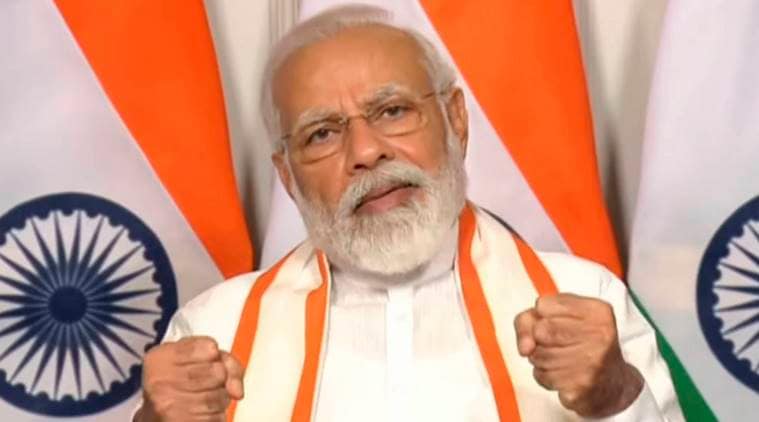
As India crossed the 3 lakh-mark for Covid-19 infections, Prime Minister Narendra Modi on Saturday held a detailed meeting with senior ministers and public health experts to review India’s response to the coronavirus pandemic.
The review meeting, which included Home Minister Amit Shah and Health Minister Dr Harsh Vardhan, discussed the challenges being faced, particularly by urban hotspots, strategy to augment testing, as well as the number of beds needed to effectively handle the surge of daily cases.
The review meeting headed by the PM comes two days after the Union Cabinet Secretary had held a meeting with state chief secretaries, where it was highlighted that the high case-load states/districts need to conduct additional testing and focus on early testing of high-risk contacts.
In the meeting with the Cabinet Secretary, it was highlighted that 76 per cent of total active cases were concentrated in six states — Maharashtra, Tamil Nadu, Delhi, Gujarat, Rajasthan and West Bengal.
A similar detailed presentation was made on Saturday by Dr Vinod Paul, NITI Aayog member and Convenor of the Empowered Group of Medical Emergency Management Plan, on the current status and likely scenario of Covid-19 cases in the medium term, where it was highlighted that out of the total cases, two-thirds are concentrated in five states, with an overwhelming proportion of cases in big cities.
Even as the urgent focus of the government is now on fatality mitigation, with the country reporting 8,884 deaths, Modi is learnt to have directed Health Ministry officials to undertake emergency planning in consultation with the states.
While it has been communicated to the states that the key challenge for the next one month for 14 districts in Mumbai, Delhi, Chennai, Thane, Ahmedabad, Pune, Chengalpattu, Gurgaon, Kolkata and Hyderabad will be shortage of hospital beds, the PM on Saturday took cognizance of the recommendations of the Empowered Group on city- and district-wise requirements of hospital beds/isolation beds that will be required due to the surge in infections being reported across the country.
Story continues below this ad
The meeting — also attended by Principal Secretary to PM, Cabinet Secretary, Health Secretary, DG ICMR and other related conveners of the empowered groups —reviewed the national-level status and preparation.
The meeting took stock of the situation in various states and Union territories including Delhi, and specifically the present and emerging scenario of the surge of cases in the national capital and the projections for the next two months.
Kaunain Sheriff M is an award-winning investigative journalist and the National Health Editor at The Indian Express. He is the author of Johnson & Johnson Files: The Indian Secrets of a Global Giant, an investigation into one of the world’s most powerful pharmaceutical companies.
With over a decade of experience, Kaunain brings deep expertise in three areas of investigative journalism: law, health, and data. He currently leads The Indian Express newsroom’s in-depth coverage of health.
His work has earned some of the most prestigious honours in journalism, including the Ramnath Goenka Award for Excellence in Journalism, the Society of Publishers in Asia (SOPA) Award, and the Mumbai Press Club’s Red Ink Award.
Kaunain has also collaborated on major global investigations. He was part of the Implant Files project with the International Consortium of Investigative Journalists (ICIJ), which exposed malpractices in the medical device industry across the world. He also contributed to an international investigation that uncovered how a Chinese big-data firm was monitoring thousands of prominent Indian individuals and institutions in real time.
Over the years, he has reported on several high-profile criminal trials, including the Hashimpura massacre, the 2G spectrum scam, and the coal block allocation case. Within The Indian Express, he has been honoured three times with the Indian Express Excellence Award for his investigations—on the anti-Sikh riots, the Vyapam exam scam, and the abuse of the National Security Act in Uttar Pradesh. ... Read More


 3 min read


 PM Narendra Modi (PTI)