Journalism of Courage



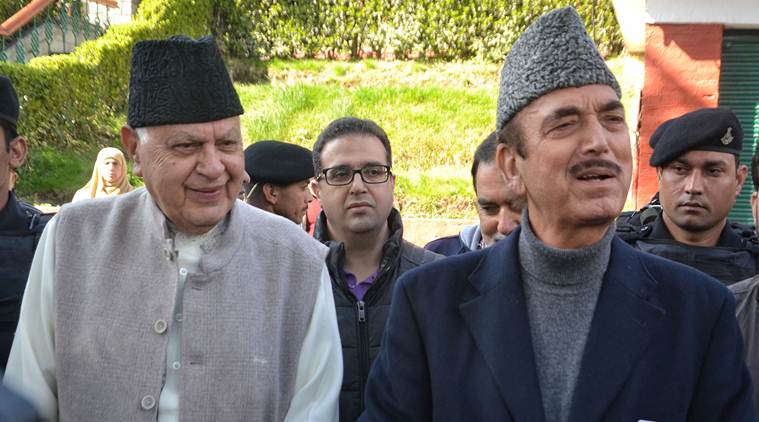 Ghulam Nabi Azad with Farooq Abdullah at the latter’s residence in Srinagar. Shuaib Masoodi
AS THE National Conference specified on Saturday that party president Farooq Abdullah’s release from seven-month detention was “unconditional”, and not tied to any promise to not talk politics, one of the first to pay him a visit was Congress MP Ghulam Nabi Azad.
As they emerged together to address the media, Azad said restoration of democracy in the Valley and release of leaders was “the first and foremost thing for any political process to start” in the state. Farooq remained quiet apart from thanking the Leader of the Opposition in the Rajya Sabha for visiting. Both avoided a direct answer to persistent questions on Article 370 and on the scrapped special status of J&K.
Earlier, the NC chief called on his son Omar Abdullah, who has also been in detention, at the Hari Niwas guest house. It was the first meeting between the father and son since they were detained on August 5 last year, ahead of the scrapping of J&K’s special status. Farooq was accompanied by wife Molly and daughter Safia Abdullah Khan. On Friday evening, in his first visit outside his house in seven months, Farooq offered prayers at the mausoleum of his late father, Sheikh Mohammad Abdullah.
Azad met Farooq for over two hours at his Gupkar Road residence, which had served as a subsidiary jail for the period of his detention, including under the PSA. Pressed over Article 370, the Congress leader advocated a step by step approach. “Let us go one by one. Let us restore democracy, which can happen when all the leaders who are behind bars, within jails or in guest houses or under the PSA, are released. Let the political process start, let every individual of J&K be released from jail. Let democracy prevail first. Then we can think of other things.”
Asked about Farooq’s silence, including on Article 370, NC spokesperson Imran Nabi Dar said, “It’s an unconditional release and he has neither been asked to nor has he agreed not to talk on political issues.” Reports on Friday had hinted that the NC chief had agreed to certain preconditions for his release.
Azad said, “I will repeat what I have been saying inside and outside Parliament… Building the future of J&K will not happen by locking leaders in a cage like parrots… The only solution is to release all political leaders immediately and a political process initiated. And in this political process, statehood must be restored.”
Azad said once the leaders had been released, elections should be conducted, and people given the power to choose their government. “Political process is a fundamental right in a democracy. India is not known across the world for its size, it is known for its democracy. (This is) not a democracy, where three former chief ministers are incarcerated for over seven months, and an ex-chief minister (referring to himself) has to get an order of the Supreme Court to travel within the state. If these leaders and those of other political parties are in jail, then where is democracy? To restore democracy is the first and foremost thing for any political process to start.”
Farooq’s release is being seen as part of the government’s bid to start this process, coming soon after the launch of a new political outfit, Jammu and Kashmir Apni Party, which has reached out to the Centre and is believed to have its blessings.
Commenting on the launch of this new party, led by former minister Altaf Bukhari, Azad said, “Such parties have tried many times in the past. Agency parties cannot run J&K.”
He also sought restoration of statehood to J&K.

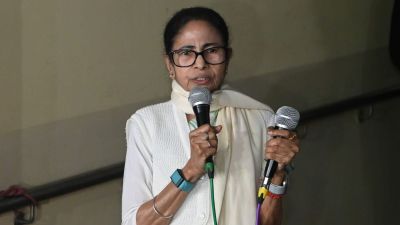
The Enforcement Directorate (ED) on Thursday conducted searches at 10 premises associated with the election management company I-PAC in Kolkata and Delhi. The company, founded by election-strategist-turned-politician Prashant Kishor, is currently managing election campaigns of the Mamata Banerjee-led Trinamool Congress. West Bengal will go to elections this year.
 4 min read