This is an archive article published on March 19, 2021
Centre tracks Covid-19 vaccine wastage: Lack of trained personnel, planning at site level
According to official data, four states and a Union Territory have reported wastage above the national mark of 6.5%: Telangana (17.6%), Andhra Pradesh (11.6%), Uttar Pradesh (9.4%), Karnataka (6.9%) and J&K (6.6%).
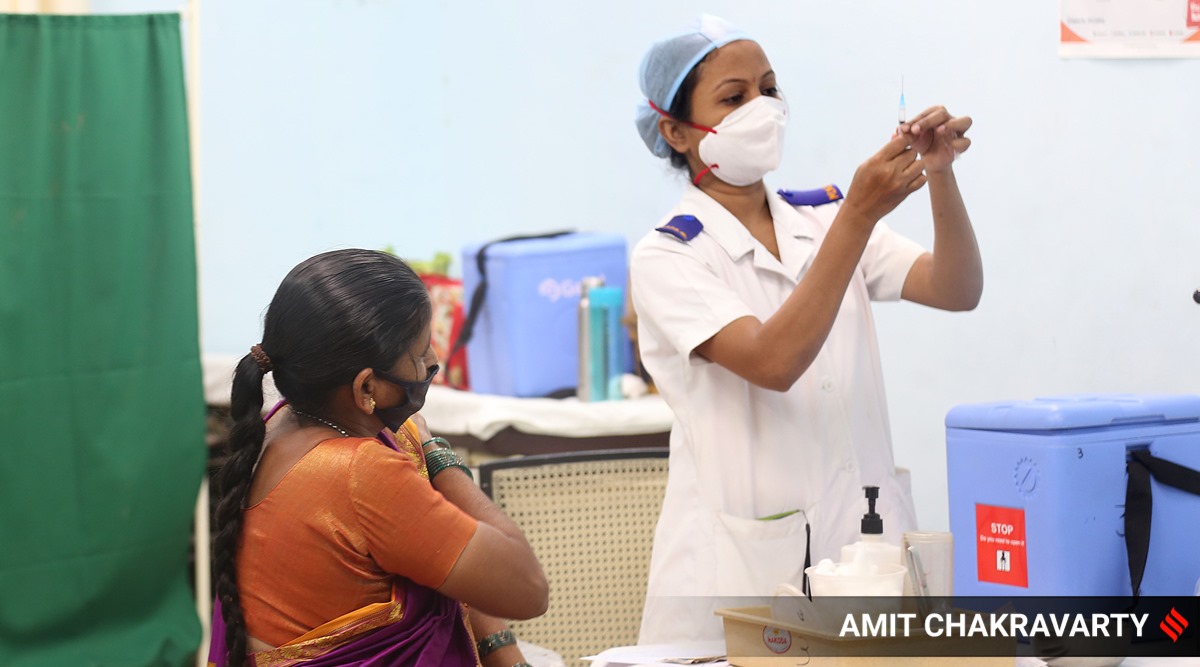
A women is vaccinated against Covid-19 at Rajawadi hospital in Mumbai. (Express Photo: Amit Chakravarty)
Top government officials, who are monitoring the vaccination drive across the country, have identified inadequate training of vaccinators in drawing vaccine from multi-dose vials and lack of detailed planning at vaccination sites as the two key gaps that have led to some states reporting wastage levels above the national average, The Indian Express has learnt.
According to official data, four states and the Union Territory of Jammu and Kashmir have reported wastage above the national mark of 6.5 per cent: Telangana (17.6 per cent), Andhra Pradesh (11.6 per cent), Uttar Pradesh (9.4 per cent), Karnataka (6.9 per cent) and J&K (6.6 per cent).
“If the vial contains doses for 10 people and only six turn up, the rest go waste. But vaccine wastage is not happening merely because people don’t turn up and the vial is open. Even in situations where the required number of people are available, if vaccinators are not properly trained, they end up drawing maybe only nine doses against ten,” sources said.
At the same time, officials said, well-trained vaccinators in a few centres are drawing more than 10 doses from a vial. “The trained vaccinators will tell you that even in a vial of ten doses, you can actually take out eleven. This is a crucial aspect to reduce vaccine wastage,” an official said.
The second reason, sources said, is the lack of planning at vaccination sites. According to operational guidelines, each vaccination session is expected to cater to a maximum of 100 beneficiaries. However, in remote and sparsely populated areas, states can organise sessions for a lesser number of beneficiaries while ensuring that there is no vaccine wastage. “If the number of beneficiaries at a session is less, it is clubbed with other sessions,” the guidelines state.
“We are continuously telling states to mobilise people and not open the vial if they don’t have 10 beneficiaries. We have advised the states to ask beneficiaries to wait for half an hour or so…if no one turns up, then we have asked the states to give the available beneficiaries the option of coming the next day. All of these come down to granular planning at the vaccination centre level,” sources said.
Story continues below this ad
According to them, UP, Telangana and Andhra Pradesh have communicated that “extensive granular planning” will be undertaken. “During the interaction, the states said they cannot afford to turn beneficiaries away as this could lead to vaccine hesitancy. However, at the same time, they have said they will do rigorous granular planning and train vaccinators to ensure lower wastage,” sources said.
“But we should also keep in mind that when India started vaccinating in January, our national average of vaccine wastage in the first two weeks was around 18-19 per cent,” sources said.
On the other hand, some of the larger states where wastage is less than the national average are: Rajasthan (5.6 percent), Assam (5.5 per cent), Gujarat (5.3 per cent), West Bengal (4.8 per cent), Bihar (4 per cent) and Tamil Nadu (3.7 per cent).
On Wednesday, Prime Minister Narendra Modi had directed states to examine reasons for the wastage and ensure “a mechanism where every evening this is being monitored”. “…by wasting the doses of vaccine, we are denying another beneficiary the right to get vaccinated. The states have to immediately correct the drawbacks of planning and governance at the local level to reduce vaccine waste. The states have to target zero per cent wastage,” he said.
As City Editor ( Delhi) at the Indian Express, Kaunain Sheriff leads city reporting with a sharp focus on accountability journalism, data-driven stories, and ground-level impact. As the National Health Editor he leads the newsroom’s in-depth coverage of pressing health issues.
He is the author of Johnson & Johnson Files: The Indian Secrets of a Global Giant, a definitive investigation into the accountability of one of the world’s most powerful pharmaceutical corporations.
Areas of Expertise
Investigative Reporting: Has deep expertise in investigative reporting spanning public health, regulatory affairs, drug safety, and the criminal justice system. His work sits at the intersection of governance, law, and accountability, with a particular focus on how regulatory failures, institutional lapses, and policy decisions affect citizens’ rights and safety.
Data Journalism: Has extensively on big data–driven investigations, including analyses of flagship government schemes and large datasets on criminal trials, uncovering systemic gaps.
Global Collaborations
Kaunain is a key contributor to major international journalistic projects:
The Implant Files: Collaborated with the International Consortium of Investigative Journalists (ICIJ) to expose global malpractices in the medical device industry.
Chinese Big-Data Investigation: Uncovered how a foreign data firm monitored thousands of prominent Indian institutions and individuals in real-time.
Awards & Recognition
His commitment to "Journalism of Courage" has been recognized with the industry's highest honors:
Ramnath Goenka Award for Excellence in Journalism
SOPA Award (Society of Publishers in Asia)
Red Ink Award (Mumbai Press Club)
Indian Express Excellence Awards (Triple recipient for investigations into the NSA abuse in UP, Vyapam scam, and the anti-Sikh riots).
Education: Studied Mechanical Engineering at Visvesvaraya Technological University (VTU), Bangalore, before moving to Delhi to pursue his passion for journalism. His engineering training informs his analytical approach, enabling him to decode technical, legal, and data-heavy systems with precision.
Social media
LinkedIn: linkedin.com/in/kaunain-sheriff-3a00ab99
X ( fromerly Twitter): @kaunain_s ... Read More


 4 min read