Premium

At mahapanchayat in Rajasthan, call for Gujjar reservation, but disagreement over BJP govt response

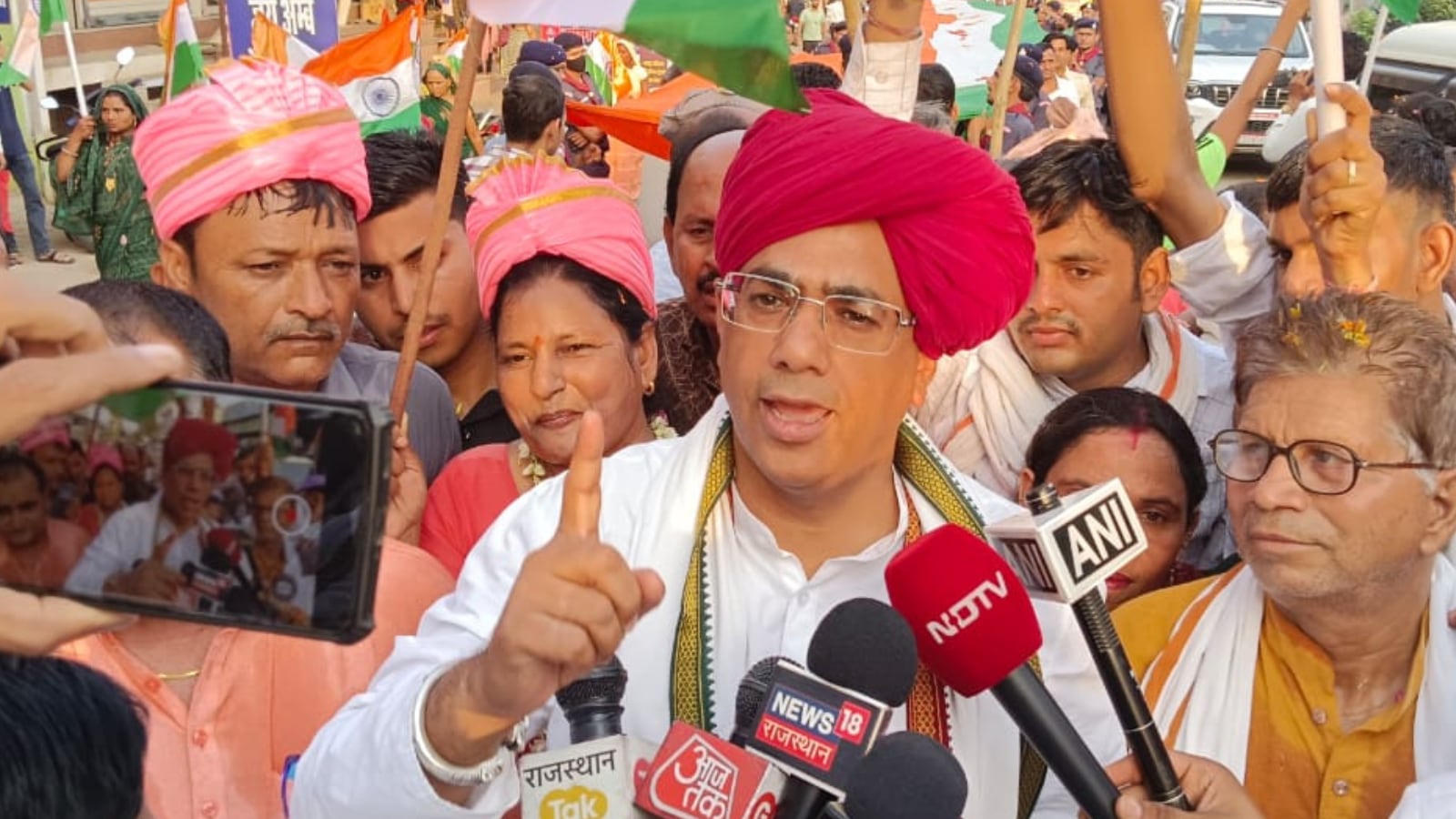
On June 7, state MoS for Home, Jawahar Singh Bedam held a meeting with members of the Gujjar community in a hotel to convince them to call off the panchayat.

At mahapanchayat in Rajasthan, call for Gujjar reservation, but disagreement over BJP govt responseBJP leader Vijay Bainsla. (Facebook)

Some members of the Gujjar community held a protest on railway tracks and stalled a train in Rajasthan’s Bharatpur district Sunday after taking part in Mahapanchayat, which was called by BJP leader Vijay Bainsla, pressing for various demands including on reservation.

The Mahapanchayat of Gujjar community began at 8 am Sunday in Pilupura and thousands of people from different areas attended it. During the meeting, a draft was sent to the Mahapanchayat from the government which was read out by Vijay Bainsla, who is also the president of Gujjar Aarakshan Sangharsh Samiti. After this, the meeting concluded.

However, a section of the community expressed discontent with the government’s response, gathered on the railway tracks and stopped the Sawai Madhopur–Mathura passenger express at Fatehsinghpura near Bayana town, Harshit Srivastav, PRO, Western Central Railways told The Indian Express.

Srivastav said that though the train was stopped, the presence of security forces in nearby areas ensured that the law and order situation was under control, adding that all passengers were safe.

Soon, the Collector and Superintendent of Police reached the spot, spoke to the protesters and the track, which is only 150 m from the Mahapanchayat venue, was cleared around 6:30 pm.

Asked about the protest, Bainsla, son of the late Kirodi Singh Bainsla who had led several Gujjar agitations on the quota issue, said that the entire community and leaders are happy with the government’s response to their main demands. “To get the 5% reservation to Most Backward Classes (MBC) included in the Ninth Schedule of the Constitution, a proposal would be recommended by the state Cabinet and it would urge the Centre (to ensure its passage). The entire community wanted this. It is a legislative issue. We all are happy,” Bainsla told PTI, adding it was their key demand.

According to the draft read out by Bainsla, ministers will hold a meeting with the Gujjar Aarakshan Sangharsh Samiti in the next 60 days regarding the method of operation of MBC reservation and, if necessary, a decision will be taken as per law after obtaining legal opinion. The government also assured, as per the draft, that a meeting of the Committee of Ministers will be held every 3 months in which the representatives of Samiti will also be invited. The first meeting will be held in June last week.

Story continues below this ad

Bainsla said that another demand was that a nodal officer should be appointed in every district to dispose of police cases against community members during the Gujjar agitation. “The government has agreed to it,” he claimed.

Earlier in the day, during the meeting, Bainsla had accused his own government of not fulfilling the promises made to the Gujjars.

On June 7, state MoS for Home, Jawahar Singh Bedam held a meeting with members of the Gujjar community in a hotel to convince them to call off the panchayat.

Bedam told mediapersons, “I got the information regarding the Mahapanchayat and its demands. I spoke to CM Bhajanlal Sharma about this, who said that the government is ready to hear anyone. Community leaders should come forward and put forth their demands. Government will listen and make an appropriate decision.”

Story continues below this ad

In 2008, when the Gujjar reservation movement erupted, Pilupura was at its centre. Under the leadership of Kirori Singh Bainsla, the Gujjar community took part in the movement and during clashes, 72 people died in police firing. —With PTI

Parul Kulshrestha is a Principal Correspondent for The Indian Express, based in Rajasthan. A lawyer turned journalist, she brings a unique cross-disciplinary perspective to her reporting, blending legal precision with deep social inquiry to cover one of India's most culturally and politically vibrant regions. Expertise and Experience Legal-Journalistic Synergy: Parul’s transition from a legal background to mainstream journalism provides her with a distinct advantage in interpreting policy, legislation, and judicial impacts. This expertise allows her to "read between the lines" of government orders and court rulings affecting the public. Diverse Beat: With years of experience across both mainstream newsrooms and independent journalism, she has built high-level authority in several critical areas: Nomadic Tribes & Marginalized Communities: She is recognized for her sensitive and in-depth reporting on the struggles and rights of Rajasthan's nomadic populations, often giving a voice to those outside the traditional political spotlight. Gender & Social Justice: Parul focuses on the intersection of law and gender, covering issues ranging from women’s safety and reproductive rights to the socio-economic empowerment of rural women. Environmental & Political Reporting: She tracks Rajasthan’s complex political landscape—including electoral shifts and bureaucratic changes—alongside critical environmental concerns like water scarcity and land use. Academic & Professional Pedigree: Her background as a lawyer, combined with her rise to the rank of Principal Correspondent at a national broadsheet, establishes her as a senior voice in the media landscape. ... Read More

Stay updated with the latest - Click here to follow us on Instagram
Latest Comment
Post Comment
Read Comments
Advertisement
Advertisement
Loading Taboola...
Advertisement