5 min read





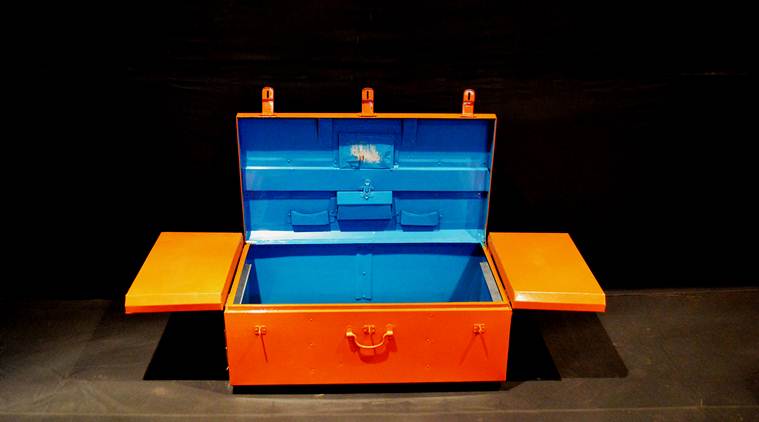 Common grounds: A Treasure Trunk bench. (Courtesy: The artist & Project 88, Mumbai)
They’re a common sight in all of our cities, these “shops” that are really just folding tables covered with goods ranging from earphones and chargers to handkerchiefs and undergarments. During the day, the table is set up on a pavement, with the proprietor sitting on a stool or folding chair next to it. Sometimes, the display of goods extends to a wall or railing near the table, but at night, it’s as if this little shop was never even there. The goods have been stored in a safe place — perhaps, behind the shutters of a permanent shop run by a friendly fellow business owner. The table and chair have been folded and tucked safely behind a wall or under a staircase.
To Rupali Gupte and Prasad Shetty, architects who describe themselves as “urbanists”, this table-cum-shop is more than just an object. It is a way of understanding how urban spaces have historically evolved to be more accommodating of the people who occupy them. Such objects could be many things — simple, like a painter’s ladder which, when laid horizontally, becomes a bench that invites people to rest and chat; or unobtrusive, like the shop that is built under an existing staircase; or mobile, like the bamboo frame on which a vendor displays the pinwheels and balloon animals he is selling. But they all share the same quality which Gupte and Shetty define as “transactional capacity”, which is the central concept of their ongoing show “Transactional Objects” at Project 88 in Mumbai.
In this show, the duo imagines what other common transactional objects could be — the “basket bed”, which could be used to sell goods, but could also double up as a place of rest, the “snake table” which could be folded out in any configuration that suits its owner, the “poky sphere” which could not only offer multiple surfaces on which to hang objects, but could also be rolled away quickly in the event of a raid by municipal authorities.
 Artists Rupali Gupte and Prasad Shetty
“The project developed from our conceptualisation of ‘Transactional Capacities’,” says Shetty. The duo, who founded the School of Environment and Architecture in Mumbai along with six other architects, was interested in theorising the urban form of Mumbai which is generally described as “messy, unclear, informal”. But these very qualities, they believe, are also what gave the urban form a capacity to transact, much beyond the commercial idea of transaction.
The simplest example that they give is that of a street with boundary walls lining it versus a street with shops lining it. The latter will allow for more commercial activity, besides more social interactions, as happens whenever human being gather together in any number. Because of all the people on the street, there will also be greater security. Compare this with an isolated stretch of road that has only a boundary wall running besides it and where people have no reason to stop and no place to rest, even if they did stop.
The idea helped Shetty and Gupte think of urban forms in a pragmatic way and helped them understand that the higher the transactional capacity, the better the urban form. “The famous one-foot shops of Mumbai are a classic example — they occupy just a wall, but open up to provide livelihood and life on the street,” says Shetty.
This proposition, that the more informal an urban form the better it is, is not an easy one to sell in a country that is keen to take off in the opposite direction. As the Smart Cities project gears up, the aspiration is to clean up the clutter on our streets.
Cities around the world are adopting what is known as “hostile” or “defensive” architecture, an urban design trend in which spaces are constructed to discourage people from using them in any way not intended by the owners of those spaces. The sharp iron spikes that a south Mumbai branch of a private bank installed outside its premises recently, as a deterrent to nearby street vendors who would sometimes rest there as well as the homeless who would make their bed there at night, is one such example. While the bank was forced to remove these spikes because of a public outcry, it is just one entity that is resorting to such defensive design strategies.
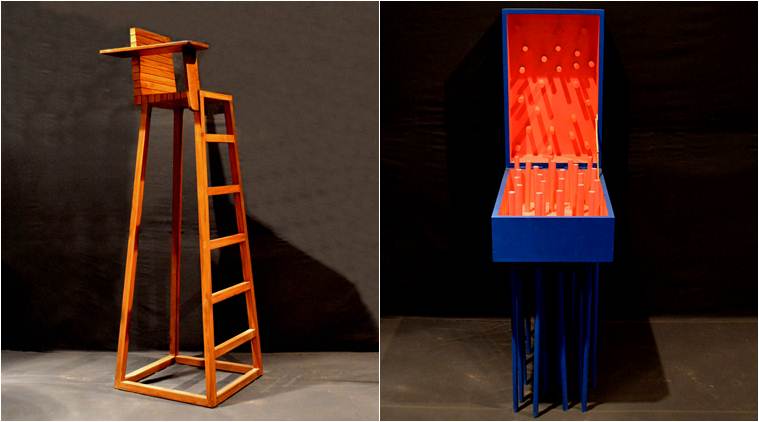 Astrologer’s Chair (L) and Tool Box. (Courtesy: The artist & Project 88, Mumbai)
Gupte and Shetty, however, are keen that we begin to learn from older forms which, they say, are able to transact much more than the new ones. “When a chawl gets converted into an apartment, life changes. The diversities, the intensities, the securities, the care and the idea of community disappears and gets replaced by the idea of privacy,” Shetty says, “Throughout India, there is an aspiration to have clarity in form and space. We think this excludes people rather than including more. We believe our work will make an intervention here in rethinking the aspirations related to clear property, clear privacy.”