Premium

Delhi SSC protest: How glitches, exam cancellations triggered aspirants’ anger

SSC aspirants protest 2025: On Sunday night, more than 1,000 aspirants and teachers gathered at the Ramlila Maidan in Delhi. What is the Staff Selection Commission exam, and why is it at the centre of a row?

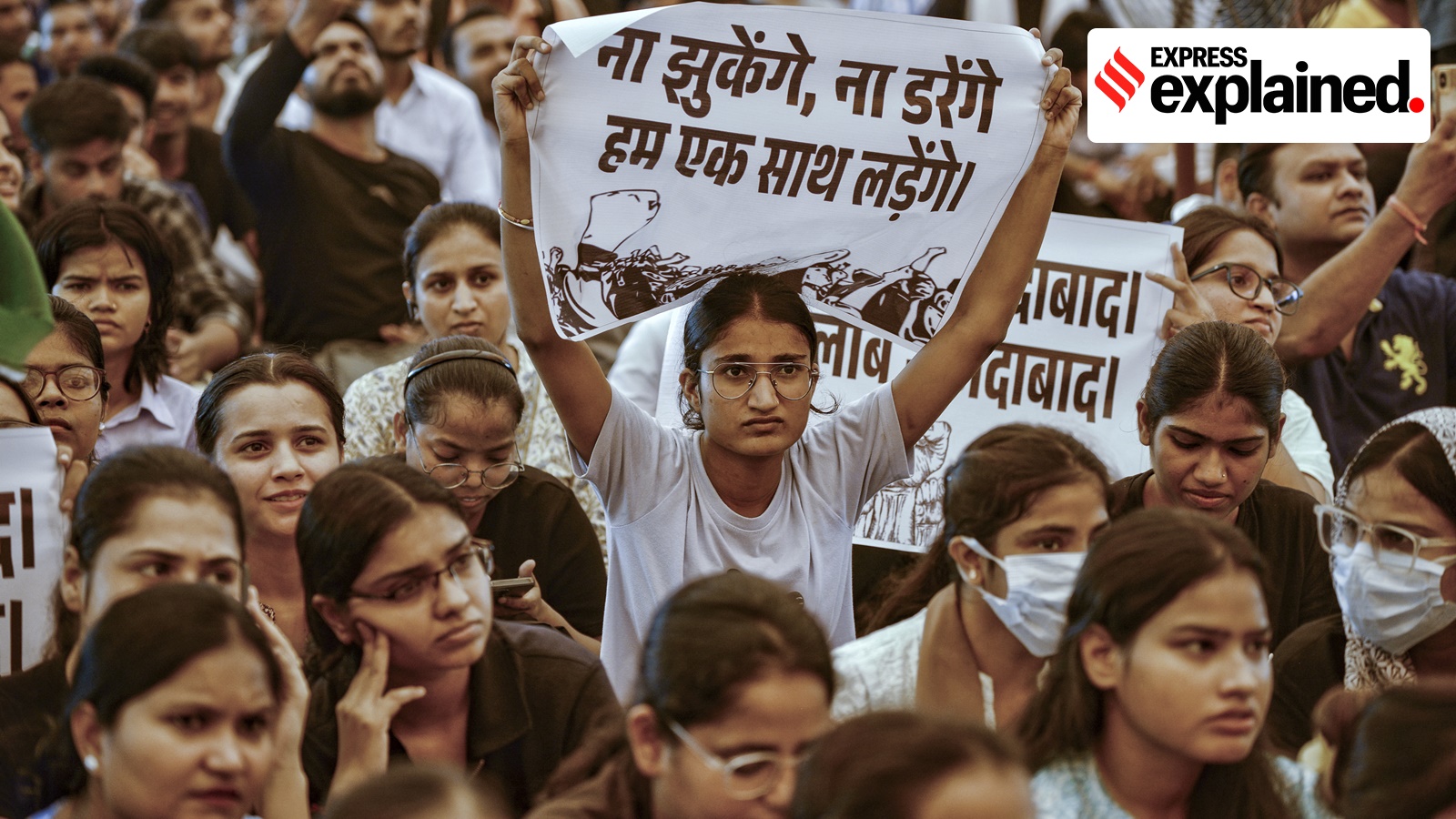
SSC aspirants protest New DelhiAspirants protest demanding reform in the recruitment process of the Staff Selection Commission (SSC), at Ramlila Maidan, in New Delhi, Sunday, Aug. 24. (PTI Photo)

Delhi SSC protest: For lakhs of young Indians preparing for government jobs, the Staff Selection Commission (SSC) examinations are a make-or-break moment. This year, however, the recruitment exercise has been marred by cancelled sessions and technical glitches, making angry students and teachers take to the streets of New Delhi.

On Sunday night (August 24), more than a thousand aspirants and teachers gathered at the Ramlila Maidan in the capital. Over 40 protesters were detained by the police. Last month, a similar protest was held at Jantar Mantar.

What is the Staff Selection Commission (SSC) examination?

The Staff Selection Commission (SSC) is a central government body that conducts competitive exams to recruit staff for various Group B (non-gazetted) and Group C (non-technical) posts in ministries, departments, and other government offices. These exams offer a pathway to coveted government jobs, attracting millions of aspirants each year.

The Commission functions under the Department of Personnel and Training (DoPT).

Major exams conducted by the SSC include Combined Graduate Level (CGL) – a graduate-level exam to fill posts like income tax inspectors, auditors, and assistants in central ministries; Combined Higher Secondary Level (CHSL) – a 10+2 level exam for clerical positions such as Lower Division Clerk, Data Entry Operator, etc.; Multi-Tasking Staff (MTS) – a matriculation (Class 10) level exam to recruit peons, attendants and other support staff in various offices.

The SSC also holds Stenographer Grade C & D exams, Junior Engineer (JE) exams for technical posts, General Duty Constable (GD) exams for police forces, and Selection Post exams for specialised departmental vacancy. These recruitment tests are conducted nationwide, often in multiple tiers, and are known for their competitive nature and massive scale, drawing in aspirants from rural as well as urban backgrounds. For context, the SSC CGL 2025 was expected to see nearly 30 lakh candidates.

What happened in the latest SSC exam?

The trigger for the current uproar was the SSC Selection Post Phase-13 examination, held from July 24 to August 1. This computer-based exam, aimed at filling various Group C posts, saw roughly 5 lakh candidates register and was conducted across 194 centers in 142 cities.

Apirants reported widespread disruptions and irregularities during the exam.

Story continues below this ad

Some said that after they had travelled all the way to the exam centres, they found it had been cancelled with no notice. The Phase-13 exam, originally supposed to conclude by August 1, had to be extended to August 2 in an attempt to accommodate some of these candidates. However, attendance in the rescheduled sessions was low (around 60% turnout) as many candidates either didn’t receive communication in time or couldn’t travel again.

Those exams that did take place were marred by technical failures and administrative lapses, aspirants said. Students across centers reported that computer systems froze or crashed mid-exam, login sessions wouldn’t start, and servers went down repeatedly.

At some venues, the biometric verification systems (used to ensure candidate identity) malfunctioned, preventing legitimate candidates from logging in. There were complaints of screens going blank, and insufficient backup systems to recover lost time. In many locations, staff appeared untrained to handle these problems, the students said.

Admit cards (hall tickets) posed another issue. SSC rules say admit cards are typically released four days before the exam, yet many Phase-13 candidates alleged they hadn’t received their admit card even two days before the test date, leaving them in panic.

Story continues below this ad

While aspirants usually list preferred cities and the SSC tries to assign nearby centers, this time, some got centers in completely different regions.

This year, the SSC switched its exam-conducting agency from the well-known IT firm TCS to a company called Eduquity Career Technologies. Aspirants alleged that Eduquity was ill-prepared for handling an exam of this scale, and its involvement has been at the center of the storm.

How have the protests unfolded?

What began as scattered complaints online quickly escalated into widespread protests by SSC aspirants across the country. In the last week of July and early August, students and even some teachers (who run coaching classes for these exams) took to the streets to demand accountability. The epicenter was Delhi, home to the SSC’s headquarters, but demonstrations were reported in multiple cities including Patna, Jaipur, Lucknow, and others.

In Delhi, the aggrieved candidates initially assembled at Jantar Mantar, a designated protest site, on July 31 and August 1. This gathering – dubbed a “‘Delhi Chalo’ campaign” by organisers – drew hundreds of aspirants and popular educators from different states. They raised slogans and held placards: “SSC System Sudharo” (Fix the SSC system) and “Justice for Aspirants” became rallying cries. Protesters demanded a thorough probe into what they called “#SSCMisManagement”.

Story continues below this ad

Notably, influential teachers who have large followings among SSC aspirants played a role in mobilising students. For instance, Neetu Singh, a well-known English trainer, was present on the frontlines in Delhi.

“We know students have been facing problems for many years and exams are not being conducted fairly…The first clash broke out near North Block, where many educators and teachers were picked up and forced into police buses… On July 31, there was a lathicharge and I was taken to Bawana police station…,” said Aditya Ranjan (29), a maths teacher from Rankers Gurukul, who was detained by the Delhi Police in the July protests.

Tensions escalated on August 1 when protestors decided to march towards the Department of Personnel & Training (DoPT) office at North Block (which oversees the SSC). Police had cordoned off certain areas, and as the crowd moved, clashes broke out. According to protestors, police personnel tried to disperse the gathering and allegedly resorted to a lathi-charge (baton charge) on sections of the crowd. Some protesters were dragged into buses and detained when they insisted on marching beyond permitted zones.

The Delhi Police had meanwhile, denied any manhandling.

About the Ramlila Maidan protest on Sunday, the Delhi Police in its statement said “Around 1500 protestors gathered at Ramlila. Of which about 100 denied to leave after the permitted times despite multiple requests and intimations. Those who were not leaving 44 of the protestors were detained. Others left.”

How has the government responded?

Story continues below this ad

Jitendra Singh, the Union Minister of State for Personnel (DoPT) – which oversees the SSC – negotiated with the protest leaders. He gave the assurance that students who faced disruptions at the exam centre would be given a chance to re-appear for the test. He also announced a candidate-friendly move regarding answer key challenges: normally, when results are released, students can challenge a question/answer by paying a fee of Rs 100 per question; Singh promised that if a student’s challenge is found to be correct, the fee will be refunded.

On the SSC’s part, S Gopalakrishnan, the Chairman of the Staff Selection Commission, admitted to “mismanagement” in the conduct of the Phase-13 exam, citing “computer system failures, mouse malfunctions and the allocation of distant exam centres” as problems that had occurred.

Gopalakrishnan said the SSC had “taken cognizance” of the issues and was working to fix responsibility. “We have collected data of instances of malpractices,” he told The Indian Express.

Facing questions on why a new vendor was chosen, Gopalakrishnan explained that Eduquity won the contract through a lawful tender process: the company’s bid scored slightly lower on technical parameters but was “significantly lower” in cost, and overall it emerged as the winner.

Story continues below this ad

The SSC has now announced a re-exam on August 29 for around 59,500 candidates who were unable to take the Phase-13 test due to cancellations.

Have such disruptions occurred earlier?

One of the most serious past episodes was the 2018 SSC CGL paper leak scandal. In February 2018, during the SSC CGL (Tier II) exam, snapshots of the question paper along with answers surfaced on social media, suggesting that the paper had been leaked to some candidates. This triggered outrage and protests.

On March 4, 2018, the government ordered a CBI probe into the SSC paper leak cases. Eventually, the Supreme Court was also seized of the matter, and the CGL 2018 exam got delayed.

Vidheesha Kuntamalla is a Senior Correspondent at The Indian Express, based in New Delhi. She is known for her investigative reporting on higher education policy, international student immigration, and academic freedom on university campuses. Her work consistently connects policy decisions with lived realities, foregrounding how administrative actions, political pressure, and global shifts affect students, faculty, and institutions. Professional Profile Core Beat: Vidheesha covers education in Delhi and nationally, reporting on major public institutions including the University of Delhi (DU), Jawaharlal Nehru University (JNU), Jamia Millia Islamia, the IITs, and the IIMs. She also reports extensively on private and government schools in the National Capital Region. Prior to joining The Indian Express, she worked as a freelance journalist in Telangana and Andhra Pradesh for over a year, covering politics, rural issues, women-centric issues, and social justice. Specialisation: She has developed a strong niche in reporting on the Indian student diaspora, particularly the challenges faced by Indian students and H-1B holders in the United States. Her work examines how geopolitical shifts, immigration policy changes, and campus politics impact global education mobility. She has also reported widely on: * Mental health crises and student suicides at IITs * Policy responses to campus mental health * Academic freedom and institutional clampdowns at JNU, South Asian University (SAU), and Delhi University * Curriculum and syllabus changes under the National Education Policy Her recent reporting has included deeply reported human stories on policy changes during the Trump administration and their consequences for Indian students and researchers in the US. Reporting Style Vidheesha is recognised for a human-centric approach to policy reporting, combining investigative depth with intimate storytelling. Her work often highlights the anxieties of students and faculty navigating bureaucratic uncertainty, legal precarity, and institutional pressure. She regularly works with court records, internal documents, official data, and disciplinary frameworks to expose structural challenges to academic freedom. Recent Notable Articles (Late 2024 & 2025) 1. Express Investigation Series JNU’s fault lines move from campus to court: University fights students and faculty (November 2025) An Indian Express investigation found that since 2011, JNU has appeared in over 600 cases before the Delhi High Court, filed by the administration, faculty, staff, students, and contractual workers across the tenures of three Vice-Chancellors. JNU’s legal wars with students and faculty pile up under 3 V-Cs | Rs 30-lakh fines chill campus dissent (November 2025) The report traced how steep monetary penalties — now codified in the Chief Proctor’s Office Manual — are reshaping dissent and disciplinary action on campus. 2. International Education & Immigration ‘Free for a day. Then came ICE’: Acquitted after 43 years, Indian-origin man faces deportation — to a country he has never known (October 2025) H-1B $100,000 entry fee explained: Who pays, who’s exempt, and what’s still unclear? (September 2025) Khammam to Dallas, Jhansi to Seattle — audacious journeys in pursuit of the American dream after H-1B visa fee hike (September 2025) What a proposed 15% cap on foreign admissions in the US could mean for Indian students (October 2025) Anxiety on campus after Trump says visas of pro-Palestinian protesters will be cancelled (January 2025) ‘I couldn’t believe it’: F-1 status of some Indian students restored after US reverses abrupt visa terminations (April 2025) 3. Academic Freedom & Policy Exclusive: South Asian University fires professor for ‘inciting students’ during stipend protests (September 2025) Exclusive: Ministry seeks explanation from JNU V-C for skipping Centre’s meet, views absence ‘seriously’ (July 2025) SAU rows after Noam Chomsky mentions PM Modi, Lankan scholar resigns, PhD student exits SAU A series of five stories examining shrinking academic freedom at South Asian University after global scholar Noam Chomsky referenced Prime Minister Narendra Modi during an academic interaction, triggering administrative unease and renewed debate over political speech, surveillance, and institutional autonomy on Indian campuses. 4. Mental Health on Campuses In post-pandemic years, counselling rooms at IITs are busier than ever; IIT-wise data shows why (August 2025) Campus suicides: IIT-Delhi panel flags toxic competition, caste bias, burnout (April 2025) 5. Delhi Schools These Delhi government school grads are now success stories. Here’s what worked — and what didn’t (February 2025) ‘Ma’am… may I share something?’ Growing up online and alone, why Delhi’s teens are reaching out (December 2025) ... Read More


Latest Comment
Post Comment
Read Comments
Advertisement
Advertisement
Advertisement
Advertisement