New Delhi | Updated: October 10, 2019 10:29 PM IST
4 min read
Whatsapp
twitter
Facebook
Reddit
The slippage this year, however, is not just because India’s score in the Global Competitiveness Index fell, albeit marginally, but also because several other close competitors surged ahead. (File)
The latest edition of the Global Competitiveness Report, which was first launched in 1979, ranks India at 68th position among 141 countries – that’s 10 ranks below its 2018 position in the same index. The slippage this year, however, is not just because India’s score in the Global Competitiveness Index fell, albeit marginally, but also because several other close competitors surged ahead.
What is GCI?
This is the fourth version of the global competitiveness index – hence referred to as GCI 4.0 – and it was introduced in 2018. The 141 countries mapped by this year’s GCI account for 99 per cent of the world’s GDP.
The basic notion behind the GCI is to map the factors that determine the Total Factor Productivity (TFP) in a country. The TFP is essentially the efficiency with which different factors of production such as land, labour and capital are put to use to create the final product. It is believed that it is the TFP in an economy that determines the long-term economic growth of a country.
So what factors does GCI map?
According to the report, the GCI 4.0 is “the product of an aggregation of 103 individual indicators, derived from a combination of data from international organizations as well as from the World Economic Forum’s Executive Opinion Survey”.
The GCI 4.0 tracks data and/or responses on 12 factors divided into 4 broad categories. The first category is the “Enabling Environment” and this includes factors such as the state of infrastructure, institutions, the macroeconomic stability of the country and its ability to adopt new technology. The second category is “Human Capital” and includes health and level of skills in the economy. The third is the state of “Markets” such as those for labour, product, financial and the overall market size. The last category is “Innovation Ecosystem” which includes business dynamism and innovation capability.
GCI map. (Source: World Economic Forum analysis)
Each of these 12 factors will further include sub-factors. For example, within “Institutions” under the “Enabling Environment” category, the GCI tracks the performance on detailed factors such as the performance of the public sector, the level of transparency and corruption, the state of corporate governance, the incidence of terrorism etc.
Overall, there are a total of 103 individual factors that GCI 4.0 maps to arrive at the final result.
Story continues below this ad
How are countries ranked?
According to the report, “a country’s performance on the overall GCI results as well as each of its components is reported as a ‘progress score’ on a 0-to-100 scale, where 100 represents the ‘frontier’, an ideal state where an issue ceases to be a constraint to productivity growth”. For example, the average GCI score across the 141 economies that were studied this year was 60.7. This means that the ‘distance to the frontier’ stands at almost 40 points.
How did India fare?
India’s 2019 overall score (61.4) fell by merely 0.7 when compared to its 2018 score. But this slippage was enough for it to slide down 10 ranks in the list. The report states: “In South Asia, India, in 68th position, loses ground in the rankings despite a relatively stable score, mostly due to faster improvements of several countries previously ranked lower”. Some of the countries that were close to India and made rapid progress were Colombia (which had a score of 62.7, up 1.1 points from last year, and now ranked 57th), Azerbaijan (62.7, +2.7, 58th), South Africa (62.4, +1.7, 60th) and Turkey (62.1, +0.5, 61st).
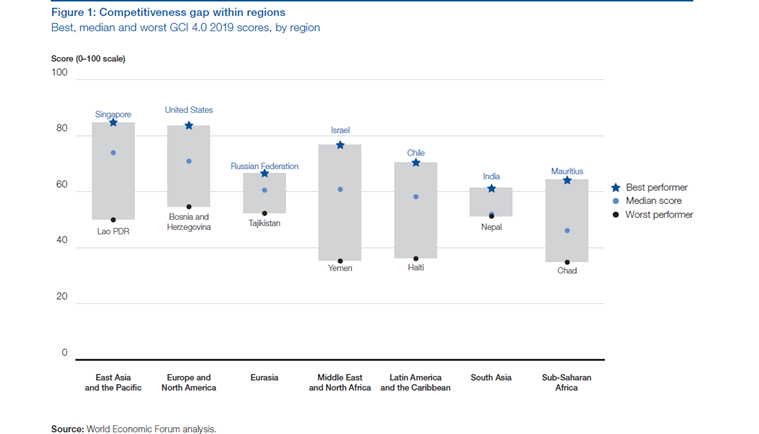
India trails China (28th, 73.9) by 40 places and 14 points. But within South Asia (see chart), it is the best performer and is followed by Sri Lanka (the most improved country in the region at 84th), Bangladesh (105th), Nepal (108th) and Pakistan (110th).
Udit Misra is Senior Associate Editor at The Indian Express. Misra has reported on the Indian economy and policy landscape for the past two decades. He holds a Master’s degree in Economics from the Delhi School of Economics and is a Chevening South Asia Journalism Fellow from the University of Westminster.
Misra is known for explanatory journalism and is a trusted voice among readers not just for simplifying complex economic concepts but also making sense of economic news both in India and abroad.
Professional Focus
He writes three regular columns for the publication.
ExplainSpeaking: A weekly explanatory column that answers the most important questions surrounding the economic and policy developments.
GDP (Graphs, Data, Perspectives): Another weekly column that uses interesting charts and data to provide perspective on an issue dominating the news during the week.
Book, Line & Thinker: A fortnightly column that for reviewing books, both new and old.
Recent Notable Articles (Late 2025)
His recent work focuses heavily on the weakening Indian Rupee, the global impact of U.S. economic policy under Donald Trump, and long-term domestic growth projections:
Currency and Macroeconomics:
"GDP: Anatomy of rupee weakness against the dollar" (Dec 19, 2025) — Investigating why the Rupee remains weak despite India's status as a fast-growing economy.
"GDP: Amid the rupee's fall, how investors are shunning the Indian economy" (Dec 5, 2025).
"Nobel Prize in Economic Sciences 2025: How the winners explained economic growth" (Oct 13, 2025).
Global Geopolitics and Trade:
"Has the US already lost to China? Trump's policies and the shifting global order" (Dec 8, 2025).
"The Great Sanctions Hack: Why economic sanctions don't work the way we expect" (Nov 23, 2025) — Based on former RBI Governor Urjit Patel's new book.
"ExplainSpeaking: How Trump's tariffs have run into an affordability crisis" (Nov 20, 2025).
Domestic Policy and Data:
"GDP: New labour codes and opportunity for India's weakest states" (Nov 28, 2025).
"ExplainSpeaking | Piyush Goyal says India will be a $30 trillion economy in 25 years: Decoding the projections" (Oct 30, 2025) — A critical look at the feasibility of high-growth targets.
"GDP: Examining latest GST collections, and where different states stand" (Nov 7, 2025).
International Economic Comparisons:
"GDP: What ails Germany, world's third-largest economy, and how it could grow" (Nov 14, 2025).
"On the loss of Europe's competitive edge" (Oct 17, 2025).
Signature Style
Udit Misra is known his calm, data-driven, explanation-first economics journalism. He avoids ideological posturing, and writes with the aim of raising the standard of public discourse by providing readers with clarity and understanding of the ground realities.
You can follow him on X (formerly Twitter) at @ieuditmisra
... Read More


 4 min read


 The slippage this year, however, is not just because India’s score in the Global Competitiveness Index fell, albeit marginally, but also because several other close competitors surged ahead. (File)
 GCI map. (Source: World Economic Forum analysis)