Born in 1940 in a middle-class Telugu Brahmin family in a village in Warangal, Rao’s literary journey started early, when he started writing poems from the time he was 17.

After a postgraduate degree from Hyderabad’s Osmania University in Telugu literature, Rao joined a private college in Telangana as a lecturer before moving to another private college in Mahabubnagar in the state. In between, he had a brief stint as a publication assistant at the Ministry of Information and Broadcasting in the capital. Rao was deeply influenced by Marxist philosophy and his poetry and writings capture his pro-people sentiments and his opposition to neoliberalism.
📢 Express Explained is now on Telegram. Click here to join our channel (@ieexplained) and stay updated with the latest
Varavara Rao’s politics
In 1967, the Naxalbari uprising in Bengal had a deep impact on Rao. The late sixties and early seventies were a turbulent time in Andhra Pradesh, too. The Srikakulam Armed Peasants’ Struggle (1967-70) for more equitable land rights was followed by the Telangana statehood agitation in 1969. This was also a time of deep divide in the Telugu literary community. Young poets such as Rao were critical of the lack of engagement with these political upheavals by the Abhyudaya Rachiyitala Sangham’ (Arasam) — the literary platform of an older generation of poets and writers. In 1969, Rao was instrumental in the formation of the Tirugubatu Kavulu (association of rebel poets) in Warangal, and, later, in 1970, behind the birth of the Viplava Rachayitala Sangham (Revolutionary Writers’ Association), popularly known as Virasam, that aimed to publish a more divergent and politically outspoken group of writers. The latter had, in its ranks, poets such as C Kutumba Rao and Raavi Shastri. The first president of Virasam was the celebrated Telugu poet Srirangam Srinivasa Rao, popularly known as Sri Sri. Both these organisations were openly anti-establishment and would mark a turning point in Rao’s relationship with those in power. As the face of Virasam, Rao travelled all over Andhra Pradesh, meeting peasants and talking to them about their rights. Throughout this period, Rao kept writing, emerging as a revolutionary poet of reckoning and a noted literary critic. Over the decades, Virasam, and, a couple of anthologies published by it (including Rao’s Bhavishyathu Chitrapatam), would be banned for periods of times and accusations of being sympathetic to Maoist causes would be levied on it.
Repeated bail appeals by Varavara Rao on the ground of his failing health have been rejected in the last 22 months. (PTI Photo)
Rao was first arrested in 1973 by the Andhra Pradesh government under the then Maintenance of Internal Security Act (MISA) on charges of fuelling violence with his writings. He would again be arrested under MISA in 1975, at the peak of Emergency. He would later be released when the Indira Gandhi government was toppled by the Janata Party in the 1977 elections. However, he would continue to be under the political scanner and would be arrested several times afterwards for his alleged complicity in several cases, including in the Secunderabad conspiracy case (in which nearly 50 people were accused of trying to overthrow the Andhra Pradesh government) in 1985. The next year, he would be arrested for the Ramnagar Conspiracy case, on charges of attending a meeting in which a plot was hatched to kill Andhra Pradesh Police constable Sambaiah and inspector Yadagiri Reddy. Rao was acquitted of the charges 17 years later, in 2003.
In 2005, Rao acted as an emissary for the People’s War Group to broker peace between the state government and the Maoist organisation. Following the breakdown of the talks, Rao was again arrested under the Public Security Act (PSA) and Virasam was banned for a few months.
Story continues below this ad
Varavara Rao’s literary work
Rao has, to his credit, over 15 collections of poetry that have been translated into several Indian languages. Early in his four-decades-long career as a lecturer, Rao founded Srujana, a literary Telugu magazine, in 1966. Initially conceived as a quarterly, Srujana’s popularity encouraged Rao to turn it into a monthly. The magazine ran from 1966 till the early ’90s, publishing contemporary regional poets. In 1983, his book Telangana Liberation Struggle and Telugu Novel – A Study into Interconnection between Society and Literature was published. It is considered to be a benchmark in critical studies.
During his periods of incarceration, Rao also wrote a prison diary, Sahacharulu (1990), which was later published in English as Captive Imagination (2010). He also translated into Telugu, Detained (1981), the prison diary of another writer who followed a trajectory similar to his, the Kenyan stalwart Ngugi wa Thiong’o, as well as Thiong’o’s novel Devil on the Cross (1980).
Varavara Rao at Faraskhana police station after court proceedings. (Express Photo)
The Elgar Parishad case and Varavara Rao’s latest incarceration
In August 2018, Rao was arrested from his residence in Hyderabad for his alleged involvement in the Bhima-Koregaon violence on January 1, 2018. An FIR filed in Pune alleged that on the eve of the 200th anniversary of the Battle of Bhima Koregaon, an evening programme, the Elgar Parishad, had been organised, in which noted leftist activists and underground Naxalite groups had participated. Police claimed that speeches delivered at the event on December 31, 2017, were partially responsible for inciting the violence the next day.
Among those arrested in the Elgar Parishad case, under the Unlawful Activities (Prevention Act (UAPA), are activists Rona Wilson, Arun Ferreira, Sudha Bharadwaj , Gautam Navlakha and Anand Teltumbde. Repeated bail appeals by Rao on the ground of his failing health have been rejected in the last 22 months.
Story continues below this ad
Also read The Indian Express Editorial | Keeping widely respected writers and academicians under a prolonged cloud of suspicion in prison does not behove a liberal democracy that respects free speech and the fundamental right to a fair trial, including bail


 6 min read


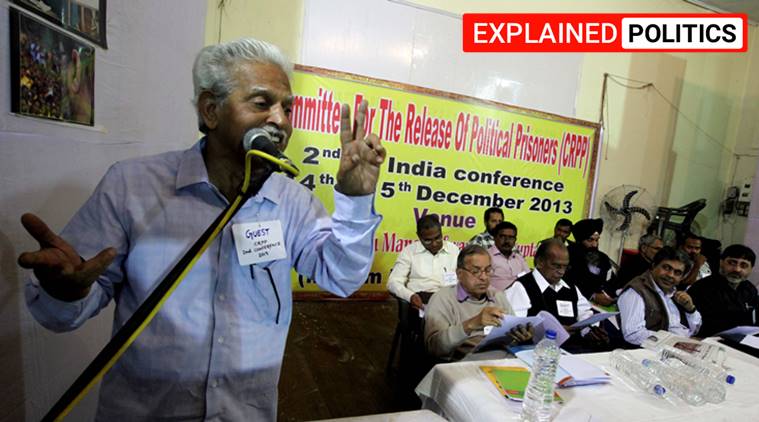 Varavara Rao addresses a conference on Committee for Release of Political Prisoners (CRPP) in Kolkata, 2013. (File/Express Photo)
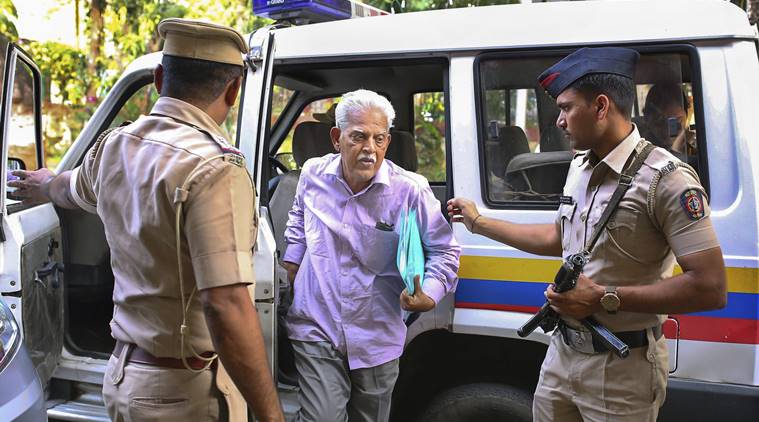 Repeated bail appeals by Varavara Rao on the ground of his failing health have been rejected in the last 22 months. (PTI Photo)
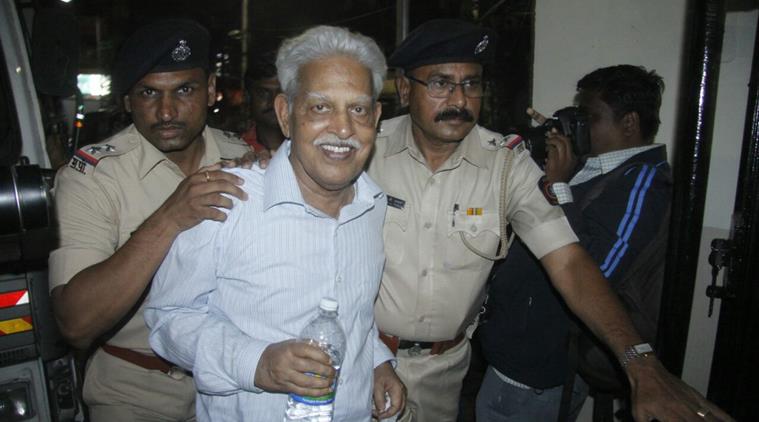 Varavara Rao at Faraskhana police station after court proceedings. (Express Photo)