Advocates scuffle with police outside the High Court in Hyderabad on Monday. (Source: PTI)
At least 200 judges of Telangana went on mass casual leave for 15 days on Tuesday as the agitation demanding cancellation of the provisional list of judicial officers appointed to the Telangana judiciary took a serious turn. There were unprecedented scenes of judges in their robes protesting outside courts — and police took the extraordinary step of physically lifting and taking away some protesting judges from outside the High Court in Hyderabad. Acting Chief Justice Dilip P Bhosale has taken a strong view of the behaviour of the protesters, and 11 district, senior civil and junior civil judges have been suspended.
So, why are the judges angry?
Telangana judges want 130 judges appointed recently to courts in Telangana to be recalled. These judges belong to Andhra Pradesh and their appointment is, therefore, against the rules stated in the AP Reorganisation Act, 2014, the protesting judges say. According to the judges, the High Court, while posting these 130 judicial officers who had opted to work in Telangana, to Telangana, had failed to follow the 40:60 allocation guideline between Telangana and Andhra, as laid down by the 2014 reorganisation Act. The Telangana Judicial Officers’ Association even alleges that the 18 judges from AP in the High Court influenced the decision. Only 3 of the 21 judges in the High Court are from Telangana.
[related-post]
Watch Video: What’s making news
But is there a larger issue?
Yes. The state has been bifurcated and the new state of Telangana has been created, but the High Court has not been divided. Which means judicial officers can be posted anywhere in AP or Telangana. According to Telangana judges, the HC should have informed the Department of Personnel and Training (DoPT) while posting judges in order to ensure they were posted in accordance with where they came from. “HC should have communicated with DoPT and the union Law Minister instead of arbitrarily posting people from AP in the Telangana judiciary,” one of the suspended judges said on Tuesday.
How many judges are we talking about?
In recent weeks, at least 900 judicial officers of various courts in united AP have been distributed among the two new states. As per a provisional list of allotment of judges to lower courts issued in the first week of May, 335 judicial officers were allotted to Telangana, 495 to AP. However, at least 130 of the 335 judges given to Telangana belong to AP, according to the Telangana Judicial Officers’ Association. According to the Association, the 234 district judges currently serving in the two states should have been divided in the 40:60 ratio. “Accordingly, 94 judges should have been allotted to Telangana and 140 to AP. However, the HC gave only 84 district judges to AP and left 46 vacancies, while appointing 102 district judges instead of 94 to Telangana. And of these 102, 72 judges are from AP and only 30 are from Telangana,” a protesting judicial officer said.
What is likely to happen now?
Says the president of the Telangana Advocates’ Joint Action Committee T Sriranga Rao: “It has been more than two years now that we have had a separate state, but we are still without a High Court. The Centre had advised the Chief Ministers of Telangana and Andhra Pradesh to discuss and allocate separate buildings for establishing separate High Courts but while Telangana is ready to allocate a separate building for the AP High Court, Andhra Pradesh Chief Minister N Chandrababu Naidu has not made any move yet.” Officials in AP said space for an HC has been marked in Amaravati where the new capital is being built, and that it would be established soon.
T Sriranga Rao and others have met union Law Minister D V Sadananda Gowda and Secretary (Personnel) DoPT Sanjay Kothari to discuss the issue. Gowda has assured the delegation that he would speak with Acting Chief Justice Dilip P Bhosale to sort out the issue.


 4 min read


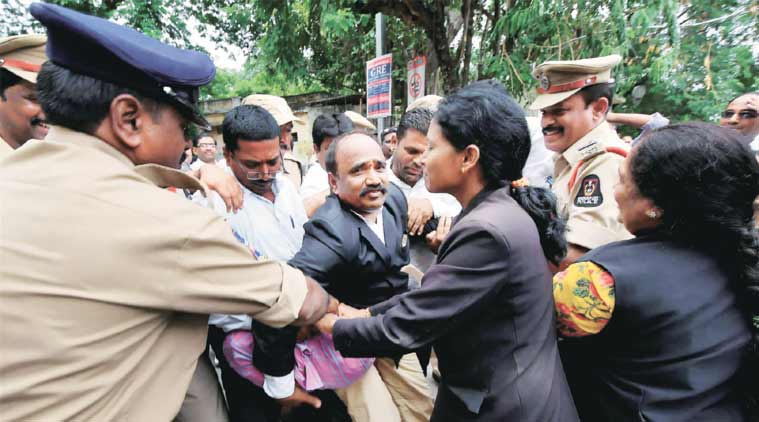 Advocates scuffle with police outside the High Court in Hyderabad on Monday. (Source: PTI)