8 min read


© The Indian Express Pvt Ltd



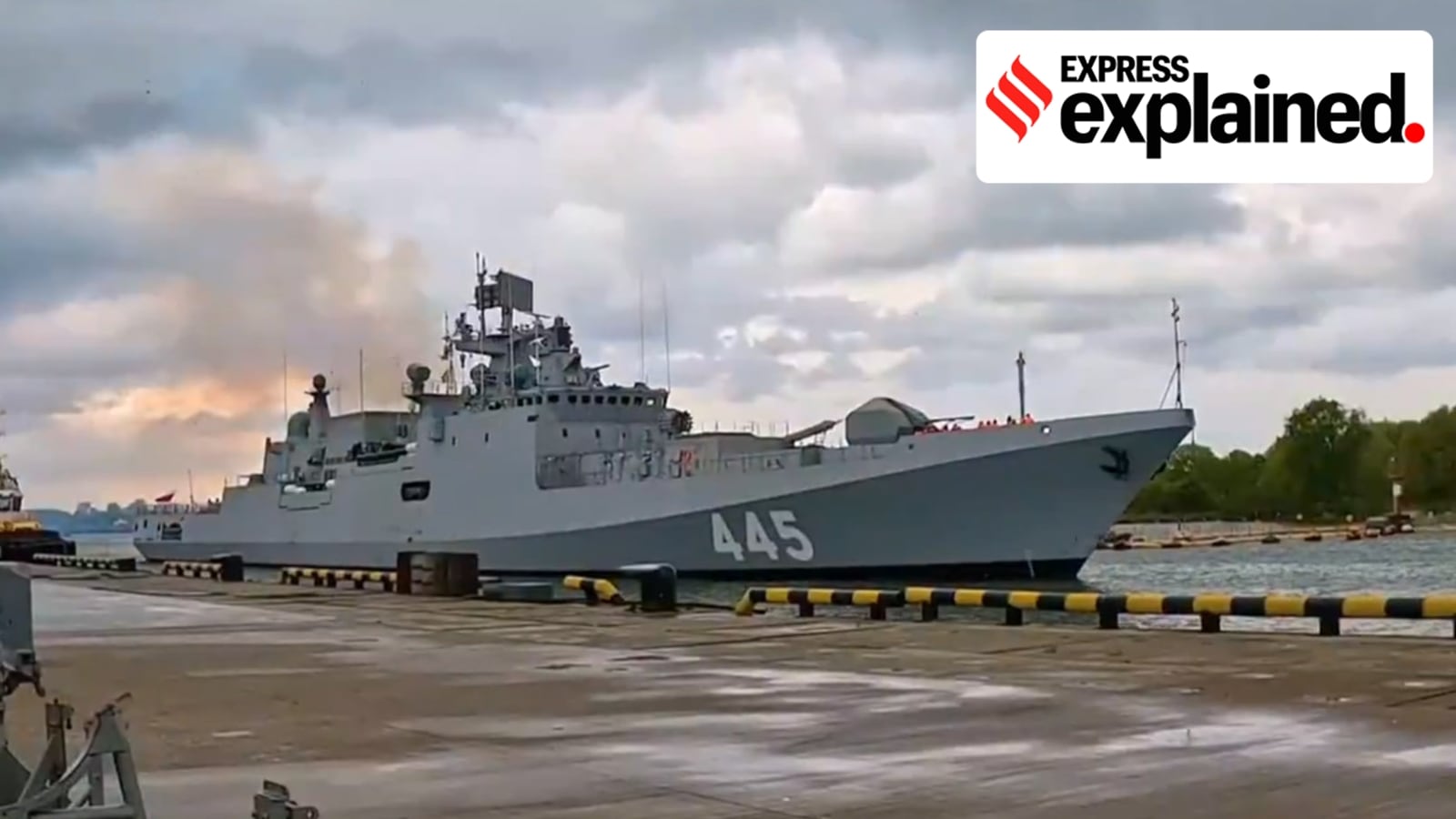 INS Tamal in Kaliningrad during trials. (Image: Screengrab from video/ X/ @indiannavy)
With the commissioning of INS Tamal at the Yantar Shipyard in Kaliningrad, Russia, on Tuesday (July 1), the Indian Navy has likely inducted its last foreign-built warship.
This is a major milestone for the Navy, which has, over the years, progressively indigenised shipbuilding, increasing bit by bit the indigenous content in warships, as well as designing them in India.
INS Tamal is the eighth Talwar-class frigate — these are improved versions of the Krivak III-class frigates — built by Russia for the Indian Navy as a part of Project 1135.6.
It is also the second of four additional follow-on ships of the class that were ordered in 2018. The first, INS Tushil, was commissioned in Kaliningrad in December last year. The final two, Triput and Tavasya, are being built in India by the Goa Shipyard Limited with transfer of technology and design assistance from Russia. Triput, which was launched into sea last July and is expected to be commissioned in 2026, will be India’s first indigenously built Talwar-class frigate.
This is the story of INS Tamal, and the Indian Navy’s journey towards indigenisation.
INS Tamal is a multirole frigate with a displacement of 4,035 long tonnes (1 long tonne = 1,016 kg) at full load, a length of 124.8 m, and a beam (width at its widest point) of 15.2 m. It has a maximum speed of 30 knots (56 km/h), and a range of upto 4,850 nautical miles (8,980 km). The ship will be manned by a crew of 250 sailors and 26 officers.
The Navy describes INS Tamal as a “formidable moving fortress at sea”, and says that it is capable of carrying out blue water operations in all four dimensions of modern naval warfare — air, surface, underwater and electromagnetic.
AIR: INS Tamal carries two kinds of anti-aircraft missiles — 24 vertically-launched Shtil surface-to-air missiles with a range of upto 70 km, and eight short-range Igla missiles. At close range, incoming aircraft and missiles can also be fended off by the ship’s two AK-630s: fully-automated 30 mm rotary cannons that can fire more than 5,000 rounds per minute.
SURFACE: INS Tamal’s anti-ship/ land attack capabilities are centred around the BrahMos supersonic cruise missile. The ship carries a complement of eight such missiles which boast an operational range in the hundreds of kilometres, and can fly at speeds of upto Mach 3 (3,700 km/h). The frigate also has one 100 mm A-190E main gun: this can fire 25 kg shells to distances of more than 20 km.
UNDERWATER: For anti-submarine warfare (ASW), INS Tamal has a RBU ASW rocket-launcher, which can fire salvos of upto 12 rockets equipped with depth charges at a time. The frigate also has two 533 mm torpedo tubes, capable of launching heavyweight torpedoes.
EW: INS Tamal boasts a complement of advanced electronic warfare (EW) suite and advanced Electro-Optical/Infra-Red systems, which act as ears and eyes of the platform. EW suite includes decoy launching systems which disrupt enemy radar, and jammers.
The warship can also accommodate the upgraded Anti-submarine and Airborne Early Warning helicopters, the Kamov 28 and Kamov 31, which, according to the Navy, act as “major force multipliers”.
The Navy had previously stated that INS Tamal’s design provides it with enhanced stealth features and greater stability characteristics, and that it is equipped with complex automated systems for nuclear, biological and chemical defence, including damage control and firefighting that can be operated centrally from sheltered posts.
“These complex systems aid in minimising casualties, achieve rapid restoration of combat effectiveness, enhancing combat capability and survivability,” the Navy had said.
INS Tamal will soon set sail for its home port in Karwar, Karnataka.
Towards indigenisation
The Navy has said that INS Tamal will be the last imported warship to be inducted into its fleet. This is the culmination of a decades-long push towards indigenisation of naval shipbuilding, and a major milestone in the road to aatmanirbharta (self-reliance) in defence.
In the early years after Independence, India neither had the know-how to build its own ships, nor the resources to develop this capability. It was thus compelled to acquire frigates and destroyers from other countries, mostly the UK and the erstwhile USSR.
Nonetheless, even at that time, the Navy understood the importance of indigenous shipbuilding, and took continuous steps to make this a reality. INS Ajay, a small patrol vessel commissioned in 1960, was the first indigenously-built ship in India.
Leander-class frigates started being produced in Mazagon Docks with British collaboration in the late 1960s. But at this time, the indigenous content of these ships (that is, the components and materials which were actually produced in India rather than imported and simply assembled) remained minimal.
For instance, Leander-class frigates of the 1970s had just 15% indigenous content. This would steadily increase over the years. Kolkata-class destroyers produced in the 2000s boasted 59% indigenous content, while the latest Vishakhapatnam and Nilgiri classes are more than 75% indigenous.
The Navy also made efforts to design ships in India. It set up the Central Design Office (CDO) in 1964, which eventually grew to be the Directorate of Naval Design (DND) in 1970. By the 1990s, this was designing aircraft carriers, submarines, and guided missile destroyers.
The Directorate of Indigenisation was established at the naval headquarters in New Delhi in 2005. This was followed by the creation of indigenous development field units at Mumbai and Visakhapatnam in March 2010.
The Navy’s way forward
Today, the majority of the Navy’s warships are built indigenously, using more than 75% indigenous components. Several Indian shipyards, both public-sector and privately held, build ships for the Navy.
In the seventh and latest volume of the Naval History Project, titled A Decade of Transformation: The Indian Navy 2011-21, Captain M Doraibabu and Commander Amrut Dilip Godbole write about the steady growth in India’s shipbuilding capabilities.
They wrote that during 2001–11, the Navy added 57,000 tonnes and 33 ships to its inventory. This grew to 92,000 tonnes and 40 ships from 2011-21, mostly from indigenous sources. Of the 39 ships built for the Navy in 2011-21, 33 were built in Indian shipyards, and of the 39 ships on order as of 2021, 37 are being built in India — the two exceptions being INS Tushil, which was commissioned last year, and Tamal.
Even these two frigates built in Russia have a sizable indigenous component — INS Tamal is built with 26% indigenous components. Between June and December this year, the Navy is set to commission 9-10 warships. It is learnt that several more will be commissioned over the next four to five years.
All of these will be built in India.
|
FRIGATE: short history of a multirole naval vessel * During Europe’s Age of Sail, the term “frigate” was used to describe fully-rigged ships (with three or more masts) built primarily for speed and manoeuverability, and intended to be used in scouting, escort, and patrol roles. Story continues below this ad While designs varied, these ships were smaller than ships of the line, the mainstays of naval battle in this era, and typically had only one gun deck. * The term fell out of use as warships without sails appeared on the scene in the second half of the 19th century. Naval tactics evolved, and frigates were effectively replaced by “cruisers” with different levels of armour and armament. * Frigates re-entered the naval lexicon during World War II. The Royal Navy used the term to describe vessels that were larger than corvettes but smaller than destroyers. They were primarily used as anti-submarine escort vessels: protecting Allied mercantile ships from German u-boat attacks in the Atlantic. Apart from their names, these modern frigates did not share much in common with models from past centuries. Story continues below this ad * The post-War development of missile technology made it possible for relatively small ships to pack tremendous firepower, further spurring the return of frigates to navies around the world. * Today, frigates are primarily meant to serve as platforms for guided missile systems. They can serve in a variety of roles, from anti-submarine, anti-ship, and anti-aircraft warfare to land attacks, and can fight either solo or as part of a larger naval formation. |