Premium
This is an archive article published on February 3, 2022

Philosopher-saint Ramanujacharya, and the Statue of Equality in his honour

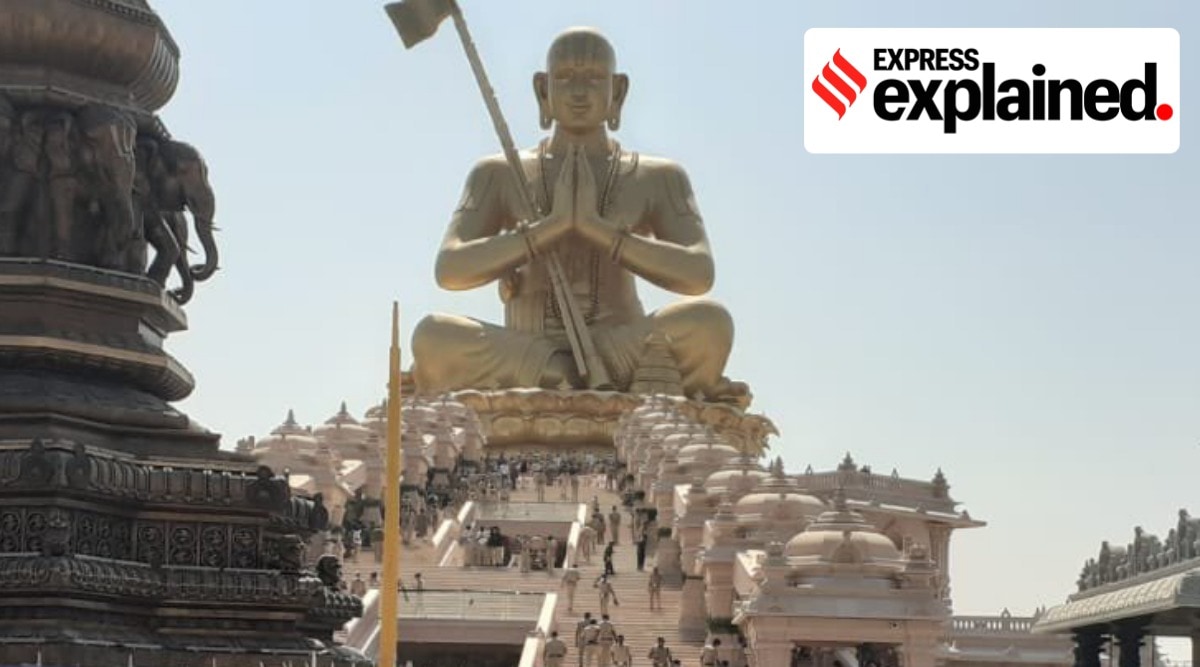
Prime Minister Narendra Modi will inaugurate the Statue of Equality, a gigantic statue of Ramanujacharya, on February 5 on the outskirts of Hyderabad. Who was Ramanujacharya? Why is it called the Statue of Equality?

The Statue of Equality at Muchintal, Hyderabad (Twitter/@mb_telangana)The Statue of Equality at Muchintal, Hyderabad (Twitter/@mb_telangana)

Prime Minister Narendra Modi will inaugurate the Statue of Equality, a gigantic statue of Ramanujacharya, on February 5 on the outskirts of Hyderabad.

Who was Ramanujacharya?

Born in 1017 in Sriperumbudur in Tamil Nadu, Ramanujacharya is revered as a Vedic philosopher and social reformer. He travelled across India, advocating equality and social justice.

Ramanuja revived the Bhakti movement, and his preachings inspired other Bhakti schools of thought. He is considered to be the inspiration for poets like Annamacharya, Bhakt Ramdas, Thyagaraja, Kabir, and Meerabai.

From the time he was a young budding philosopher, Ramanuja appealed for the protection of nature and its resources like air, water, and soil. He went on to write nine scriptures known as the navaratnas, and composed numerous commentaries on Vedic scriptures.

Ramanuja is also credited with establishing the correct procedures for rituals performed in temples throughout India, the most famous being Tirumala and Srirangam.

Why is it called the Statue of Equality?

Ramanuja was an advocate of social equality among all sections of people centuries ago, and encouraged temples to open their doors to everyone irrespective of caste or position in society at a time when people of many castes were forbidden from entering them.

He took education to those who were deprived of it. His greatest contribution is the propagation of the concept of “vasudhaiva kutumbakam”, which translates as “all the universe is one family”.

Story continues below this ad

He travelled across India for several decades, propagating his ideas of social equality and universal brotherhood from temple podiums. He embraced the socially marginalised and condemned, and asked royal courts to treat them as equals. He spoke of universal salvation through devotion to God, compassion, humility, equality, and mutual respect, which is known as Sri Vaishnavam Sampradaya.

According to Chinna Jeeyar Swami, the Vaishnava seer behind the Statue of Equality, Ramanujacharya’s social philosophy was designed to cross the boundaries of the caste system and to embrace the whole of humanity.

“Ramanujacharya liberated millions from social, cultural, gender, educational, and economic discrimination with the foundational conviction that every human is equal regardless of nationality, gender, race, caste, or creed. We are celebrating his 1,000th birth anniversary as the ‘Festival of Equality’, upholding the view that the world is one family, ‘vasudhaiva kutumbakam’,” Chinna Jeeyar has said.

Where is the statue located?

The 216-foot-tall statue, which was first proposed in 2018, is located at the 45-acre scenic Jeeyar Integrated Vedic Academy (JIVA) at Muchintal near Shamshabad on the outskirts of Hyderabad.

Story continues below this ad

The statue was proposed and designed by Chinna Jeeyar. The rituals for the dedication of the statue started on Wednesday (February 2) with over 5,000 Vedic scholars performing a maha yajna that is said to be the world’s largest of its kind in modern times.

Newsletter | Click to get the day’s best explainers in your inbox

Sreenivas Janyala is a Deputy Associate Editor at The Indian Express, where he serves as one of the most authoritative voices on the socio-political and economic landscape of Telangana and Andhra Pradesh. With a career spanning over two decades in mainstream journalism, he provides deep-dive analysis and frontline reporting on the intricate dynamics of South Indian governance. Expertise and Experience Regional Specialization: Based in Hyderabad, Sreenivas has spent more than 20 years documenting the evolution of the Telugu-speaking states. His reporting was foundational during the historic Telangana statehood movement and continues to track the post-bifurcation development of both Telangana and Andhra Pradesh. Key Coverage Beats: His extensive portfolio covers a vast spectrum of critical issues: High-Stakes Politics: Comprehensive tracking of regional powerhouses (BRS, TDP, YSRCP, and Congress), electoral shifts, and the political careers of figures like K. Chandrashekar Rao, Chandrababu Naidu, and Jagan Mohan Reddy. Internal Security & Conflict: Authoritative reporting on Left-Wing Extremism (LWE), the decline of the Maoist movement in former hotbeds, and intelligence-led investigations into regional security modules. Governance & Infrastructure: Detailed analysis of massive irrigation projects (like Kaleshwaram and Polavaram), capital city developments (Amaravati), and the implementation of state welfare schemes. Crisis & Health Reporting: Led the publication's ground-level coverage of the Covid-19 pandemic in South India and major industrial incidents, such as the Vizag gas leak. Analytical Depth: Beyond daily news, Sreenivas is known for his "Explained" pieces that demystify complex regional disputes, such as river water sharing and judicial allocations between the sister states. ... Read More


 

Latest Comment
Post Comment
Read Comments
Advertisement
Advertisement
Advertisement
Advertisement