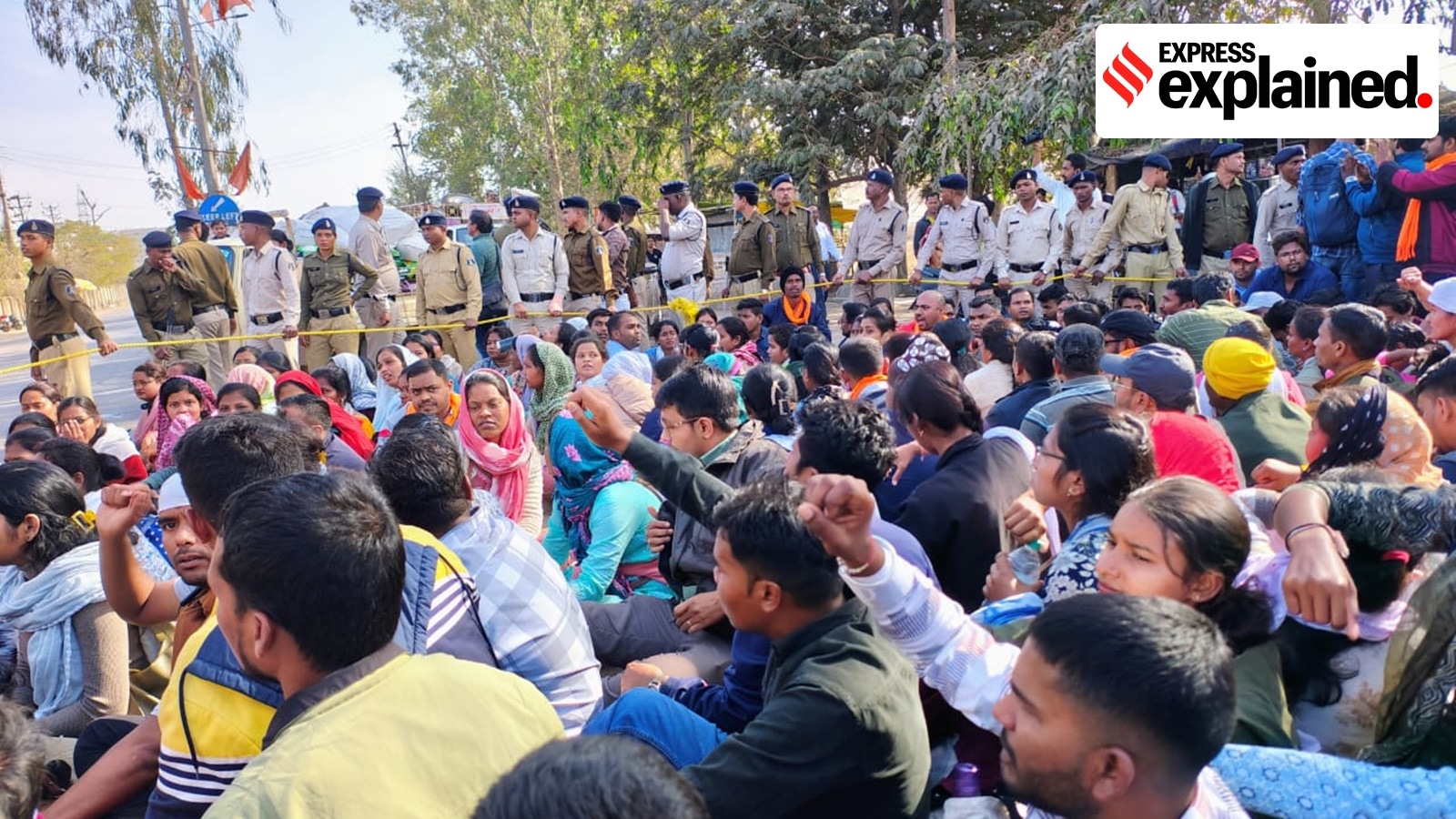
The teachers have been protesting as they are about to lose their jobs following order orders. On Thursday, Former Chief Minister Bhupesh Baghel spoke in their support. “This government is not able to provide new jobs, but is snatching existing jobs. The government has fired 2,897 people working in the education department, 70% of them are from the Scheduled Tribes,” Baghel posted on X.

The agitation has intensified over the past fortnight, with hundreds of B.E.d.-qualified teachers marking their protest in Raipur by cleaning streets, donating blood, men tonsuring their heads and women cutting their hair, going into the Sendh lake for a ‘Jal Samadhi satyagraha’, and forming a human chain to spell out the word ‘samayojan (adjustment)’.
On Wednesday, a group of teachers sat outside the BJP office, appealing to the government to give them other vacant posts in the education department. When the police allegedly asked them to go to New Raipur where a ground “has been designated for protests”, the teachers blocked a road.
A senior police officer said their arrest was preventive and no FIR was registered.
Why are teachers in Chhattisgarh protesting?
The latest trigger is a High Court ruling in a contempt case in December 2024.
Essentially, rulings by the Supreme Court and the Chhattisgarh High Court will logically lead to the termination of 2,855 teachers of Classes 1 to 5.
Story continues below this ad
These teachers have B.Ed degrees, while the Supreme Court has held that the eligibility criterion to teach in primary schools should be Diploma in Elementary Education (D.El.Ed).
The genesis of this issue was a notification passed on June 28, 2018 by the National Council for Teacher Education (NCTE), a statutory body. The notification held B.Ed degree-holders eligible for appointment as primary school teachers.
Based on this notification, Chhattisgarh School Education Services (Educational and Administrative Cadre) Recruitment and Promotion Rules 2019 included B.Ed. Degree as a qualification for the post of Assistant Teacher under the state government.
However, on January 11, 2021, an advertisement in Rajasthan for the Rajasthan Teacher Eligibility Test excluded B.Ed degree holders. This prompted one Devesh Sharma, a B.Ed degree holder, to move the Rajasthan High Court.
Story continues below this ad
On the other hand, candidates with D.El.Ed also approached the Rajasthan High Court, aggrieved by the inclusion of B.Ed holders.
On November 25, 2021, the Rajasthan High Court quashed the 2018 NCTE notification. The matter went to the Supreme Court, and on August 11, 2023, the top court upheld the Rajasthan High Court order.
The verdict said, “A teacher must be trained to teach students at “primary level”, and this is precisely what the training of Diploma in elementary education (D.El.Ed.) does… B.Ed. is not a ‘higher qualification’, or a better qualification, as is being canvassed in its favour, while comparing it with ‘Diploma in elementary education’. B.Ed. is a different qualification; a different training. Even assuming it is a higher qualification, it would still not be a suitable qualification for primary level of classes.”
However, the SC said teachers appointed prior to this judgement were not to be disturbed. On the same issue, the court on April 8, 2024 in an order clarified, “We make it clear that this benefit is only for the candidates who were appointed prior to the date our judgment delivered on 11th August, 2023. Mere selection of such candidates or their participation in the process will not entitle them for a benefit under our present order.”
So what happened in Chhattisgarh?
Story continues below this ad
On May 4, 2023, the Chhattisgarh government advertised jobs of primary school teachers in which B.Ed holders were allowed to participate. A month later, on June 10, 2023, examinations were conducted and a merit list released on July 2, 2023.
In the meantime, the SC ruling came on August 11 of the same year. Based on this judgement, the D.El.Ed candidates who could not make it to the merit list went to the Chhattisgarh High Court.
In the same month, the Chhattisgarh High Court stopped the counselling sessions of B.Ed holders, but the latter approached the Supreme Court and got interim relief, which the SC said would be subject to the final judgement of the Chhattisgarh High Court.
From September 2023, these B.E.d-qualified teachers were given appointment letters by the then Congress government, months ahead of the Assembly elections in November.
Story continues below this ad
The Chhattisgarh HC gave its final verdict on April 2, 2024, which went against the B.Ed holders. The teachers then rushed to the Supreme Court, which upheld the HC verdict on August 28 of the same year.
Then in December, the High Court, in a contempt case for not implementing its order, told the Chhattisgarh government it had “two weeks” to rearrange the selection list of candidates. The court warned of “serious action” if its order was not implemented. The next court hearing in the matter is on January 14.
What are the protesting teachers saying?
The teachers have approached the Supreme Court again with a review petition. Vikas Mishra, one of the teachers leading the protests, said, “How are we at fault? Many left private jobs for this post. Several have lost out on other government jobs to choose this. Many have taken loans and got married thanks to the government job. We earnestly request the government to adjust us in similar posts for teachers. The government can do this as several thousands of jobs in the education department are vacant and we are qualified for them.”
How have the BJP, Congress reacted?
BJP spokesperson Kedar Gupta told The Indian Express, “This issue has been created due to the mistakes made by the Bhupesh Baghel government, and the BJP government is trying its best to resolve it.”
Story continues below this ad
Hitting back at Gupta, Sushil Anand Shukla, communications head for the Congress in the state, said, “If the Congress government made mistakes, then the BJP must clarify why they proceeded with two counselling sessions for these teachers. There are many vacant posts in the education department and these teachers can easily be absorbed, but the BJP just wants to play politics.”


 6 min read