6 min read





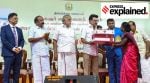
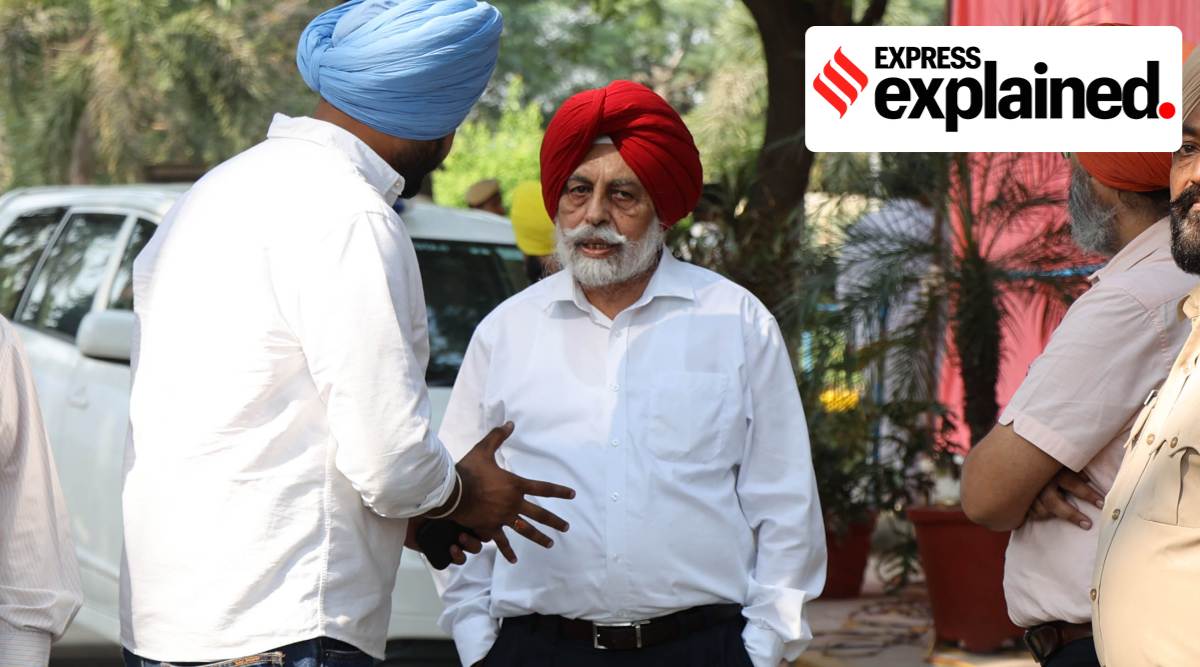 VC PAU Dr Satbir Singh Gosal comes out after Chief Minister Bhagwant Mann's function at the inauguration of the newly-built Milk Processing and Butter Plant at Verka Milk Plant in Ludhiana on Wednesday. (Express Photo: Gurmeet Singh)
In yet another confrontation between the Raj Bhavan and the AAP-led state government in Punjab, Governor Banwarilal Purohit has objected to the appointment of Punjab Agricultural University’s (PAU) Vice-Chancellor.
In a letter to Chief Minister Bhagwant Mann on Tuesday (October 18), Governor Purohit has termed as “illegal” the appointment of biotechnologist Dr Satbir Singh Gosal to the post of V-C. Asking for the V-C’s “immediate removal”, the Governor has claimed the appointment was done “without following UGC norms” and without approval from the Chancellor (the Governor is the ex officio Chancellor of PAU).
The Indian Express explains the rules that govern PAU, Punjab’s only state university for farmer welfare and a premiere institution known for its agricultural research.
When was the PAU established? What is the Act of Parliament that governs it?
Punjab Agricultural University (PAU), with its campus in Ludhiana, was established in 1961 under the Punjab Agricultural University Act, passed by the state legislature, which received the assent of the Governor on October 13, 1961. Its campus was inaugurated by then Prime Minister Pandit Jawahar Lal Nehru on July 8, 1963.
However, during the reorganisation of Punjab after Haryana was carved out as a separate state, an ordinance was promulgated for the establishment of two independent universities for both states. This ordinance was subsequently replaced by an Act of Parliament —“The Haryana and Punjab Agricultural Universities Act, 1970”— which currently governs the PAU.
The roots of the university lie in its College of Agriculture, the oldest and the largest of the four constituent colleges of PAU. The college was originally established in 1906 as Punjab Agricultural College and Research Institute, Lyallpur (now Faisalabad, Pakistan), and was shifted to Ludhiana after Partition.
The Board of Management
According to the Act, the Governor of Punjab is the Chancellor of the university and the honorary chairman of the board. However, it is the V-C who is the chief executive of the university and working chairman of the board. The 14-member board of management also includes the Punjab chief secretary and secretaries from the agriculture and finance departments as its members.
The Act empowers the Board of Management to take policy decisions, make appointments and control finances and assets of the university. However, if the board fails to reach a unanimous decision to appoint the V-C within two months after the post falls vacant, the Chancellor has to intervene and make the appointment.
What does the Act say on V-C appointment?
The Act has empowered the Board of Management to appoint the Vice-Chancellor, as per the section 14 (j).
The section 15 of the Act, specifying the rules for the appointment of the V-C, says that if the board members fail to reach a unanimous decision with regard to the selection of a name, then the intervention of the Chancellor (the Governor) has to be sought and he has to make the appointment.
As per chapter III of the statues of the university on appointment of the V-C, derived from the Act, it says: “..The Board may either take up the matter on its own or elect a screening committee of three persons… the committee shall recommend at least three names to the Board in order of preference… The Board may arrange for informal or formal interviews with one or more prospective appointees and make the final selection…”
Gosal’s appointment
The post of PAU V-C had fallen vacant after the tenure of Dr Baldev Singh Dhillon ended on June 30, 2021– during the previous Congress government.
However, a regular V-C was not appointed for more than a year and additional charge as the acting V-Cs was given to three senior bureaucrats —- IAS officers Anirudh Tewari (July-October 2021), DK Tiwari (October 2021-May 2022) and Sarvjit Singh (May-August 2022). Till August 18 this year, Sarvjit Singh, additional chief secretary, agriculture, was the acting V-C of the university.
Five months after the AAP government took over, CM Mann on August 19 announced Gosal’s appointment as the new V-C.
What Punjab govt is saying
A senior official from Punjab said that the Governor’s objection to the appointment was “just politics”.
“After Dhillon’s tenure got over, three IAS officers were appointed as acting VCs with due approval of the Governor. Thereafter a panel of three names was shortlisted for the appointment of a regular V-C. Other than Dr Gosal, two other eminent scientists on the panel were — Dr Lakhwinder Singh Randhawa, a cotton breeder, and Dr Navtej Bains, a wheat scientist. However, the board of management unanimously agreed on Gosal’s name. As per the Act, we had to ask the Chancellor to intervene if the board failed to reach a unanimous decision but that wasn’t the case…,” said the official.
Do UGC rules apply to PAU?
No, said Kirpal Singh Aulakh, former vice-chancellor, PAU, as the varsity is “an autonomous body with its own Act and board of management.”
“As per the Act passed by the Parliament in 1970 regarding agricultural universities of Punjab and Haryana, the Board of Management is fully empowered to appoint the Vice-Chancellor. PAU is an autonomous body and governed by its own Act of Parliament, not UGC rules. It is not even directly under the Punjab government as the CM is not a member of its board of management,” said Aulakh.
“UGC applies to higher education institutions, but not agricultural ones. PAU’s parent body is the Indian Council of Agricultural Research (ICAR), Delhi, the highest organization for agricultural education in the country,” said another official.
Dr HS Kingra, president, PAU Teachers Association (PAUTA), said: “After being a headless varsity for 15 months, PAU had finally got a regular V-C with the appointment of academically acclaimed Dr Gosal. The uncertainty again will impact farmers and the agrarian economy of Punjab. Such appointments should not be subjected to political moves.”
Past political controversies
In 1976, late Dr Sukhdev Singh was removed as the V-C of the PAU after alleged political interference by Congress leader Sanjay Gandhi. He remained V-C for just 20 days before being replaced by Dr Amrik Singh Cheema.
Dr Kirpal Singh Aulakh resigned as V-C in 2007, without completing his second term, in protest against the alleged interference by Badals. He had accused former CM Parkash Singh Badal of pressurising him on certain issues.