Premium
This is an archive article published on October 17, 2019

Explained: Why India trails in Global Hunger Index

In Global Hunger Index report, India has the highest percentage of children who suffer from acute undernutrition. On other parameters, where India has improved, the pace has been relatively slow.

Simply Put — Global Hunger index: Why India trails The GHI slots countries on a scale ranging from “low” hunger to “moderate”, “serious”, “alarming”, and “extremely alarming”. India is one of the 47 countries that have “serious” levels of hunger.
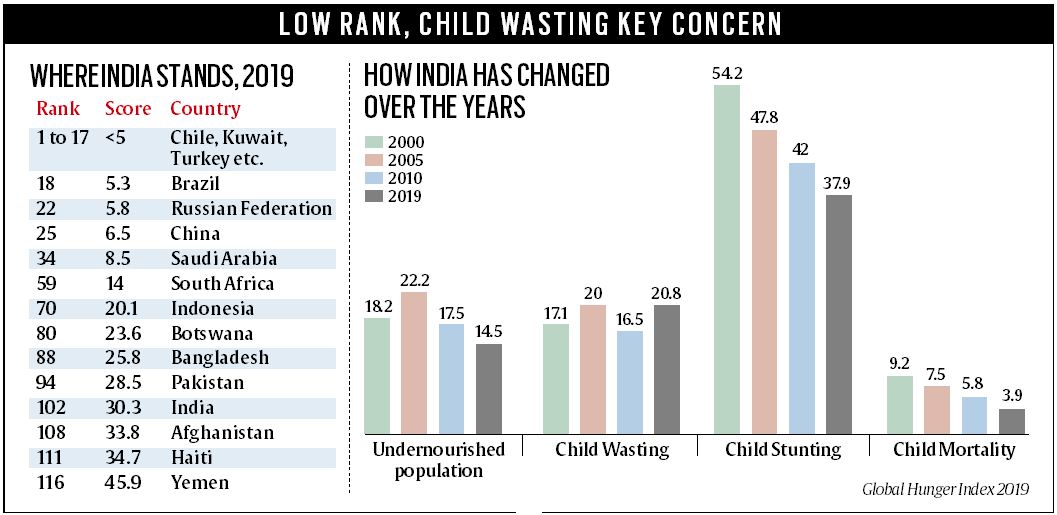
The latest Global Hunger Index (GHI) has ranked India a lowly 102 among the 117 countries it has mapped. In 2018, India was pegged at 103 but last year 119 countries were mapped. So while the rank is one better this year, in reality, India is not better off in comparison to the other countries. The GHI slots countries on a scale ranging from “low” hunger to “moderate”, “serious”, “alarming”, and “extremely alarming”. India is one of the 47 countries that have “serious” levels of hunger.

On the whole, the 2019 GHI report has found that the number of hungry people has risen from 785 million in 2015 to 822 million. It further states that “multiple countries have higher hunger levels now than in 2010, and approximately 45 countries are set to fail to achieve ‘low’ levels of hunger by 2030”.

What is the Global Hunger Index?

The GHI has been brought out almost every year by Welthungerhilfe (lately in partnerships with Concern Worldwide) since 2000; this year’s report is the 14th one. A low score gets a country a higher ranking and implies a better performance.

The reason for mapping hunger is to ensure that the world achieves “Zero Hunger by 2030” — one of the Sustainable Development Goals laid out by the United Nations. It is for this reason that GHI scores are not calculated for certain high-income countries.

While in common parlance hunger is understood in terms of food deprivation, in a formal sense it is calculated by mapping the level of calorie intake.

Source: Global Hunger Index 2019

But the GHI does not limit itself to this narrow definition of hunger. Instead, it tracks the performance of different countries on four key parameters because, taken together, these parameters capture multiple dimensions — such a deficiency of micronutrients — of hunger, thus providing a far more comprehensive measure of hunger.

How does GHI measure hunger?

For each country in the list, the GHI looks at four indicators:

Story continues below this ad

* Undernourishment (which reflects inadequate food availability): calculated by the share of the population that is undernourished (that is, whose caloric intake is insufficient);

* Child Wasting (which reflects acute undernutrition): calculated by the share of children under the age of five who are wasted (that is, those who have low weight for their height);

* Child Stunting (which reflects chronic undernutrition): calculated by the share of children under the age of five who are stunted (that is, those who have low height for their age);

* Child Mortality (which reflects both inadequate nutrition and unhealthy environment): calculated by the mortality rate of children under the age of five (in part, a reflection of the fatal mix of inadequate nutrition.

Story continues below this ad

Each country’s data are standardised on a 100-point scale and a final score is calculated after giving 33.33% weight each to components 1 and 4, and giving 16.66% weight each to components 2 and 3.

Countries scoring less than or equal to 9.9 are slotted in the “low” category of hunger, while those scoring between 20 and 34.9 are in the “serious” category and those scoring above 50 are in the “extremely alarming” category.

What is India’s score relative to those of the others?

Among the BRICS grouping, India is ranked the worst, with China at 25 and a score of just 6.5. Within South Asia, too, India is behind every other country. Sri Lanka, Nepal, Bangladesh and Pakistan (in that order) are all ahead of India.

Some of the other countries ahead of India are Saudi Arabia (rank 34), Venezuela (rank 65, even as its score has doubled from just over 8 to over 16, because of the socio-economic and political crisis), Lesotho (rank 79), Burkina Faso (rank 88), and North Korea (rank 92).

Story continues below this ad

In stark contrast to India, which has the world’s largest democracy and one of the biggest economies, most of the countries below India on the GHI — Afghanistan, Haiti or Yemen etc — are either poorly governed or war-torn or ravaged by natural calamities.

Why is India ranked so low on GHI?

With an overall score of 30.3, India finds itself sandwiched between Niger (score 30.2, rank 101) and Sierra Leone (score 30.4, rank 103). In 2000, India’s score was 38.8 and its hunger level was in the “alarming” category. Since then, India has steadily improved on most counts to reduce its score and is now slotted in th” “serious” category.

But the pace of India’s improvement has been relatively slow. Nothing illustrates this better than the trajectory of Niger and Sierra Leone, which in 2000 had scores of 52.1 and 53.6, respectively, and found themselves in the “extremely alarming” category of hunger — and were much worse off than India.

So, even though India has improved its score, many others have done more and that explains why despite achieving relatively fast economic growth since 2000, India has not been able to make commensurate strides in reducing hunger.

Story continues below this ad

What are the reasons for which India’s improvements have been slow?

For one, notwithstanding the broader improvements, there is one category — Child Wasting, that is, children with low weight for their height — where India has worsened. In other words, the percentage of children under the age of 5 years suffering from wasting has gone up from 16.5 in 2010 to 20.8 now. Wasting is indicative of acute undernutrition and India is the worst among all countries on this parameter.

“India’s child wasting rate is extremely high at 20.8 percent — the highest wasting rate of any country in this report for which data or estimates were available. Its child stunting rate, 37.9 percent, is also categorized as very high in terms of its public health significance… In India, just 9.6 percent of all children between 6 and 23 months of age are fed a minimum acceptable diet,” states the report.

“In 2014 the prime minister instituted the ‘Clean India’ campaign to end open defecation and ensure that all households had latrines. Even with new latrine construction, however, population’s health and consequently children’s growth and development as their ability to absorb nutrients is compromised,” it said.

Udit Misra is Senior Associate Editor at The Indian Express. Misra has reported on the Indian economy and policy landscape for the past two decades. He holds a Master’s degree in Economics from the Delhi School of Economics and is a Chevening South Asia Journalism Fellow from the University of Westminster. Misra is known for explanatory journalism and is a trusted voice among readers not just for simplifying complex economic concepts but also making sense of economic news both in India and abroad. Professional Focus He writes three regular columns for the publication. ExplainSpeaking: A weekly explanatory column that answers the most important questions surrounding the economic and policy developments. GDP (Graphs, Data, Perspectives): Another weekly column that uses interesting charts and data to provide perspective on an issue dominating the news during the week. Book, Line & Thinker: A fortnightly column that for reviewing books, both new and old. Recent Notable Articles (Late 2025) His recent work focuses heavily on the weakening Indian Rupee, the global impact of U.S. economic policy under Donald Trump, and long-term domestic growth projections: Currency and Macroeconomics: "GDP: Anatomy of rupee weakness against the dollar" (Dec 19, 2025) — Investigating why the Rupee remains weak despite India's status as a fast-growing economy. "GDP: Amid the rupee's fall, how investors are shunning the Indian economy" (Dec 5, 2025). "Nobel Prize in Economic Sciences 2025: How the winners explained economic growth" (Oct 13, 2025). Global Geopolitics and Trade: "Has the US already lost to China? Trump's policies and the shifting global order" (Dec 8, 2025). "The Great Sanctions Hack: Why economic sanctions don't work the way we expect" (Nov 23, 2025) — Based on former RBI Governor Urjit Patel's new book. "ExplainSpeaking: How Trump's tariffs have run into an affordability crisis" (Nov 20, 2025). Domestic Policy and Data: "GDP: New labour codes and opportunity for India's weakest states" (Nov 28, 2025). "ExplainSpeaking | Piyush Goyal says India will be a $30 trillion economy in 25 years: Decoding the projections" (Oct 30, 2025) — A critical look at the feasibility of high-growth targets. "GDP: Examining latest GST collections, and where different states stand" (Nov 7, 2025). International Economic Comparisons: "GDP: What ails Germany, world's third-largest economy, and how it could grow" (Nov 14, 2025). "On the loss of Europe's competitive edge" (Oct 17, 2025). Signature Style Udit Misra is known his calm, data-driven, explanation-first economics journalism. He avoids ideological posturing, and writes with the aim of raising the standard of public discourse by providing readers with clarity and understanding of the ground realities. You can follow him on X (formerly Twitter) at @ieuditmisra           ... Read More


Latest Comment
Post Comment
Read Comments
Advertisement
Advertisement
Advertisement
Advertisement