This is an archive article published on May 11, 2020
ExplainSpeaking: Are Indian labour laws as inflexible (or pro-worker) as is often claimed?
Coronavirus (COVID-19): In the days and weeks ahead, we could see the impact of the summary suspension of labour laws on both job creation and labour welfare.
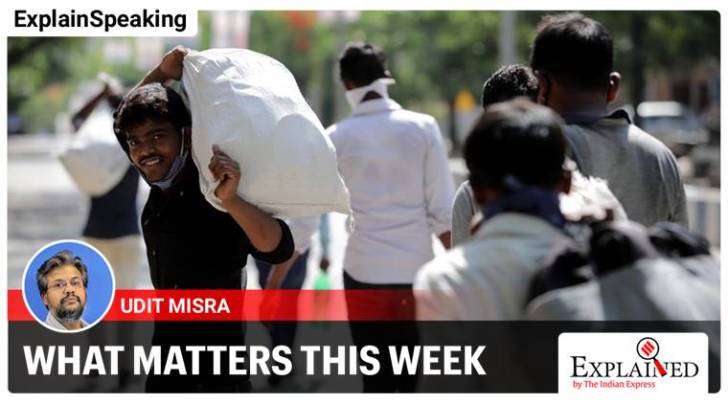
In the days and weeks ahead, we could see the impact of the summary suspension of labour laws on both job creation and labour welfare. (Express photo: Arul Horizon)
Dear Readers,
Last week, three BJP-ruled states announced sweeping changes to the application of labour laws in a bid to kickstart the economy. Some other, non-BJP, states also tweaked labour laws, but those changes were not as big as the ones that Uttar Pradesh in particular unleashed.
These state governments argue that without being constrained by laws of any kind — minimum wages, dispute resolution, health compensations etc. — Indian firms will roar back to health and finally achieve their potential of being world-beaters.
But some questions arise. One, the changes appeared rushed. Take, for example, the UP ordinance which exempted “factories and other manufacturing establishments [from the] application of certain labour laws for a period three years”.
The use of the word “certain” was odd — nowhere did the ordinance state which specific laws were being suspended. Nowhere in the ordinance for example, was there a mention of firms being required, by law, to pay “minimum” wages to workers.
In the days and weeks ahead, we could see the impact of the summary suspension of labour laws on both job creation and labour welfare (wages, exploitation, rights etc.). In that sense, what we are likely to witness is a massive not-so-randomised control trial to test whether (and to what extent) India’s labour laws have been holding back its growth.
Radhicka Kapoor, Senior Fellow at the Indian Council for Research on International Economic Relations, says this notion of “inflexibility” is misplaced. She points to a 2019 paper by Aditya Bhattacharjea, Professor at the Delhi School of Economics, that traces the origins (and the dodgy journey, as it turns out) of the notion that Indian labour laws are “inflexible”.
The story starts in 2004 when Timothy Besley and Robin Burgess created an index to measure the regulatory variations across Indian states. “This measure,” Bhattacharjea says, “was based on state-level amendments to the Industrial Disputes Act (IDA), which is just one out of dozens of Indian labour laws”.
He then goes on to explain the technicalities (read ‘multiple inaccuracies’) of this index as well as the incorrect (read ‘blind’) manner in which this index was repeatedly used by researchers over the years to reinforce the point that Indian labour laws were “inflexible” — “which has distorted the policy implications of their research findings”.
Bhattacharjea concludes: “As in the children’s game of Chinese Whispers, later researchers successively distorted their predecessors’ interpretation of the index, so that eventually it came to be characterised as a measure of the degree of legally-mandated job security, which it was not supposed to be.”
Perhaps our policymakers should get greater clarity on the flexibility or the lack of it in Indian labour laws — after all, this is the fundamental premise on which the labourers of the some of the most populous states are being subjected to work under norms that were considered exploitative even when we were ruled by the British.
Udit Misra is Senior Associate Editor at The Indian Express. Misra has reported on the Indian economy and policy landscape for the past two decades. He holds a Master’s degree in Economics from the Delhi School of Economics and is a Chevening South Asia Journalism Fellow from the University of Westminster.
Misra is known for explanatory journalism and is a trusted voice among readers not just for simplifying complex economic concepts but also making sense of economic news both in India and abroad.
Professional Focus
He writes three regular columns for the publication.
ExplainSpeaking: A weekly explanatory column that answers the most important questions surrounding the economic and policy developments.
GDP (Graphs, Data, Perspectives): Another weekly column that uses interesting charts and data to provide perspective on an issue dominating the news during the week.
Book, Line & Thinker: A fortnightly column that for reviewing books, both new and old.
Recent Notable Articles (Late 2025)
His recent work focuses heavily on the weakening Indian Rupee, the global impact of U.S. economic policy under Donald Trump, and long-term domestic growth projections:
Currency and Macroeconomics:
"GDP: Anatomy of rupee weakness against the dollar" (Dec 19, 2025) — Investigating why the Rupee remains weak despite India's status as a fast-growing economy.
"GDP: Amid the rupee's fall, how investors are shunning the Indian economy" (Dec 5, 2025).
"Nobel Prize in Economic Sciences 2025: How the winners explained economic growth" (Oct 13, 2025).
Global Geopolitics and Trade:
"Has the US already lost to China? Trump's policies and the shifting global order" (Dec 8, 2025).
"The Great Sanctions Hack: Why economic sanctions don't work the way we expect" (Nov 23, 2025) — Based on former RBI Governor Urjit Patel's new book.
"ExplainSpeaking: How Trump's tariffs have run into an affordability crisis" (Nov 20, 2025).
Domestic Policy and Data:
"GDP: New labour codes and opportunity for India's weakest states" (Nov 28, 2025).
"ExplainSpeaking | Piyush Goyal says India will be a $30 trillion economy in 25 years: Decoding the projections" (Oct 30, 2025) — A critical look at the feasibility of high-growth targets.
"GDP: Examining latest GST collections, and where different states stand" (Nov 7, 2025).
International Economic Comparisons:
"GDP: What ails Germany, world's third-largest economy, and how it could grow" (Nov 14, 2025).
"On the loss of Europe's competitive edge" (Oct 17, 2025).
Signature Style
Udit Misra is known his calm, data-driven, explanation-first economics journalism. He avoids ideological posturing, and writes with the aim of raising the standard of public discourse by providing readers with clarity and understanding of the ground realities.
You can follow him on X (formerly Twitter) at @ieuditmisra
... Read More


 4 min read


 In the days and weeks ahead, we could see the impact of the summary suspension of labour laws on both job creation and labour welfare. (Express photo: Arul Horizon)