3 min read
© IE Online Media Services Pvt Ltd



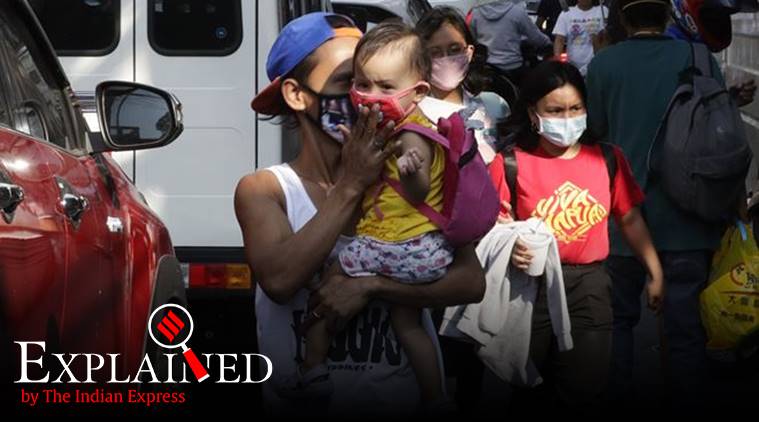 People wear masks in Manila, Philippines, on Thursday amid fears of the novel coronavirus infection spreading. (Photo: AP)
The World Health Organization (WHO) has not yet declared the novel coronavirus infection a Public Health Emergency of International Concern (PHEIC). Instead, the WHO has encouraged “all countries to enhance their surveillance for severe acute respiratory infections (SARI), to carefully review any unusual patterns of SARI or pneumonia cases and to notify WHO of any suspected or confirmed case of infection with novel coronavirus.”
The novel coronavirus (a new strain of coronavirus which has not been previously identified in human beings) is one among a large family of coronaviruses that can cause illnesses ranging from the common cold to the more serious Middle East Respiratory Syndrome (MERS) and the Severe Acute Respiratory Syndrome (SARS).
Also Read | Telling Numbers: Novel coronavirus cases now 4,500, half as many as SARS cases in 2003
The source of the novel coronavirus is not yet known and there is no treatment for it so far.
The infection has killed more than 100 people in China, and according to the WHO’s latest situation report, there are 5,997 confirmed cases of coronavirus in the country and 68 in the rest of the world.
Other countries where confirmed coronavirus cases have been reported include Japan, Vietnam, Singapore, Australia, Thailand, Nepal, Germany, France, the US and Canada.
In India, the first case was reported on Thursday. The person who tested positive is a student at Wuhan University and is currently in isolation at a Kerala hospital.
What criteria does the WHO follow to declare PHEIC?
PHEIC is declared in the event of some “serious public health events” that may endanger international public health.
Under the International Health Regulations (IHR), a public health emergency is defined as “an extraordinary event which is determined, as provided in these Regulations: to constitute a public health risk to other States through the international spread of disease; and to potentially require a coordinated international response”.
The responsibility of declaring an event as an emergency lies with the Director-General of the WHO and requires the convening of a committee of members.
What are the implications of a PHEIC being declared?
In the past decade, WHO has declared public health emergencies for outbreaks including swine flu, polio and Ebola.
There are some implications of declaring a PHEIC for the host country, which in the case of the coronavirus is China. Declaring a PHEIC may lead to restrictions on travel and trade.
However, several countries have already issued advisories to their citizens to avoid traveling to China, while others are airlifting their citizens from it.
Don’t Miss from Explained | How to read the AYUSH ministry advisory on coronavirus infection
A recent report in The New York Times said, “An outbreak originating in China and reaching beyond its borders has summoned fresh fears, sending markets into a wealth-destroying tailspin. It has provoked alarm that the world economy may be in for another shock, offsetting the benefits of the trade truce and the geopolitical easing, and providing new reason for businesses and households to hunker down.”