Premium
This is an archive article published on December 11, 2021

Explained: To roll out Covid-19 booster vaccines, or not to

When protection given by a Covid vaccine course starts to wane, a booster can help maintain immunity levels. But vaccinating the entire population is the priority.

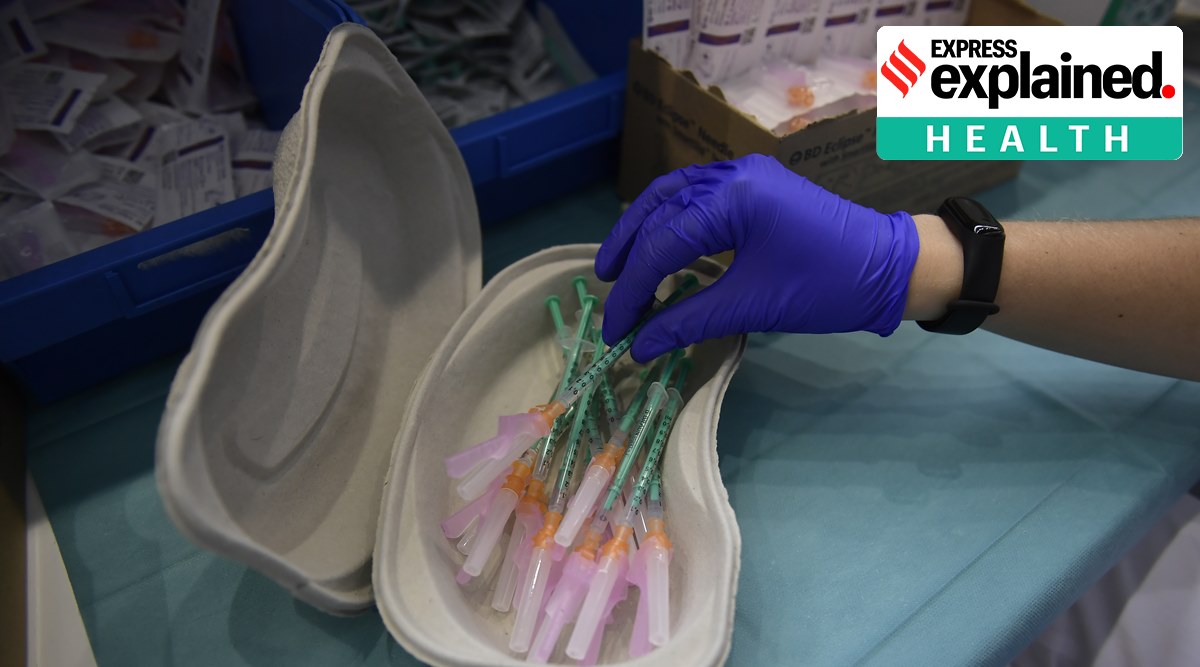
A healthworker prepares shots of a Covid-19 vaccine. (AP Photo/Alvaro Barrientos, File)A healthworker prepares shots of a Covid-19 vaccine. (AP Photo/Alvaro Barrientos, File)

On Friday, the Health Ministry said India is still examining the possibility of administering booster shots of the Covid-19 vaccine, while noting that the World Health Organization (WHO) has not taken a stand on this.

Experts have said boosters will be required for continuing protection from Covid, while stressing that second-dose coverage is of high priority. Some have suggested looking at both options simultaneously — increasing coverage and offering targeted boosters to vulnerable sections.

What is a ‘booster’ dose?

Most Covid vaccines are administered in two doses, with a few given as a single dose. A booster is an additional shot given after the protection provided by the original shot(s) has begun to decrease over time, so that people can maintain their level of immunity for longer.

“How long immunity developed by an infection or a vaccination will last will vary depending upon various factors,” said leading immunologist Dr Vineeta Bal. For example, antibodies decay over time, and even memory T-cells will die after a few years or months.

In the past, boosters were recommended for smallpox prevention every three to five years. Tetanus toxoid boosters are also recommended today for adults and pregnant women after childhood vaccination.

What is the published evidence of waning immunity following Covid vaccination?

In September, a study at ICMR–Regional Medical Research Centre, Bhubaneswar showed a significant drop in antibodies against Covid-19 within four months after complete vaccination.

Another study, on the immune response to mRNA vaccines, was published in Science earlier this year. At six months, it found declining antibody levels, but durable memory B cell and T cell responses. Most of the B cells were able to cross-bind with the Alpha, Beta and Delta variants.

Story continues below this ad

A study in the US showed that antibodies reduce by more than 80% six months after receiving the second dose of the Pfizer-BioNTech mRNA vaccine.

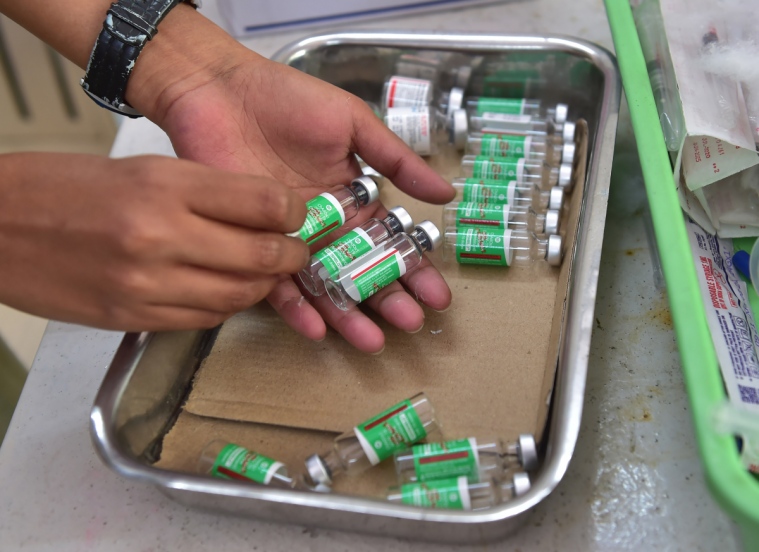
A health worker shows empty vials after administering Covid-19 vaccines to beneficiaries at a government hospital in Bengaluru, Friday, Dec. 10, 2021. (PTI Photo/Shailendra Bhojak)

Have studies been done on the effect of a booster dose?

BioNTech and Pfizer have said a three-shot course was able to neutralise the Omicron variant in a laboratory test; the third dose increased neutralising antibodies by a factor of 25.

A recent study by Indian Council of Medical Research (ICMR) scientists suggested use of booster shots of Covishield to fight emerging variants. The study, posted on bioRxiv and yet to be peer-reviewed, evaluated the neutralising potential of blood samples from people who received two doses of Covishield.

Under what other circumstances can administering a booster be considered?

Breakthrough infections with Delta are associated with high viral loads. If community transmission is high, boosters would help in controlling viral spread, said Dr Sanjay Pujari, member of the ICMR national task force on Covid-19. He noted that daily case counts in Israel have remained low after booster coverage increased.

Story continues below this ad

“In India, where there are no surplus stocks of different vaccines, the policymakers need to take a call whether to aggressively enhance the vaccine coverage and whether booster shots can be given, at least to those who were vaccinated more than six months ago. Particularly those with comorbidities and frontline health workers,” said scientist Dr V S Chauhan.

Experts such as Dr Bal said boosters are not an answer to surges, especially in an outbreak area. In any community, mass vaccination for specific diseases provides a robust way of preventing morbidity. The goal should be vaccination of the entire eligible population with the recommended number of doses, they stressed.

Indian Medical Association president Dr J A Jayalal stressed the need for the Centre to roll out a booster for healthcare and frontline workers and immunocompromised persons. “Immunity is sufficient to face normal infection. Now, with another variant, Omicron, there are reports indicating high transmissibility, and in such an event, it will be healthcare workers who will be most at risk due to increased frequency of exposure. The viral load average immunity will not be sufficient… Firstly, of course, all people in the country should be vaccinated,” he said.

What is the reasoning of some countries in administering boosters?

The US Centers for Disease Control and Prevention (CDC) has recommended booster shots, at least six months after their second dose, for all adults who received a Pfizer-BioNTech or Moderna vaccine. The European CDC has urged citizens to get fully vaccinated and adhere to recommendations on booster vaccination.

Story continues below this ad

In many European countries where vaccinations started almost a year ago, there has been a surge in the pandemic. Armed with vaccine stocks, these countries and the US have rolled out booster shots for the last several months.

Experts pointed out, however, that the situation in the US and Europe is different compared to India. The number of Delta variant-caused cases is increasing in many countries.

Besides, there is some preliminary evidence that immunity mediated by mRNA vaccines (such as those from Pfizer-BioNTech and Moderna) starts waning earlier than that mediated by adenovirus-vector-based vaccines (such as Covishield), especially for T cell response. This was discussed in a letter published In the New England Journal of Medicine last month. “Hence mRNA vaccine recipients might be more in need for boosters earlier than Indians (since 80+% vaccine recipients in India have received Covishield),” Dr Bal said.

Why is the WHO not throwing its weight behind boosters?

According to a WHO statement in October, the degree of waning of immunity and need for booster doses may differ between vaccine products, target populations, circulating SARS-CoV2 virus, in particular variants of concern, and intensity of exposure. Introducing booster doses should be evidence-driven and targeted to groups in greatest need; improving coverage of primary vaccination series should be prioritised over booster vaccination, it said.

Story continues below this ad

What is India’s policy on booster doses?

On Friday, the Health Ministry said two experts bodies are still examining this. About the WHO, Dr V K Paul, head of India’s Covid-19 task force, noted: “They have absolute clarity on the administration of a booster. It is under consideration. It has clearly and emphatically highlighted the need to complete primary vaccination, as the most important priority. Our thinking and the overall picture are also aligned with the same approach to complete the task of vaccinating adults with two doses,” Paul said.

ICMR chief Dr Balram Bhargava also said India is still examining the issue of booster doses. “The data (on antibody response) has shown that vaccines are still effective after nine months to a year. This depends on the type of vaccines,” Bhargava said.

Newsletter | Click to get the day’s best explainers in your inbox

How should we view booster shots in the context of Omicron?

Information on Omicron variant is still emerging. ICMR chief Dr Balram Bhargava said India will soon begin testing of Covaxin and Covishield against Omicron.

Story continues below this ad

Experts said Omricon appears to spread very easily in the unvaccinated population, based on reports from Africa. Whether this will be the case in fully vaccinated people is unclear. Expert accounts from Africa suggest the disease itself is mild, and hospitalisation is mostly not needed. But once again, a lot more data from other places is needed before this can be confirmed as a general trend.

“Israel is an example of how mass booster vaccination have kept their case numbers low. Although some triple vaccinated individuals have tested positive for Omicron, they have had mild symptoms and there has been no rapid spread. However, further long-term data is needed,” leading immunologist Dr Vineeta Bal said.

Anuradha Mascarenhas is a Senior Editor at The Indian Express, based in Pune. With a career spanning three decades, she is one of the most respected voices in Indian journalism regarding healthcare, science and environment and research developments. She also takes a keen interest in covering women's issues . Professional Background Education: A gold medalist in Communication and Journalism from Savitribai Phule Pune University and a Master’s degree in Literature. Author: She authored the biography At The Wheel Of Research, which chronicles the life and work of Dr. Soumya Swaminathan, the former Chief Scientist at the WHO. Key Focus: She combines scientific accuracy with storytelling, translating complex medical research into compelling public and human-interest narratives. Awards and Recognition Anuradha has won several awards including the Press Council of India's national award for excellence in journalism under the gender based reporting category in 2019 and the Laadli Media award (gender sensitivity -2024). A recipient of the Lokmat journalism award (gender category-2022), she was also shortlisted for the RedInk awards for excellence in journalism-2021. Her debut book At The Wheel Of Research, an exclusive biography of Dr Soumya Swaminathan the inaugural chief scientist of World Health Organisation was also nominated in the Popular Choice Category of JK Paper AUTHER awards. She has also secured competitive fellowships including the Laadli Media Fellowship (2022), the Survivors Against TB – New Research in TB Media Fellowship (2023) and is part of the prestigious 2025 India Cohort of the WomenLift Health Leadership Journey.” Recent Notable Articles (Late 2025) 1. Cancer & Specialized Medical Care "Tata Memorial finds way to kill drug-resistant cancer cells" (Nov 26, 2025): Reporting on a breakthrough for triple-negative breast cancer, one of the most aggressive forms of the disease. Discipline, diet and purpose; How a 97-year-old professor defies ageing'' (Nov 15, 2025) Report about Prof Gururaj Mutalik, the first Head of Department at Pune's B J Government Medical College who at 97 credits his longevity to healthy habits and a strong sense of purpose. 2. Environmental Health (The "Breathless Pune" Series) Long-term exposure even to 'moderate' air leads to chronic heart, lung, kidney issues" (Nov 26, 2025): Part of an investigative series highlighting that even "safe" pollution levels are damaging to vital organs. "For every 10 µg/m3 increase in PM2.5 level, there was 6-8% jump in medicine sales" (Nov 23, 2025): Using commercial data to prove the direct link between air quality and respiratory illnesses in Pune. 3. Lifestyle & Wellness News "They didn't let cancer, diabetes and heart disease stop them from travelling" (Dec 22, 2025): A collaborative piece featuring survivors who share practical tips for traveling with chronic conditions. At 17, his BP shot up to 200/120 mmHG; Lancet study flags why child and teen hypertension doubled between 2000 and 2020'' (Nov 12,2025)--A report that focusses on 17-year-old-boy's hypertensive crisis and reflects the rising global trend of high blood pressure among children and adolescents. 4. Scientific Recognition & Infrastructure For promoting sci-comm, gender diversity: IUCAA woman prof highlighted in Nature" (Nov 25, 2025): Covering the global recognition of Indian women scientists in gender studies and physics. Pune researchers find a spiral galaxy like the Milky Way from early universe'' (December 3, 2025)- A report on how Indian researchers discovered a massive galaxy that existed when the universe was just 1.5 billion years old , one of the earliest to have been observed so far. Signature Beat: Health, Science & Women in Leadership Anuradha is known for her COVID-19 reportage, where she was one of the first journalists to provide detailed insights into the Covishield and Covaxin trials. She has a dedicated interest in gender diversity in health and science, often profiling women researchers who are breaking the "leaky pipeline" in STEM fields. Her writing style is scrupulous, often featuring interviews with top-tier scientists and health experts from various institutions.   ... Read More


Latest Comment
Post Comment
Read Comments
Advertisement
Advertisement
Advertisement
Advertisement