India as a ‘developed’ country: where we are, and the challenges ahead, explained
The 'developed country' goal is the first of the five vows that Prime Minister Narendra Modi exhorted Indians to take during his address to the nation on Independence Day. What does being a developed country entail, where does India stand now, and what are the challenges on the road that it faces here onward?
Prime Minister Narendra Modi addresses the nation from the ramparts of the Red Fort on the occasion of the 76th Independence Day, in New Delhi, Aug 15, 2022. (PTI)
In his Independence Day address, Prime Minister Narendra Modi asked Indians to embrace the “Panch Pran” — five vows — by 2047 when the country celebrates 100 years of independence. The first vow, he said, is for India to become a developed country in the next 25 years. It was a “big resolution”, the PM said. What will it take?
Different global bodies and agencies classify countries differently. The ‘World Economic Situation and Prospects’ of the United Nations classifies countries into three broad categories: developed economies, economies in transition, and developing economies. The idea is “to reflect basic economic country conditions”, and the categories “are not strictly aligned with the regional classifications”. So, it isn’t as though all European countries are “developed”, and all Asian ones are “developing”.
You’ve Read Your Free Stories For Now
Sign up and keep reading more stories that matter to you.
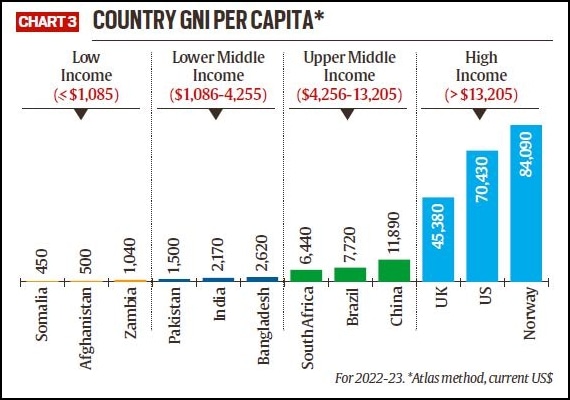
To categorise countries by economic conditions, the United Nations uses the World Bank’s categorisation (chart 3, with selected countries), based on Gross National Income (GNI) per capita (in current US dollars).
Chart 3: Country GNI per capita
But the UN’s nomenclature of “developed” and “developing” is being used less and less, and is often contested. Former US President Donald Trump had criticised the categorisation of China as a “developing” country, which allowed it to enjoy some benefits in the World Trade Organization. If China is a “developing” country, then the US should also be “made” one, Trump had said.
But why is the United Nations classification contested?
It can be argued that the UN classification is not very accurate and, as such, has limited analytical value. Only the top three mentioned in chart 3 alongside — the US, the UK and Norway — fall in the developed country category. There are 31 developed countries according to the UN in all. All the rest — except 17 “economies in transition” — are designated as “developing” countries, even though in terms of proportion, China’s per capita income is closer to Norway’s than Somalia’s. China’s per capita income is 26 times that of Somalia’s while Norway’s is just about seven times that of China’s.
Then there are countries — such as Ukraine, with a per capita GNI of $4,120 (a third of China’s) — that are designated as “economies in transition”.
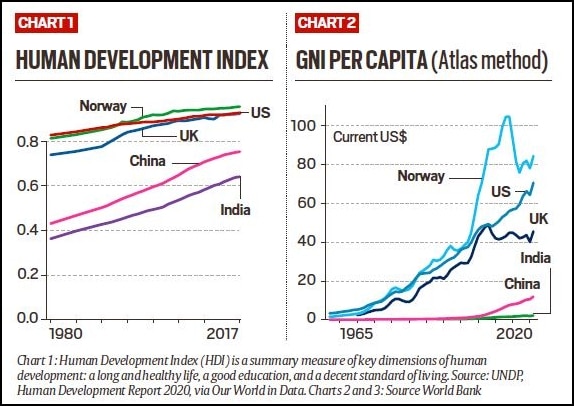
As chart 2 shows, India is currently far behind both the so-called developed countries, as well as some developing countries. Often, the discourse is on the absolute level of GDP (gross domestic product). On that metric, India is one of the biggest economies of the world — even though the US and China remain far ahead.
Chart 1: Human Development Index; Chart 2: GNI per capital
However, to be classified as a “developed” country, the average income of a country’s people matters more. And on per capita income, India is behind even Bangladesh. China’s per capita income is 5.5 times that of India, and the UK’s is almost 33 times.
The disparities in per capita income often show up in the overall quality of life in different countries. A way to map this is to look at the scores of India and other countries on the Human Development Index (HDI), a composite index where the final value is reached by looking at three factors: the health and longevity of citizens, the quality of education they receive, and their standard of life.
India has made a secular improvement on HDI metrics. For instance, the life expectancy at birth (one of the sub-metrics of HDI) in India has gone from around 40 years in 1947 to around 70 years now. India has also taken giant strides in education enrolment at all three levels — primary, secondary, and tertiary.
What is the distance left to cover?
Story continues below this ad
When compared to the developed countries or China, India has a fair distance to cover. A 2018 diagnostic report on India by the World Bank said: “Even though India is the world’s third-largest economy in purchasing power parity (PPP) terms, most Indians are still relatively poor compared to people in other middle income or rich countries. Ten per cent of Indians, at most, have consumption levels above the commonly used threshold of $10 (PPP) per day expenditures for the global middle class.”
Also, “Other metrics, such as the food share of consumption, suggest that even rich households in India would have to see a substantial expansion of their total consumption to reach levels of poor households in rich countries.”
One way to make this assessment is to look at how long other countries took to get there. For instance, in per capita income terms, Norway was at India’s current level 56 years ago — in the year 1966.
Story continues below this ad
Comparing India to China is more useful. China reached that mark in 2007. Theoretically then, if India were to grow as fast as China did between 2007 and 2022, then, broadly speaking, it will take India another 15 years to be where China is now. But then, China’s current per capita income was achieved by the developed countries several decades earlier — the UK in 1987, the US and Norway in 1979.
India’s current HDI score (0.64) is much lower than what any of the developed countries had even in 1980. China reached the 0.64 level in 2004, and took another 13 year to reach the 0.75 level — that, incidentally, is the level at which the UK was in 1980.
The World Bank’s 2018 report had made a mention of what India could achieve by 2047.
“By 2047 — the centenary of its independence — at least half its citizens could join the ranks of the global middle class. By most definitions this will mean that households have access to better education and health care, clean water, improved sanitation, reliable electricity, a safe environment, affordable housing, and enough discretionary income to spend on leisure pursuits,” it said.
Story continues below this ad
But it also laid out a precondition for this to happen: “Fulfilling these aspirations requires income well above the extreme poverty line, as well as vastly improved public service delivery.”
To see this in perspective, note that at the last count, as of 2013, India had 218 million people living in extreme poverty — which made India home to the most number of poor people in the world.
Udit Misra is Senior Associate Editor at The Indian Express. Misra has reported on the Indian economy and policy landscape for the past two decades. He holds a Master’s degree in Economics from the Delhi School of Economics and is a Chevening South Asia Journalism Fellow from the University of Westminster.
Misra is known for explanatory journalism and is a trusted voice among readers not just for simplifying complex economic concepts but also making sense of economic news both in India and abroad.
Professional Focus
He writes three regular columns for the publication.
ExplainSpeaking: A weekly explanatory column that answers the most important questions surrounding the economic and policy developments.
GDP (Graphs, Data, Perspectives): Another weekly column that uses interesting charts and data to provide perspective on an issue dominating the news during the week.
Book, Line & Thinker: A fortnightly column that for reviewing books, both new and old.
Recent Notable Articles (Late 2025)
His recent work focuses heavily on the weakening Indian Rupee, the global impact of U.S. economic policy under Donald Trump, and long-term domestic growth projections:
Currency and Macroeconomics:
"GDP: Anatomy of rupee weakness against the dollar" (Dec 19, 2025) — Investigating why the Rupee remains weak despite India's status as a fast-growing economy.
"GDP: Amid the rupee's fall, how investors are shunning the Indian economy" (Dec 5, 2025).
"Nobel Prize in Economic Sciences 2025: How the winners explained economic growth" (Oct 13, 2025).
Global Geopolitics and Trade:
"Has the US already lost to China? Trump's policies and the shifting global order" (Dec 8, 2025).
"The Great Sanctions Hack: Why economic sanctions don't work the way we expect" (Nov 23, 2025) — Based on former RBI Governor Urjit Patel's new book.
"ExplainSpeaking: How Trump's tariffs have run into an affordability crisis" (Nov 20, 2025).
Domestic Policy and Data:
"GDP: New labour codes and opportunity for India's weakest states" (Nov 28, 2025).
"ExplainSpeaking | Piyush Goyal says India will be a $30 trillion economy in 25 years: Decoding the projections" (Oct 30, 2025) — A critical look at the feasibility of high-growth targets.
"GDP: Examining latest GST collections, and where different states stand" (Nov 7, 2025).
International Economic Comparisons:
"GDP: What ails Germany, world's third-largest economy, and how it could grow" (Nov 14, 2025).
"On the loss of Europe's competitive edge" (Oct 17, 2025).
Signature Style
Udit Misra is known his calm, data-driven, explanation-first economics journalism. He avoids ideological posturing, and writes with the aim of raising the standard of public discourse by providing readers with clarity and understanding of the ground realities.
You can follow him on X (formerly Twitter) at @ieuditmisra
... Read More