5 min read

Journalism of Courage



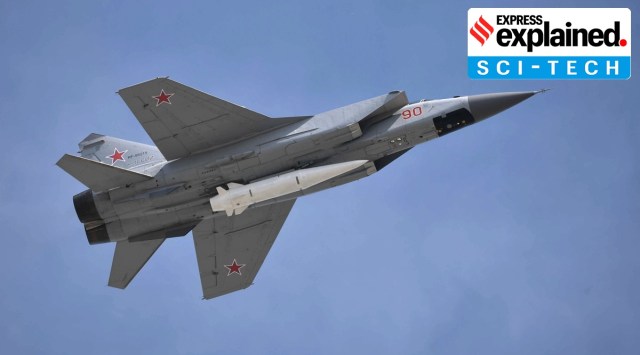 A Kinzhal missile is carried by a Mikoyan MiG-31K interceptor (Source: Wikimedia Commons)
 Russia on Thursday (March 9) unleashed its biggest aerial strike against Ukraine in weeks, hitting critical infrastructure or residential buildings in 10 regions and killing at least nine people. Among a varied range of powerful missiles launched by Moscow, there were six hypersonic missiles, known as Kinzhals, or Daggers, that the Ukrainian defence forces failed to intercept and shoot down.
Speaking to the media, Yuriy Ignat, spokesperson of Ukraine’s air force, said, “This was a major attack and for the first time with so many different types of missiles.” He added that Russian forces fired a total of 81 missiles, out of which only 34 were taken down by Ukraine.
Although this wasn’t the first time that Moscow used Kinzhals against Kyiv, they hadn’t launched so many of them in a single attack. According to media reports, the hypersonic missile, one of the newest weapons developed by Russia, was first fired by Russian forces in March 2022, when it destroyed a large underground warehouse containing missiles and aviation ammunition in the village of Deliatyn in western Ukraine’s Ivano-Frankivsk region.
What is a hypersonic missile?
A hypersonic missile, such as Kinzhal, is capable of flying at least at the speed of Mach 5, i.e. five times the speed of sound, and is manoeuvrable. The manoeuvrability of the hypersonic missile is what differentiates it from a ballistic missile, as the latter follows a set course or a ballistic trajectory. Thus, unlike ballistic missiles, hypersonic missiles do not follow a ballistic trajectory and can be manoeuvred to the intended target.
This makes them extremely lethal because by the time they are detected by ground-based radars, they are already quite near to their target.
There are two types of hypersonic weapons systems: Hypersonic Glide Vehicles (HGV) and Hypersonic Cruise Missiles. The HGVs are fired from a rocket before gliding to the intended target while the hypersonic cruise missile is powered by air-breathing high-speed engines or ‘scramjets’ after acquiring their target.
What are the benefits of hypersonic missiles?
As per a former Commander of US Strategic Command, General John Hyten, hypersonic weapons can enable responsive, long-range strike options against distant, defended or time-critical threats (such as road mobile missiles) when other forces are unavailable, denied access or not preferred. He made this statement while testifying before the US Congressional Committee on armed services. Conventional hypersonic weapons use only kinetic energy i.e. energy derived from motion, to destroy unhardened targets or even underground facilities.
What do we know about Kinzhal?
Unveiled in 2018, Kinzhal, according to the Russians, is capable of reaching speeds of Mach 10 and greater, with a range of about 1,250 miles. The missile is also believed to be nuclear-capable and usually launched by MiG-31 warplanes, The New York Times said. As mentioned before, it was first used against Ukraine last year.
Apart from Kinzal, Moscow reportedly has two other types of hypersonic missile systems. One is the Avangard hypersonic glide vehicle, which can fly at speeds as high as Mach 27, as per Russian officials. And the other is the Zircon anti-ship missile. However, there have been no reports of Zircon or Avangard being used in a war.
Can the use of Kinzhal help Russia win the war?
When Russia first used this hypersonic missile against Ukraine in 2022, experts didn’t think that its use would radically tilt the war’s outcome in Moscow’s favour.
Talking about Kinzhal with the BBC last year, James Acton, co-director of the nuclear policy program at the Carnegie Endowment for International Peace, said, “I don’t view it as that significant.”
Even the US defence forces at the time believed that Kinzhal can’t cause too much destruction and deaths in Ukraine. US Northern Command chief Air Force Gen. Glen VanHerck, in May 2022, claimed that the Russian hypersonic missiles were “underperforming” due to accuracy issues.
However, since last year many other analysts have accepted that such weapon systems can pose a massive threat to missile defence systems. According to a report by NPR, Dee Dee Martinez, comptroller of the US Missile Defense Agency, in 2022 said, “The development and deployment of missile defence systems to counter these advanced threats presents unique, but surmountable challenges, which require further development and technology investments.”