4 min read

© IE Online Media Services Pvt Ltd



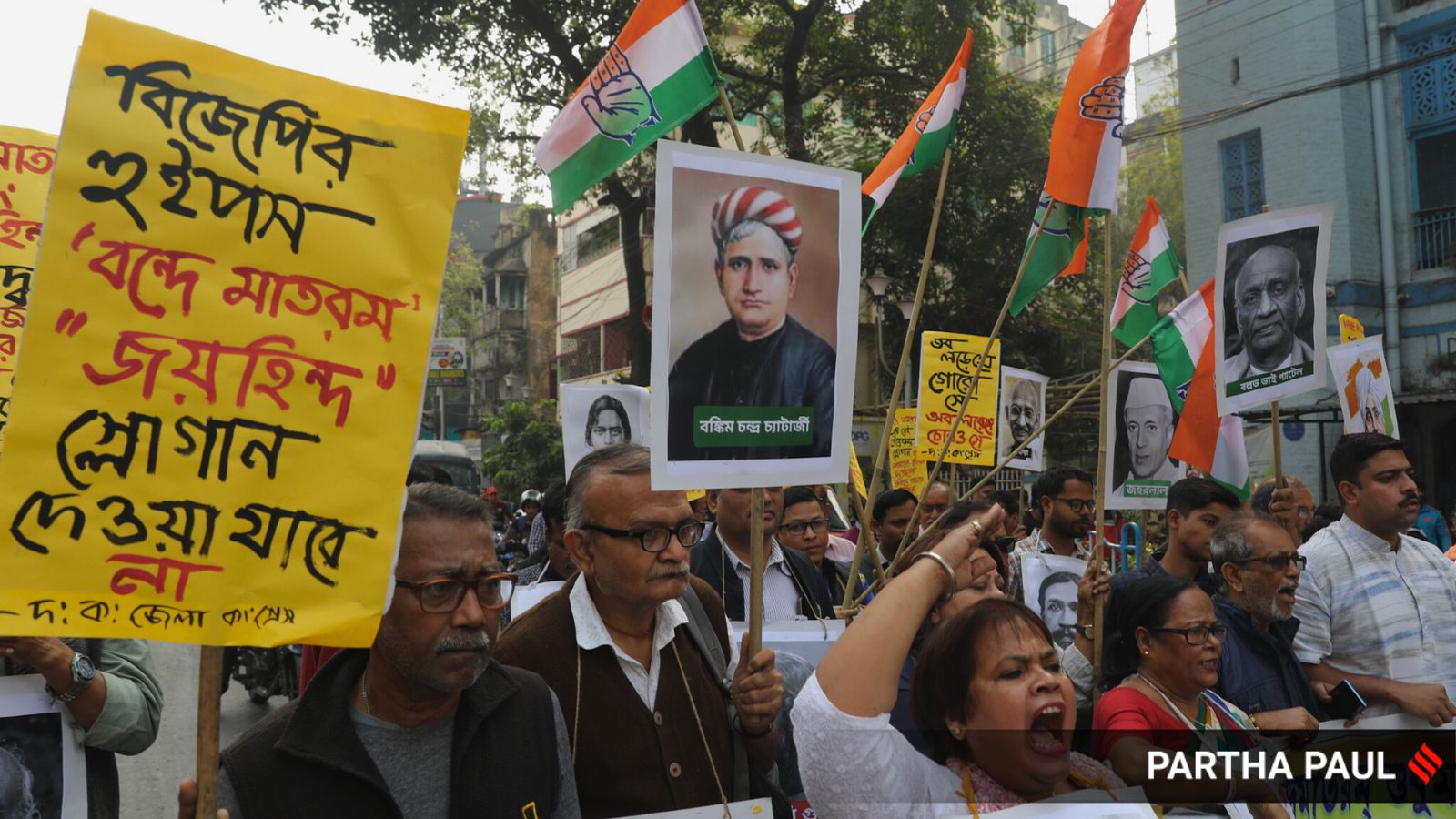 South Kolkata District Congress workers march from Hazra More to Jadu Babu’s Bazaar, protesting the move to bar Vande Mataram and Jai Hind inside Parliament. (Express photo by Partha Paul)
Vande Mataram debate in Lok Sabha: Initiating the discussion on 150 years of Vande Mataram in Lok Sabha on Monday (December 8), Prime Minister Narendra Modi called the song an inspiration to all Indians, and accused the Congress of “fracturing” the song by giving in to the demands of the Muslim League.
In October 1937, the Congress Working Committee had decided that when Vande Mataram is sung at national gatherings, only the first two stanzas should be sung, as the other “stanzas of the song are little known and hardly ever sung. They contain certain allusions and a religious ideology which may not be in keeping with the ideology of other religious groups in India.”
On Monday, the Congress was quick to hit back at Modi, calling him a “distorian” and accusing him of insulting Rabindranath Tagore, who too was of the view that the first two stanzas of the song should be sung at national gatherings.
While the journey of Vande Mataram becoming India’s national song is well-known, here is what some key figures of the Indian Independence movement, including Tagore, Mahatma Gandhi, and Mohammad Ali Jinnah said about Vande Mataram.
Vande Mataram features in Bankim Chandra Chattopadhyay’s novel Anandamath, which is about a rebellion of sanyasis against Muslim rulers. The Muslim League was against some references in the song, and also believed that “bowing to the mother” amounts to idolatry. The tallest League leader, Jinnah, was a prominent critic of the song.
To give one example, at the Sind Provincial Muslim League Conference meeting in Karachi in October 1938, Jinnah said, the Congress started Legislatures “with a song of Vande Mataram… which is not only idolatrous but in its origin and substance a hymn to spread hatred for the Musalmans.”
Within the Congress, there was a discussion about the Vande Mataram issue. Several people, including Subhas Chandra Bose (who supported the song wholeheartedly) and Nehru, wrote to Tagore to seek his opinion.
Tagore wrote to Nehru, “To me the spirit of tenderness and devotion expressed in its first portion, the emphasis it gave to beautiful and beneficent aspects of our motherland made a special appeal, so much so that I found no difficulty in dissociating it from the rest of the poem and from those portions of the book of which it is a part, with all the sentiments of which, brought up as I was in the monotheistic ideals of my father, I could have no sympathy.”
He added, “I freely concede that the whole of Bankim’s ‘Vande Mataram’ poem, read together with its context, is liable to be interpreted in ways that might wound Moslem susceptibilities, but a national song, though derived from it, which has spontaneously come to consist only of the first two stanzas of the original poem, need not remind us every time of the whole of it, much less of the story with which it was accidentally associated. It has acquired a separate individuality and an inspiring significance of its own in which I see nothing to offend any sect or community.” [From Sabyasachi Bhattacharya’s book, Vande Mataram: The Biography of a Song).
While Gandhi expressed admiration for the song, in the 1930s, he also said that it should not be sung at gatherings where people objected to it.
On July 1, 1939, he wrote in Harijan, ‘No matter what its [Vande Mataram] source was and how and when it was composed, it has become a most powerful battle-cry among Hindus and Mussalmans of Bengal during the partition days. It was an anti-imperialist cry…. It had never occurred to me that it was a Hindu song or meant only for Hindus. Unfortunately, now we have fallen on evil days… I would not risk a single quarrel over singing Vandemataram at a mixed gathering.”
The same month, he again wrote in Harijan that “if at any mixed gathering any person objected to the singing of Vandemataram even with the Congress expurgations, the singing should be dropped.” [Mahatma Gandhi and the Harmony of Music, By Teresa Joseph & AM Thomas].