Premium
This is an archive article published on January 20, 2022

Explained: Gujarat HC’s ‘Justice Clock’ and other digital initiatives

The Justice Clock will exhibit vital statistics of the justice delivery system in Gujarat, to 'maximise outreach and visibility'.

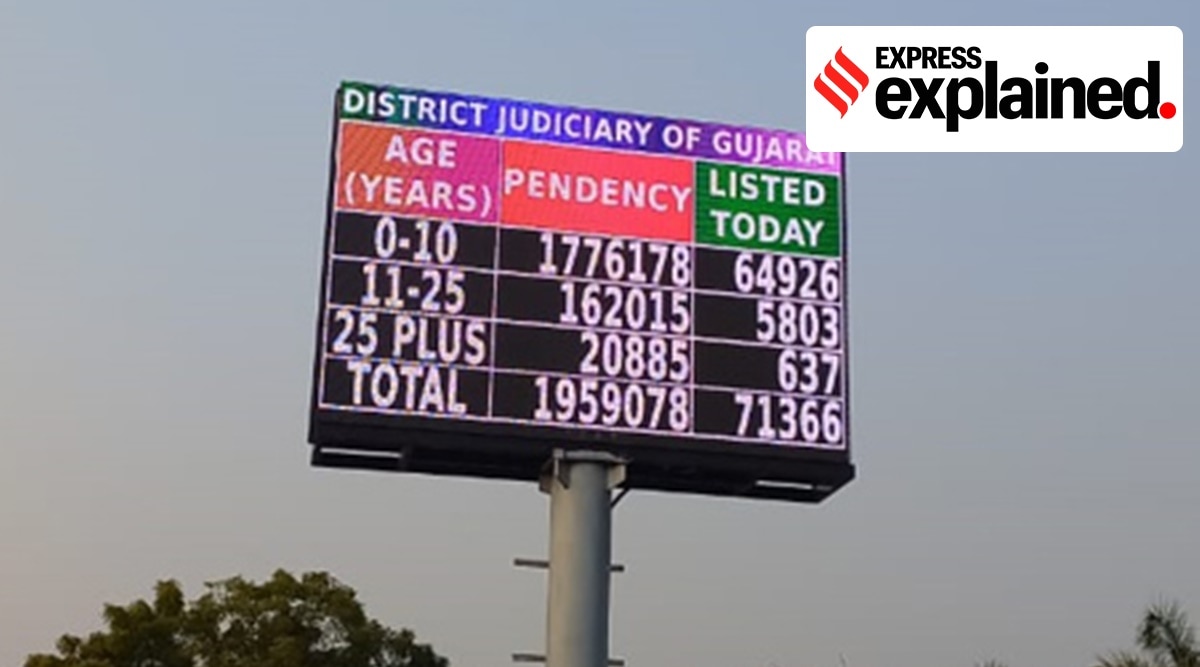
Justice Clock gujarat HC, what is Justice Clock, express explained, indian expressJustice Clock: An LED display of 7 feet by 10 feet, placed at a height of 17 feet from the ground, has been erected at a busy crossroad near the Gujarat High Court premises. (Express photo)

Supreme Court e-Committee chairperson and SC judge Justice DY Chandrachud on Monday inaugurated two digital services for Gujarat High Court — a ‘Justice Clock’, and electronic payment of court fee.

What is the ‘Justice Clock’ ?

An LED display of 7 feet by 10 feet, placed at a height of 17 feet from the ground, has been erected at a busy crossroad near the Gujarat High Court premises. This ‘Justice Clock’ will exhibit vital statistics of the justice delivery system in Gujarat, to “maximise outreach and visibility” of the work done by the state judiciary.

The interface has been designed and developed in-house and will display data from the National Judicial Data Grid (NJDG) in real-time. A similar format of Gujarat judiciary-related statistics will also be available on the Gujarat HC website under a tab of ‘Virtual Justice Clock’, accessible to all.


While the data is already publicly accessible on NJDG’s website, with an option to further distil the statistics district-wise, this new initiative — through the physical LED display as well as the virtual justice clock — is aimed at greater accessibility and transparency.

According to Gujarat HC Chief Justice Aravind Kumar, “one of the crucial aspects” covered in the content of Justice Clock is the case clearance rate (CCR) for current date, last date, last week, last month, this year and last year. “This CCR is kind of a goal which we will set ourselves and we shall strive hard to achieve 100%, where disposal matches the institution (of cases),” said Chief Justice Kumar during the virtual inaugural function of the facility.

What is e-court fee and how will it help?

While the online e-Courts fee system was already available for the Gujarat High Court, which was tested on a pilot basis allowing advocate and parties to procure judicial stamps online through electronic payment and upon submission of a PDF receipt, this platform now stands expanded to all district and taluka courts.

Story continues below this ad

The payment platform is of StockHolding Corporation of India Ltd (SHCIL) as empanelled by the Gujarat government. A PDF receipt of the fee paid will be generated and submitted to the court registry concerned. It will then be verified from within the digital case information system and locked as ‘consumed’, wherein the receipt will be defaced, so as to avoid its reuse or misuse.

Why the two initiatives?

The two digital initiatives add to a slew of other digital measures the Gujarat HC has undertaken to cope with Covid-19. As Justice DY Chandrachud has often emphasised, digital transformation brings in transparency and openness in court proceedings and also provides a glimpse to the public at large of how judges function. One such measure of bringing courtrooms to every device was the initiation of the live streaming of Gujarat HC proceedings.

On Monday, highlighting the purpose of the ‘Justice Clock’, Justice Chandrachud said, “Let there be no doubt about it that all these measures are now bringing focus on judges, how we conduct ourselves, how long we sit in courts, the seriousness with which courts are handled and cases are conducted, the courtesy which judges show to members of the bar and litigants, particularly those lawyers who are not among the higher echelons in the hierarchy of the bar.”

Facilitating electronic payment of court fee becomes essential especially in light of Covid, when physical entry of advocates and litigants have been restricted inside the premises. With electronic payment, the need to physically procure judicial stamp papers and submission of fee is done away with. As Gujarat High Court Advocates’ Association president Asim Pandya pointed out, the experience of advocates in paying court fee through the traditional judicial stamp papers “was not very satisfactory”.

Story continues below this ad
Also in Explained | The debate over marital rape

Are there any concerns with these initiatives?

While the initiative of electronic payment of court fee has seen unilateral support across the Bar, about the the ‘Judicial Clock’, Gujarat High Court Advocates Association president Asim Pandya, while lauding the effort for bringing in “transparency”, expressed a concern that “in the zeal to show higher disposal of cases to the public,” let justice not be “sacrificed”.

Speaking at the inaugural event, Pandya said that while “quick disposal of cases is good, but justice is better”, adding that ‘justice’ is the heart and soul of every judicial system. “I am a little averse to the word ‘disposal of cases’. We usually dispose of things that are not wanted. Cases are to be decided and not to be disposed of. In my personal view, it would be more appropriate if the justice clock uses the phrase ‘cases decided’ rather than ‘cases disposed of,” said Pandya.

Newsletter | Click to get the day’s best explainers in your inbox

Sohini Ghosh is a Senior Correspondent at The Indian Express. Previously based in Ahmedabad covering Gujarat, she recently moved to the New Delhi bureau, where she primarily covers legal developments at the Delhi High Court Professional Profile Background: An alumna of the Asian College of Journalism (ACJ), she previously worked with ET NOW before joining The Indian Express. Core Beats: Her reporting is currently centered on the Delhi High Court, with a focus on high-profile constitutional disputes, disputes over intellectual property, criminal and civil cases, issues of human rights and regulatory law (especially in the areas of technology and healthcare). Earlier Specialty: In Gujarat, she was known for her rigorous coverage in the beats of crime, law and policy, and social justice issues, including the 2002 riot cases, 2008 serial bomb blast case, 2016 flogging of Dalits in Una, among others. She has extensively covered health in the state, including being part of the team that revealed the segregation of wards at the state’s largest government hospital on lines of faith in April 2020. With Ahmedabad being a UNESCO heritage city, she has widely covered urban development and heritage issues, including the redevelopment of the Sabarmati Ashram Recent Notable Articles (Late 2025) Her recent reporting from the Delhi High Court covers major political, constitutional, corporate, and public-interest legal battles: High-Profile Case Coverage She has extensively covered the various legal battles - including for compensation under the aegis of North East Delhi Riots Claims Commission - pertaining to the 2020 northeast Delhi riots, as well as 1984 anti-Sikh riots. She has also led coverage at the intersection of technology and governance, and its impact on the citizenry, from, and beyond courtrooms — such as the government’s stakeholder consultations for framing AI-Deepfake policy. Signature Style Sohini is recognized for her sustained reporting from courtrooms and beyond. She specialises in breaking down dense legal arguments to make legalese accessible for readers. Her transition from Gujarat to Delhi has seen her expand her coverage on regulatory, corporate and intellectual property law, while maintaining a strong commitment to human rights and lacuna in the criminal justice system. X (Twitter): @thanda_ghosh ... Read More


Latest Comment
Post Comment
Read Comments
Advertisement
Advertisement
Advertisement
Advertisement