7 min read
© The Indian Express Pvt Ltd



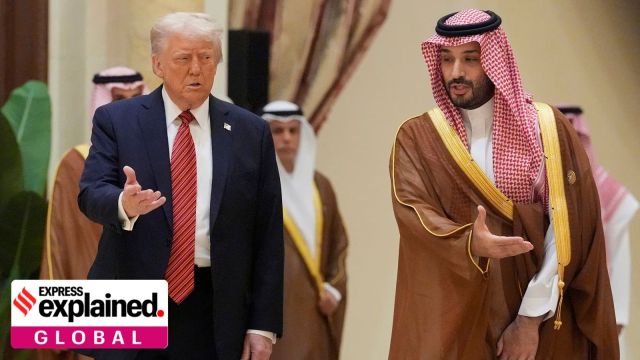 US President Donald Trump and Saudi Crown Prince Mohammad bin Salma. (File)
 Earlier this month, the United States cleared $1.4 billion in military sales to Saudi Arabia, including $500 million to train the Royal Saudi Land Forces (RSLF). This was the first American foreign military sales (FMS) package to the Kingdom since it was designated a Major Non-NATO Ally during Crown Prince Mohammed bin Salman’s landmark visit to the White House in late November.
That visit had also yielded Trump’s authorisation to sell F-35 fighter jets to Saudi, a Strategic Defense Agreement to facilitate more military sales, technology transfers, and joint training programs, among other agreements. It has been widely noted that this re-entrenches Washington as the primary guarantor of Saudi security.
But although the US remains Saudi Arabia’s biggest defence partner, the Crown Prince’s visit only entrenches the new transactional nature of their relationship, and does not signal a fresh alignment in strategic needs and visions. In fact, the US-Saudi defence relationship has, in recent times, quietly diverged on multiple accounts.
Since MbS took over the reins of the Kingdom in 2017, one of his key priorities has been a sweeping overhaul of Saudi Arabia’s fledgling military-industrial complex.
For one of the world’s largest defense spenders, the lion’s share of the Saudi defence budget has always been devoted to importing foreign equipment — 75% in 2024, for instance. A key pillar of the Kingdom’s Vision 2030 is to achieve 50% localisation for military spending; last month, the Kingdom announced that it had reached the 25% mark.
Second, despite its exorbitant expenditure, the Saudi military has arguably never been seen (even domestically) as self-sufficient in its ability to prosecute a military engagement, and thus been reliant on external security support. Riyadh has consistently sought a mutual defense arrangement with Washington, replete with all legal obligations on the US to protect Saudi, and the injection of substantially more personnel and material. Since 2023, the need to shore up external support has been exacerbated by Israel’s demonstrable ability to unilaterally change the region’s security landscape through brute military force, alongside the historic Iranian threat.
However, this has not been forthcoming from the Trump White House and Saudi Arabia had decisively abandoned hopes of a deal by November 2024. This, in turn, catalysed Riyadh’s existing efforts to diversify its defense relationships.
Saudi Arabia has especially invested in developing its nascent defense relationship with China; the Saudi Defense Minister even committed to taking military ties to a “higher level” in Beijing in June, building on new joint exercises (such as Blue Sword since 2019), and personnel training.
In any case, China being the largest destination of Saudi crude exports, the largest source of Saudi imports ($56 billion in 2024, with USA at $19 billion), as well as the leading investor in multiple Vision 2030 projects, has meant that Riyadh has long been Beijing’s most prominent partner in the Middle East.
That said, in the short term, Beijing is unlikely to replace Washington’s military heft in Saudi Arabia. To bolster its position, Riyadh thus engaged Pakistan to formalise a Strategic Mutual Defense Agreement (SMDA). This SMDA is arguably more about peace time operationalisation and less about mutual defence during military crises; its principal function is to transfer Pakistani military learnings to KSA, leveraging their historic relationship, to aid indigenous capacity building.
In fact, just a day after Washington’s December 2 FMS announcement, Lt Gen Fahad bin Saud Al-Johani, Commander of the RSLF, visited Rawalpindi and called on Field Marshal Asim Munir. Here, both sides recommitted to strengthening collaboration in military training programs and Pakistan’s military advisory support to the RSLF — all of which form the functional aspects of the Saudi-Pak SMDA.
The Donald Trump administration’s guiding star for most bilateral defense agreements in both his first and second terms, has been the need to promote military sales and create more jobs for the US defense industry. With its sizable sovereign wealth fund and its large investment portfolio in the US, Saudi Arabia has readily matched American needs. MbS has even committed to increasing Saudi investment in the US to $1 trillion from the current $600 billion. In return, Washington has committed to selling more arms to the Kingdom, especially as part of their May 2025 agreement worth $142 billion (which the Trump administration terms the largest defense sales agreement in history).
However, apart from the complete lack of specifics in terms of platforms or equipment (the December FMS represents 0.99% of the May $142 billion commitment), the corollary is that Washington will not take on greater responsibility that demands an increased American military footprint in the region. Even in the December sales package, the US Defense Security Cooperation Agency clarified that it does not entail the injection of any new American contractors and personnel into Saudi Arabia.
Meanwhile, the Saudi refusal to commit to normalisation of ties with Israel is especially (and perhaps disproportionately) important to Trump who in May had said that he “fervently hopes” for it. Indeed, it is a crucial missing piece in the Abraham Accords (Arab-Israel normalisation agreements) jigsaw, which the US President views as a personal project.
Naturally, this was reportedly also the primary bone of contention during MbS’s Washington visit. For Riyadh, both Israel’s refusal to commit to a time bound framework for recognising a Palestinian state as well as Washington’s reluctance to commit to mutual defence, significantly reduce its incentives to risk adverse public opinion by normalising ties with Israel. The White House readout following MBS’ visit made no mention of even a potential, conditional, or in-principle normalization of Saudi-Israel ties.
Lastly, Saudi’s growing closeness with China may have implications for its partnership with the US. While President Trump did announce the possible sale of F35 fighters to Saudi Arabia, note that the UAE had also secured a similar commitment from the first Trump administration; despite an initial agreement for 50 fighters, the deal ultimately succumbed to US intelligence concerns. The New York Times reported that Washington offered the F35 to the UAE along with controls that effectively acted as kill switches, largely due to US concerns vis-à-vis China.
Ultimately, Abu Dhabi turned to France to secure a $17.2 billion deal for 80 Dassault Rafales in 2021. Notably, this was despite the Emirates being the first country to sign the Abraham Accords in 2020, and arguably having deeper ties with Israel than any other Gulf state.
Since Riyadh’s ties with Beijing are manifestly deeper, the F35 sale would represent a sea change in the Washingtonian security bureaucracy’s priorities to protect sensitive US technologies. In any case, Washington’s legal obligation to maintain Israel’s qualitative military edge already means that Saudi Arabia might receive the F35 without major customizations (with Israel remaining opposed to the sale altogether).
The bottom-line then is that while Riyadh continues to lobby for greater commitment from Washington, it can also reciprocate the United States’ transactionalism, refuse to budge on Israel, and attempt to compensate for crucial gaps left in its partnership with Washington by cultivating new partners and strengthening old ones.