6 min read
© The Indian Express Pvt Ltd



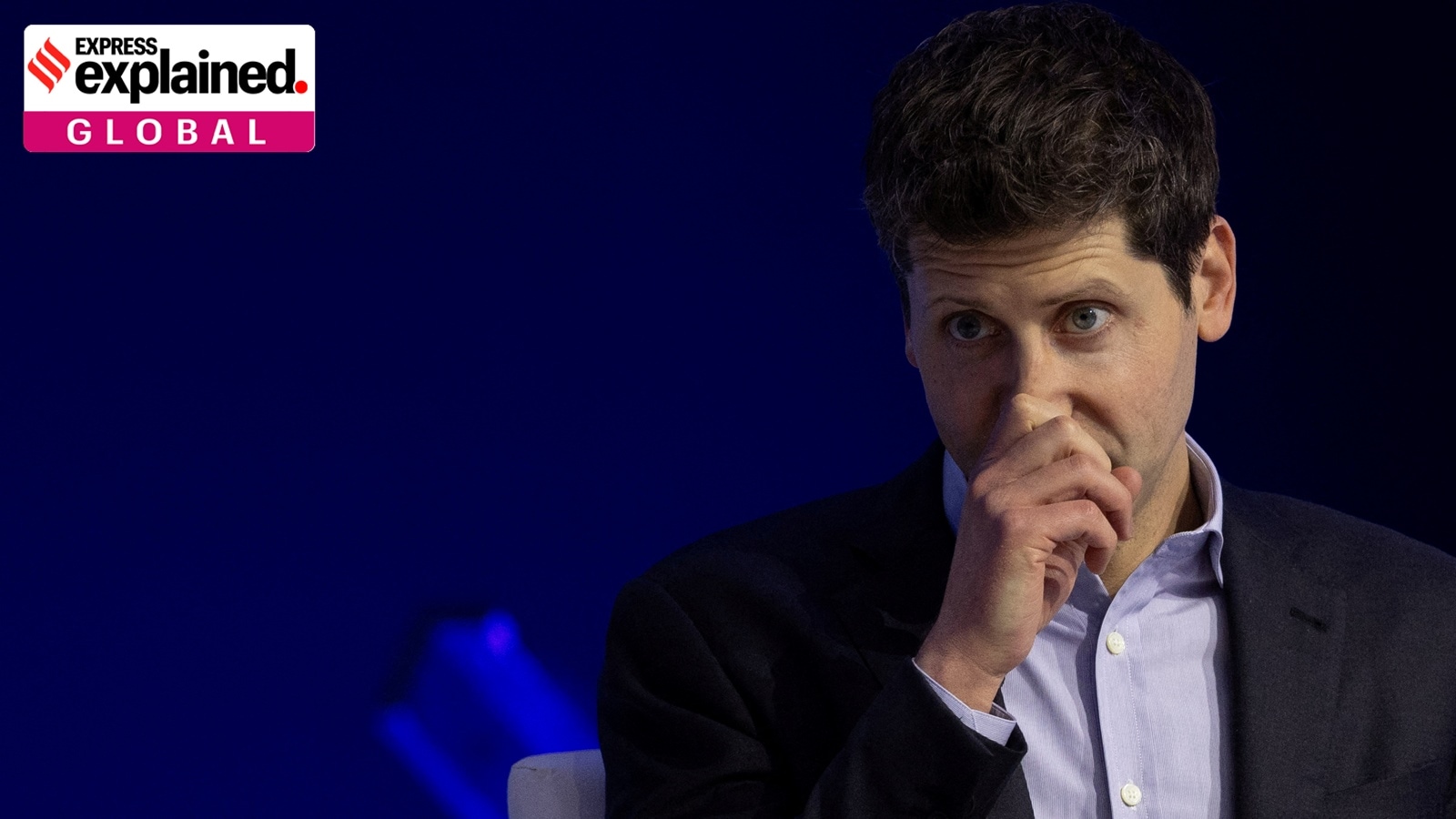 Sam Altman, CEO of OpenAI, attends the Asia-Pacific Economic Cooperation (APEC) CEO Summit in San Francisco, California, U.S. November 16, 2023. (REUTERS/Carlos Barria/File Photo)
 Sam Altman was reinstated as OpenAI’s chief executive on Wednesday (November 22), days after the organisation’s board of directors sacked him. The company said it “reached an agreement in principle” with Altman to pave the way for his return.
As part of the deal, OpenAI’s board of directors will be overhauled, removing all the members, who had played a role in Altman’s ouster. The only holdover is Adam D’Angelo, the chief executive of Q&A forum Quora.
The development has put an end to almost a week-long chaos that sent shockwaves across the tech world. Here is a look at what sparked the tumult at OpenAI, how the company’s unique structure played a role in Altman’s dismissal and what led to his return.
The firing
In a blogpost published minutes after the dismal of Altman on November 17, OpenAI accused the entrepreneur of being “not consistently candid in his communications with the board” and said it “no longer has confidence in his ability to continue leading” the company.
Beyond this statement, OpenAI refused to give further details about what caused Altman’s ouster. According to Western media reports, however, the dismissal was the culmination of the growing rift between Altman and other boards of directors.
OpenAI broke into the mainstream after the launch of the chatbot ChatGPT in November last year. While it made OpenAI one of the foremost tech companies in the world, Altman became the face of the generative AI revolution. However the success divided the board members.
Some members were increasingly worried about the potential dangers that the company’s technology posed to society. They also felt that Altman wasn’t focusing enough on these risks and was more concerned about building OpenAI’s business.
The reasons
Just weeks before his dismissal, Altman had an argument with Helen Toner, one of the OpenAI’s board members and an AI safety researcher at Georgetown University, over her recent research paper that compared the approaches to safety taken by OpenAI and rival company Anthropic.
“Mr Altman complained that the research paper seemed to criticise OpenAI’s efforts to keep its AI technologies safe while praising the approach taken by Anthropic,” according to a report by The New York Times. Toner defended her paper, saying it “analysed the challenges that the public faces when trying to understand the intentions of the countries and companies developing AI. But Mr Altman disagreed,” the report added.
Following the confrontation, Ilya Sutskever, an AI researcher, co-founder, and board member of OpenAI, and other senior company leaders discussed if Toner should be removed, sources told The NYT. To everyone’s surprise, however, Sutskever, who has repeatedly flagged the risks that AI can pose in the future, sided with other board members, including D’Angelo, Toner, and Tasha McCauley (a technology entrepreneur), and sacked Altman last week. Greg Brockman, president and co-founder of OpenAI, wasn’t part of the decision-making process and he later resigned. Both Altman and Brockman were also on the board of directors.
On Monday (November 20), Sutskever posted on X that he regretted his “participation in the board’s actions.”
There was another reason for the bad blood among the board members. They couldn’t agree on the candidates to fill the vacant seats on the board of directors.
“After vetting four candidates for one position, the remaining directors couldn’t agree on who should fill it, said the two people familiar with the board’s deliberations. The stalemate hardened the divide between Mr Altman and Mr Brockman and other board members,” The NYT report said.
The structure
About two days after Altman’s ouster, speculation began that he would return to OpenAI on two conditions, including the removal of the board, and an overhaul of OpenAI’s governance rules.
OpenAI has a unique company structure in comparison to other private firms. The organisation has a nonprofit entity and a for-profit entity. Both of them are controlled by a board of directors, which has the authority to decide the company’s leadership without the influence of its investors. Moreover, OpenAI’s governance rules state that only a minority of board members are allowed to hold a financial stake in the company and “only board members without such stakes can vote on decisions where the interests of limited partners and OpenAI Nonprofit’s mission may conflict.”
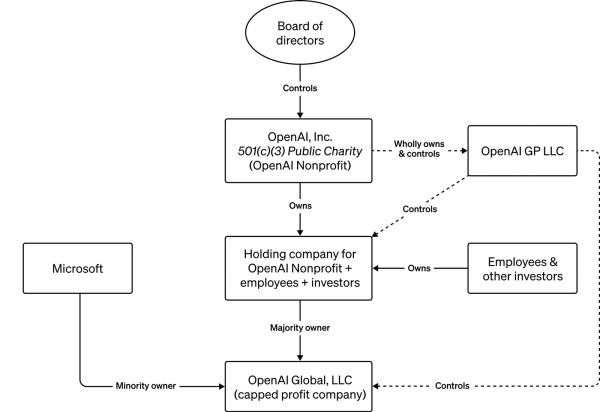 OpenAI company structure. (Credit: OpenAI)
For instance, Altman didn’t have any equity in the company apart from a small investment through a venture capitalist firm that he used to head before becoming CEO of OpenAI. According to experts, this made his position in the company vulnerable and led to his sudden exit.
The return
Therefore, in the agreement that Altman reached with OpenAI, the company agreed to rejig the board of directors to ensure the entrepreneur’s return. Not only this, it has also indicated that it could expand the board. It remains to be seen if the company’s governance rules are also changed to strengthen Altman’s position.
The entrepreneur’s return came after nearly all of OpenAI’s 800 employees on Monday threatened to resign and follow Altman to Microsoft, which asked him to lead an AI lab with Brockman. These employees had also signed an open letter, calling on the board to quit and accusing it of being “incapable of overseeing OpenAI”.