4 min read

Journalism of Courage



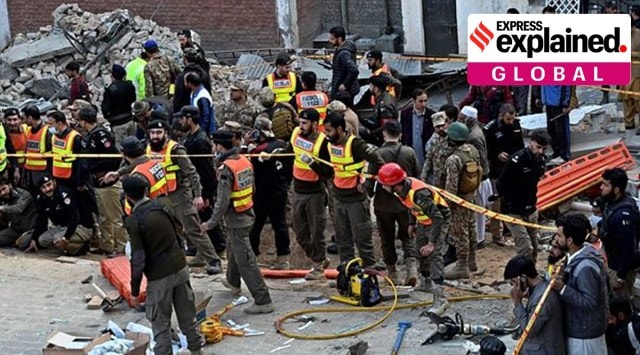 Security officials and rescue workers at the site of the suicide bombing in Peshawar, Pakistan, on Jan 30. (Photo: AP)
 More than 40 people were killed and around 100 injured after a suicide blast at a mosque in Pakistan’s Peshawar on Monday. The mosque was located in the high-security Police Lines area of the city, and many of the victims are police personnel who had gathered for afternoon prayers.
According to a Press Trust of India (PTI) report, the bomber is suspected to belong to the Pakistan Taliban. Here is what we know so far.
Peshawar is the capital of Khyber Pakhtunkhwa province, which borders Afghanistan. Around 1:40 pm, when people were offering ‘zuhur’ prayers, the suicide bomber, sitting in the front row, blew himself up. The explosion caused a part of the mosque to collapse, trapping many in the rubble.
As per the latest reports, rescue operations are still on at the mosque. Many of those who have been rushed to hospitals are in critical condition, Lady Reading Hospital told Dawn.
Reuters quoted Peshawar’s police chief Ijaz Khan as saying that the mosque was located inside a compound that includes the headquarters of the provincial police force and a counter-terrorism department. The fact that the bomber managed to penetrate such a high-security area has raised concerns.
According to PTI, a brother of Umar Khalid Khurasani, commander of the Tehreek-e-Taliban Pakistan (TTP), claimed that the suicide attack was part of revenge for his brother, who was killed last August in Afghanistan.
The TTP, also known as the Pakistani Taliban, has carried out a number of attacks in Pakistan, including on security personnel.
Pakistan Prime Minister Shehbaz Sharif said the attackers behind the incident “have nothing to do with Islam”, as per a PTI report. “Terrorists want to create fear by targeting those who perform the duty of defending Pakistan. The entire nation is standing united against the menace of terrorism,” Shehbaz said, adding that a comprehensive strategy would be adopted to improve the law-and-order situation in restive Khyber Pakhtunkhwa.
Foreign Minister Bilawal Bhutto Zardari also condemned the attack, saying “terrorist incidents before the local and general elections were meaningful”.
Khyber Pakhtunkhwa Governor Haji Ghulam Ali condemned the blast and urged the people to donate blood for the injured, saying that it would be a “huge favour for the police”.
Former PM Imran Khan said there was a need to improve intelligence gathering. “Strongly condemn the terrorist suicide attack in police lines mosque Peshawar during prayers. My prayers & condolences go to victims’ families. It is imperative we improve our intelligence gathering & properly equip our police forces to combat the growing threat of terrorism,” he tweeted.
Umar Khalid Khurasani, also known as Abdul Wali, was a senior leader of the Pakistani Taliban. He was killed in a roadside bombing in eastern Afghanistan when travelling with two aides and a driver. All four died in the attack.
Khurasani, according to The Express Tribune, was from the Safi tribe of Safo village, in Mohmand district of Khyber Pakhtunkhwa.
The TTP has waged a war against the Pakistani state for over a decade, demanding stricter enforcement of sharia laws, release of their militants in the custody of security personnel, and a reduction of Pakistani military presence in the country’s tribal regions. When the Taliban returned to power in Afghanistan, many in Pakistan had celebrated it. However, soon after, the TTP, became active once again in the north-west tribal regions, earlier federally administered but now part of Khyber Pakhtunkhwa.
In November 2022, the TTP ended its ceasefire with the Pakistan government, after which its terror activities have gone up.