9 min read

Journalism of Courage



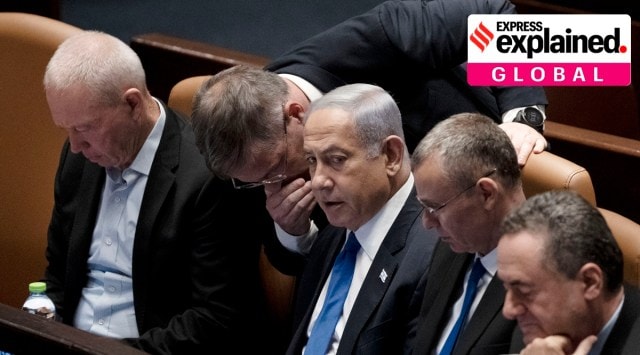 Lawmakers surround Israel's Prime Minister Benjamin Netanyahu, center, at a session of the Knesset, Israel's parliament, in Jerusalem, Monday, July 24, 2023. (AP Photo/Maya Alleruzzo)
 Once again, Prime Minister Benjamin Netanyahu of Israel has pushed the limits, defying a nationwide protest movement to win new curbs on the Israeli judiciary’s power to pose a check on his far-right coalition government.
But after years of brinkmanship and chaos management by the Israeli leader, this feels different. Such is the rancor and rupture caused by this particular Netanyahu victory that many Israelis wonder whether the damage to society might not be fixable — and whether Netanyahu will be able to manage the aftermath of a showdown he set in motion.
In the final moments before the vote, Netanyahu sat passively between a pair of Cabinet colleagues as the two men quarreled with each other — apparently over whether to offer a last-minute concession — shouting over the top of their party leader as if oblivious to his presence.
Around them in the voting chamber, furious opposition lawmakers yelled abuse at Netanyahu and his allies, warning them that they were shunting Israel toward ruin.
“You are the government of destruction!” shouted one opponent. “Enemies of Israel!” screamed another.
The passing of the vote, minutes later, provided a rare moment of certainty, after a seven-month period in which it was often unclear, even until Monday afternoon, whether Netanyahu would really dare to press ahead with his unpopular proposal.
It also took Israel into the unknown.
At home, it left one half of society wondering whether their country — under the control of Netanyahu’s alliance of religious conservatives and ultranationalists — would now slide slowly into a religious autocracy.
“These could be the last days of Israeli democracy,” said Yuval Noah Harari, an Israeli author and historian of humanity. “We might witness the rise of a Jewish supremacist dictatorship in Israel, which will not just be a terrible thing for Israeli citizens, but also a terrible thing for the Palestinians, for Jewish traditions, and potentially, for the entire Middle East.”
In a prime-time speech televised hours after the vote, Netanyahu presented these fears as alarmist.
“We all agree that we — Israel — has to remain a strong democracy,” he said. “That it will continue to protect individual rights for everyone. That it won’t become a religious state. That the court will remain independent.”
But to critics and supporters alike, questions remain about the stability and capacity of Israel’s armed forces, after a surge in protests from thousands of military reservists.
There is also the specter of social and economic turmoil, after major unrest broke out overnight in cities across the country, labor leaders warned of a general strike, a doctors’ union announced a daylong reduction in medical services, and high-tech businesses said they were considering moving to more stable economies, according to a new survey.
Abroad, the vote fostered greater ambiguity about the future of Israel’s alliance with the United States, after expressions of growing alarm from the Biden administration. It heightened the unease among American Jews about the trajectory of the Jewish state.
And among Palestinians, it raised fears of more brazen Israeli settlement in the occupied West Bank, a project that Israel’s Supreme Court had in some cases opposed, and greater restrictions on the Arab minority in Israel.
For years, Netanyahu has placed himself at the center of every political showdown, implying at times that he was all that stood between Israel and disaster. He has seemed to weather it all.
But now the 73-year-old’s health and stamina have become a national issue, after months of grueling political combat and a contentious vote that came just a few hours after he ended 30-hour stay in the hospital to have a pacemaker implanted.
The spectacle of rival Cabinet ministers arguing right next to him set off debate about how much control this political veteran still retains over his far-right alliance. Despite unusual pressure from President Joe Biden, and accusations from 15 former security chiefs that the law endangers Israel’s security, Netanyahu pushed ahead with it at the behest of his more extreme coalition partners.
Then there is Netanyahu’s ongoing corruption trial: Critics fear Netanyahu could attempt to scuttle it now that the Supreme Court is less able to oppose him, a claim he has long denied.
Beneath all this lurks the possibility of an imminent and existential crisis for Israeli governance. If the Supreme Court in the coming weeks uses the remaining tools at its disposal to block the implementation of the new law, it could force the various parts of the Israeli state to decide which arm of government to obey.
“I think it’s going to be a Pyrrhic victory,” said Anshel Pfeffer, a biographer of Netanyahu. “All the foundations of the Israeli establishment, including Netanyahu’s own government, have been weakened by what’s happened.”
Some Israelis have seen the court as a bulwark against a system that has relatively few other checks and balances — the country has no constitution, and just one house of parliament.
But Netanyahu and his supporters argue that the new law, which prevents the court from overruling the government through the subjective legal standard of “reasonableness,” enhances democracy by giving elected lawmakers greater autonomy from unelected judges.
Emmanuel Shilo, editor of a right-wing news outlet, wrote of his “happiness that our votes weren’t tossed into the garbage bin after all. That our elected officials at long last are doing something with the mandate we gave them.”
Others insisted no major transformation lay ahead. “There isn’t any dictatorship and regrettably nothing is really going to change in the justice system,” wrote Shimon Riklin, a right-wing television anchor.
For Israel’s secular protest movement, it was another blow, but one that many saw as a call to keep fighting. The movement’s seven-month struggle to delay the overhaul, through weekly marches and rallies, has helped reenergize a privileged sector of society that had at times been seen as apathetic or complacent about Israel’s political direction.
“This is some kind of consolation,” said Mira Lapidot, a museum curator and regular protest participant. “There is a sense of needing to decide what kind of life you want to live.”
But underpinning this rejuvenation is also a sense of fear. Netanyahu’s coalition includes a finance minister who has described himself as a proud homophobe, a security minister who was convicted of racist incitement, and an ultra-Orthodox party that proposed fining women for reading the Torah at the holiest site in Judaism.
For Israel’s Arab minority, which forms roughly one-fifth of the country’s population of 9 million, the law feels like the harbinger of a dangerous new era.
Palestinian citizens of Israel have played only a peripheral role in the anti-overhaul demonstrations, wary of a protest movement that has generally focused on sustaining the status quo of the Jewish state rather than fighting for equal rights for Palestinians.
“A part of our community believes that this government is just like previous ones and that our situation now is just as bad as it always was,” said Mohammad Osman, a 26-year-old political and social activist from Nahf, an Arab town in southern Israel. But Osman saw the overhaul as a very real threat to the Arab minority. “We will be the first to be harmed,” he said.
The vote also makes the future of Israel’s relationship with the United States seem more fraught than usual. Washington provides Israel with nearly $4 billion a year in military aid and gives Israel crucial diplomatic cover at the United Nations.
But the new law has drawn several expressions of concern from Biden, and in the buildup to its passage, two former American ambassadors to Israel suggested something once unthinkable: an end to US military aid.
US leaders going back to President Dwight Eisenhower have long clashed with Israel’s prime ministers. But this particular crisis is different because it is not over foreign policy but Israel’s character, undermining the perception of an alliance between two like-minded democracies, said Aaron David Miller, a former US diplomat and mediator in the Israeli-Palestinian conflict.
“The first order of business is when you’re in a hole stop digging,” Miller said. “Netanyahu’s hole with Joe Biden just got a lot deeper.”
He added: “Biden’s not looking for a fight with Netanyahu. But it’s clear there will be no embraces, let alone White House visits.”