4 min read
© The Indian Express Pvt Ltd



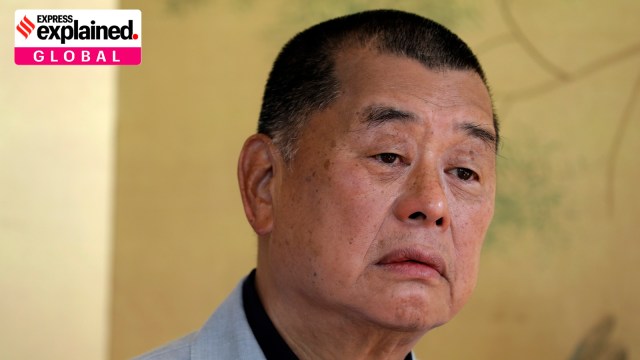 Hong Kong media tycoon Jimmy Lai pauses during an interview in Hong Kong on July 1, 2020. (AP Photo/Vincent Yu, File)
The national security trial of pro-democracy media tycoon Jimmy Lai began on Monday in Hong Kong. He faces three charges under the national security law and a further count of sedition that could send him to prison for life if convicted.
Lai has been in jail since December 2020, first in pre-trial detention and later because of short prison sentences over a spat of different charges pertaining to the management of Apple Daily, a now-shuttered Chinese-language tabloid he founded, and unlawful assembly.
Who is Jimmy Lai?
Born in Guangzhou, China, Lai moved to Hong Kong at age 12 as a stowaway on a fishing boat. He worked his way up from toiling in a Hong Kong sweatshop to starting a multi-million dollar empire in a span of a few decades, becoming one of Hong Kong’s richest residents. However, Lai has also been a consistent supporter of democracy and a critic of the Chinese government and its meddling in Hong Kong.
Beijing’s crackdown on the 1989 pro-democracy protests in Tiananmen Square deeply influenced and shaped Lai’s political views, according to a BBC profile. His open criticism of China’s policies, censorship, repression of the freedom of speech and the Tiananmen massacre in his writings in newspapers was a constant irritant for Beijing.
Beijing’s censorship of his bookstores in China led to Lai establishing Apple Daily and a digital magazine called Next, both of which were pro-democracy publications.
What are the charges against Lai?
The charges against Lai “centre in part on posts he made on social media and articles published in Apple Daily, urging Western governments to impose sanctions on Hong Kong and China,” according to a report by The New York Times. Prosecutors claim that such calls were in violation of the national security law that Beijing imposed on Hong Kong in June 2020. Lai has also been accused of sedition.
What is the significance of the trial?
The trial is closely watched as it is seen as a trial of press freedom and a test for judicial independence in Hong Kong. It will also demonstrate how Hong Kong’s judicial system would interpret and implement the national security law, in which political crimes aren’t clearly defined. While China says the law is required to counter threats to the country’s sovereignty, critics claim that it is used to curb dissent.
Experts and activists have also accused Lai’s prosecution of violating his right to a fair trial. According to Human Rights Watch, the media tycoon has been denied a trial by jury, which was once a standard practice in Hong Kong when defendants faced serious punishments. Instead, a panel of three handpicked judges are hearing Lai’s case.
Lai’s son, Sebastien, told Al Jazeera in a recent interview: “Obviously, this is a show trial”.
He added, “They’re basically punishing (him) for standing up for the freedoms that the Hong Kong region has, and that were also promised during the handover. That’s all it is, really, and they’re using a national security law, and the national security law isn’t retroactive. So if we look at it even just on that very level, on their word, then none of these guys should be in jail.”