6 min read


© The Indian Express Pvt Ltd



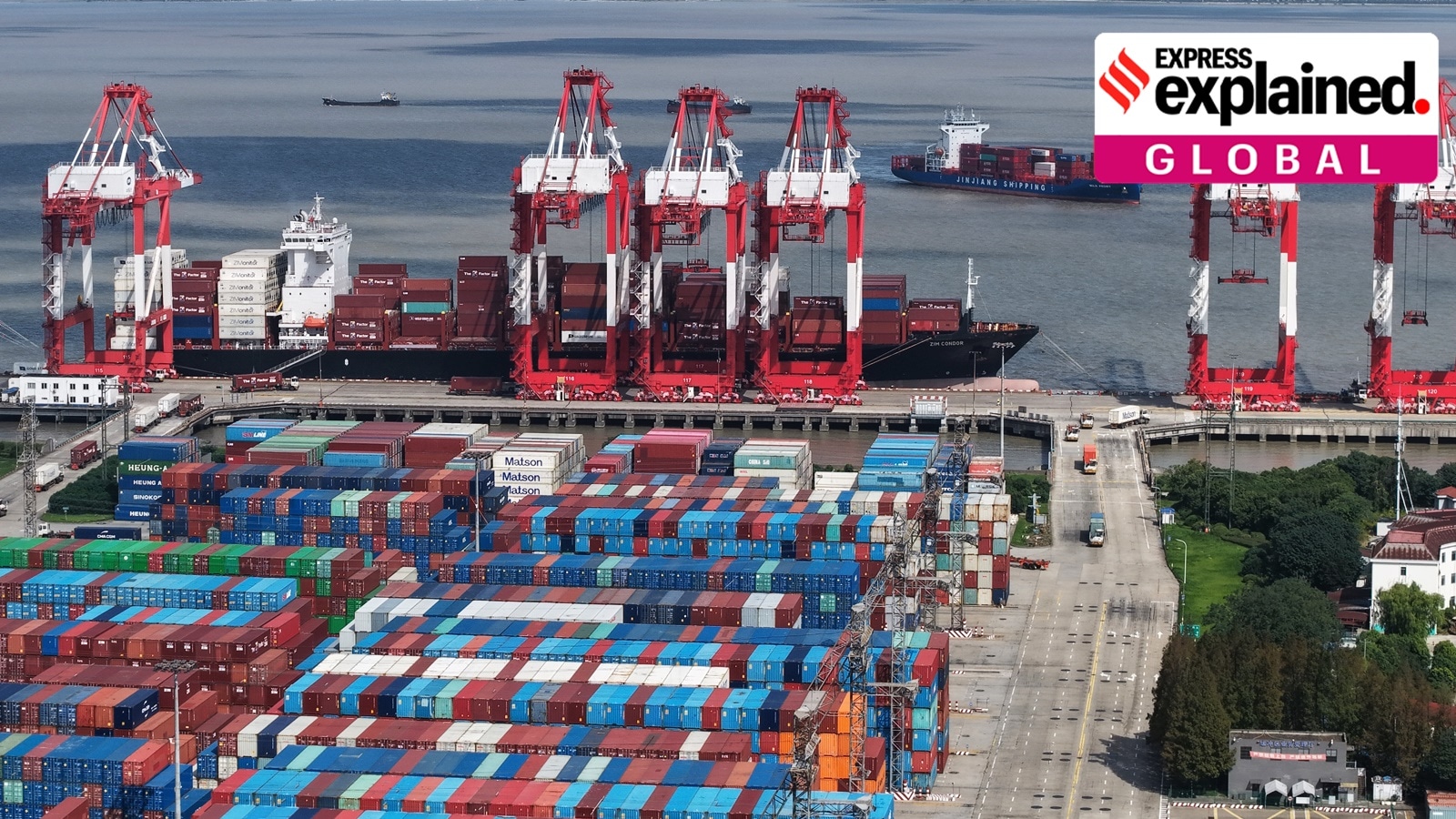 China trade imbalance 2025: An aerial view of a container terminal in Shanghai, China, Monday, Dec. 8, 2025. (Chinatopix Via AP)
China $1 trillion trade surplus:Earlier this week, trade data from China showed that in the first eleven months of 2025, the country hit over $1 trillion in trade surplus — meaning the value of its exports exceeded that of its imports by that figure. No country has ever recorded such a figure in that time period.
Data also showed that shipments to the United States, which imposed tariffs on China and the rest of the world beginning in April, dropped around 29% year-on-year. And yet, China’s export-heavy growth model continues to surge ahead.
What does this mean for global trade, and is the data all good news for China? In this interview with The Indian Express, Lizzi C. Lee, a Fellow at the Center for China Analysis, Asia Society Policy Institute, Washington DC, explains how to read the figure.
How do you see the $1 trillion milestone in the context of China’s growth trajectory?
The record surplus reflects China’s long-standing ability to produce at scale, not a sudden surge in competitiveness. Over two decades, China built dense supply-chain clusters and a policy environment that consistently favoured manufacturing and exports. The weaker value of the Chinese currency, the renminbi, also helped at the margin this year, although it didn’t fundamentally change the picture.
What makes this milestone especially significant is that it comes when China’s own domestic demand is weak and global trade is uncertain. The surplus has grown partly because production capacity kept expanding, while consumption and investment at home lagged. It is as much a sign of imbalance as it is of strength.
What are the constituents of this figure? Do they indicate exports of higher- or lower-value goods?
The export mix has shifted decisively toward higher-value goods. November’s data show the same pattern seen throughout the year: strong machinery and electronics, weak labour-intensive exports. Automobiles and integrated circuits did much of the heavy lifting, with export growth far outpacing traditional categories like apparel or toys, which continued to shrink.
This reflects two realities. First, China is moving up the value chain. Second, low-margin sectors are under pressure from both global competition and China’s own “anti-involution” push. It refers to how, in recent months, the government has spoken about the subject of manufacturing overcapacity amid low domestic demand, which has led to firms reducing their prices to appeal to consumers. However, with continuous demand-supply mismatch, it could very well lead to firms undercutting each other into oblivion. This is being termed involution, and the government has increasingly sought to contain the situation.
China hasn’t replaced the United States; it has leaned more heavily on everyone else, most notably, the Global South. November’s export rebound came almost entirely from non-US markets, while US demand remained soft.
Some rerouting through Southeast Asia likely exists, given the US tariff risks. However, diversification is a big part of what’s carrying the surplus.
How does the surplus interact with China’s push against involution and foreign accusations of dumping goods, or selling them for cheaper to other countries?
It highlights a dilemma. At home, officials say they want to avoid endless price wars and curb blind capacity expansion. Abroad, China faces growing accusations that this very expansion is distorting markets. Europe’s criticism, including French President Emmanuel Macron’s recent remarks about China undermining its industrial model, reflects deeper anxiety over strategic sectors.
The surplus won’t slow China’s manufacturing machine on its own. But it raises questions about whether current output levels are sustainable without provoking more trade friction.
In the short run, China can continue exporting strongly because its cost structure and supply chains remain competitive. But the long-run outlook is more complicated. Many countries are now reducing reliance on Chinese goods, especially in strategic sectors.
The term “China shock” was coined in a 2013 paper by US economists David Autor, David Dorn, and Gordon H Hanson. They argued that China’s economic boom greatly impacted the US economy. When China joined the World Trade Organisation in 2001, it marked its deeper integration into global trade. The promise of free trade meant that other countries were also expected to benefit from economic exchanges.
In their paper, however, the economists argued that over the next several years, cheap goods from China directly competed with US manufacturing. Although consumers did benefit, this “China shock” led to the loss of around 2.4 million jobs from 1999 through 2011, and they were not replaced by jobs that were as good. Economists are still debating whether China’s manufacturing success was a net benefit for the US.
A “second China shock” is possible today, but it is more likely to happen in the advanced manufacturing/technology category rather than cheap consumer goods. China’s rapid advance in the areas of EVs, batteries, solar energy, and electronics is already triggering protective moves abroad. That pushback is part of why China’s domestic debate on involution has become more urgent.
What does this data mean for the upcoming policy meet, China’s Central Economic Work Conference?
The CEWC, held every December, sets China’s economic priorities for the coming year: growth targets, macro policy, sectoral focus, and risk management. It is where the official leadership also takes the temperature on the current economic realities.
This year, the surplus will likely be interpreted both as a victory and as a signal of potential internal weakness. Strong trade numbers boost growth prospects (and confidence!) and signal China’s resilience to external shocks, but the export numbers alongside soft imports further accentuate sluggish domestic demand. The conference will stress confidence, rebalancing growth, macro policy coordination, anti-involution, tech upgrading, livelihood issues, etc. While managing trade tensions is part of the context, it is not the central focus of the conference.