Premium
This is an archive article published on October 5, 2022

What led to the Credit Suisse crisis, and what is the road ahead?

There is speculation that Credit Suisse is about to collapse, much like Lehman Brothers did in 2008. What has triggered the concern?

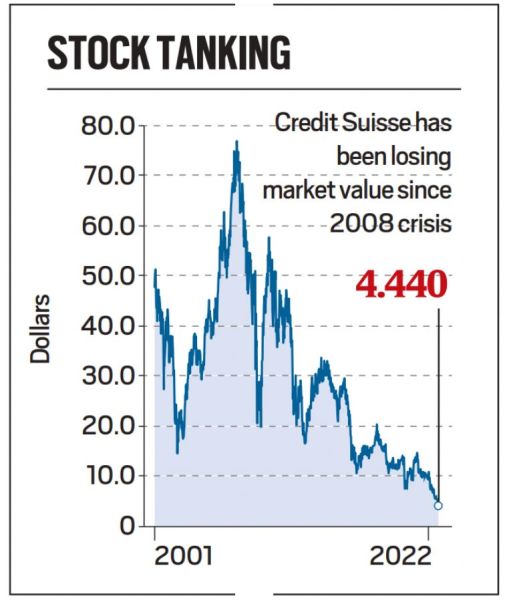
Since the beginning of 2022, Credit Suisse’s share price has fallen close to 60 per cent.Since the beginning of 2022, Credit Suisse’s share price has fallen close to 60 per cent.

Over the past few days, the share price of Credit Suisse, one of the oldest and historically one of the most influential banks in the world, has hit an all-time low. Since the beginning of 2022, Credit Suisse’s share price has fallen close to 60 per cent. At the same time, the spreads on credit default swaps (CDS) on Credit Suisse debt have spiked to a 14-year high — the highest since the global financial crisis of 2008.

These two trends have led many, especially those on social media, to speculate if Credit Suisse is about to collapse, much like Lehman Brothers, an iconic American investment bank, did in 2008.

What has triggered the concern around Credit Suisse?

The most recent trigger seems to be a letter written by Chief Executive Ulrich Koerner to Credit Suisse’s employees on September 30.

“I know it’s not easy to remain focused amid the many stories you read in the media — in particular, given the many factually inaccurate statements being made. That said, I trust that you are not confusing our day-to-day stock price performance with the strong capital base and liquidity position of the bank,” he wrote.

Reportedly, Credit Suisse had just over 50,000 employees and 1.6 trillion Swiss francs ($1.62 trillion) in assets under management at the end of 2021.

However, it has been losing its market value since the 2008 global financial crisis (see chart). The share price has witnessed almost a secular decline. The reason for this is fairly straightforward — Credit Suisse has made several risky bets and ended up losing a lot of investor money. That, in turn, has hurt its profitability, eroded investor confidence, and has made raising fresh capital costlier.

For instance, Credit Suisse directed many customers to invest as much $10 billion in Greensill Capital. Greensill was itself a lender of sorts — it intermediated between suppliers and clients. In other words, it paid suppliers upfront cash and took their place in waiting for the clients to pay. The business attracted a lot of attention and money, thanks to banks such as Credit Suisse.

Story continues below this ad

But there were increasing question marks over Greensill’s ability to remain solvent. By March 2021, Greensill had filed for bankruptcy, denting Credit Suisse and its rich investors.

When Archegos Capital Management, a hedge fund run by Bill Hwang, collapsed, also in March 2021, Credit Suisse lost another $5.5 billion.

Such losses were punctuated by high-profile managerial malpractices and exits, further undermining investor confidence. For example, in 2020, then CEO Tidjane Thiam had to quit after it became clear that he had been spying on Credit Suisse’s wealth management executive Iqbal Khan.

How did it impact Credit Suisse?

The secular decline in Credit Suisse’s share price is one good way to understand how investors have progressively shrugged away from the iconic bank.

Story continues below this ad

Further, Credit Suisse bonds have increasingly become cheaper — because fewer people want to lend money to it — and this has resulted in the yields rising quite sharply. Higher yields essentially imply that the bank would have to pay higher returns for every dollar or euro it borrows from the market.

This becomes a problem, especially in the current scenario facing the developed economies, when growth prospects are tanking and central banks are raising interest rates to contain inflation.

A bank with worsening profitability has to raise money at rapidly rising interest rates, but in a market that does not provide high enough returns, it is bound to struggle.

The other equally worrisome issue is the rise in the spread of Credit Default Swaps.

Story continues below this ad

What are CDS?

Essentially, a CDS is an insurance instrument. If an investor who has lent money to a firm (say Credit Suisse) is unsure about the firm’s ability to repay, the investor can buy a CDS on Credit Suisse’s bond. A CDS promises that if Credit Suisse fails to pay back, the insurer would pay the amount.

In return, the insurance firm selling the CDS gets a certain interest. This interest is called the spread of CDS. When these spreads rise, they signal the rising probability that a particular bond will fail. For Credit Suisse bonds, CDS spreads have spiked to 14-year highs.

What has Credit Suisse said?

Story continues below this ad

Credit Suisse is expected to unveil a new plan to transform the bank’s functioning and gain investor confidence on October 27.

“We are in the process of reshaping Credit Suisse for a long-term, sustainable future — with significant potential for value creation. Given the deep franchise we have, with a long-standing focus on serving some of the world’s most successful entrepreneurs, I am confident we have what it takes to succeed,” Koerner wrote in the memo.

Udit Misra is Senior Associate Editor at The Indian Express. Misra has reported on the Indian economy and policy landscape for the past two decades. He holds a Master’s degree in Economics from the Delhi School of Economics and is a Chevening South Asia Journalism Fellow from the University of Westminster. Misra is known for explanatory journalism and is a trusted voice among readers not just for simplifying complex economic concepts but also making sense of economic news both in India and abroad. Professional Focus He writes three regular columns for the publication. ExplainSpeaking: A weekly explanatory column that answers the most important questions surrounding the economic and policy developments. GDP (Graphs, Data, Perspectives): Another weekly column that uses interesting charts and data to provide perspective on an issue dominating the news during the week. Book, Line & Thinker: A fortnightly column that for reviewing books, both new and old. Recent Notable Articles (Late 2025) His recent work focuses heavily on the weakening Indian Rupee, the global impact of U.S. economic policy under Donald Trump, and long-term domestic growth projections: Currency and Macroeconomics: "GDP: Anatomy of rupee weakness against the dollar" (Dec 19, 2025) — Investigating why the Rupee remains weak despite India's status as a fast-growing economy. "GDP: Amid the rupee's fall, how investors are shunning the Indian economy" (Dec 5, 2025). "Nobel Prize in Economic Sciences 2025: How the winners explained economic growth" (Oct 13, 2025). Global Geopolitics and Trade: "Has the US already lost to China? Trump's policies and the shifting global order" (Dec 8, 2025). "The Great Sanctions Hack: Why economic sanctions don't work the way we expect" (Nov 23, 2025) — Based on former RBI Governor Urjit Patel's new book. "ExplainSpeaking: How Trump's tariffs have run into an affordability crisis" (Nov 20, 2025). Domestic Policy and Data: "GDP: New labour codes and opportunity for India's weakest states" (Nov 28, 2025). "ExplainSpeaking | Piyush Goyal says India will be a $30 trillion economy in 25 years: Decoding the projections" (Oct 30, 2025) — A critical look at the feasibility of high-growth targets. "GDP: Examining latest GST collections, and where different states stand" (Nov 7, 2025). International Economic Comparisons: "GDP: What ails Germany, world's third-largest economy, and how it could grow" (Nov 14, 2025). "On the loss of Europe's competitive edge" (Oct 17, 2025). Signature Style Udit Misra is known his calm, data-driven, explanation-first economics journalism. He avoids ideological posturing, and writes with the aim of raising the standard of public discourse by providing readers with clarity and understanding of the ground realities. You can follow him on X (formerly Twitter) at @ieuditmisra           ... Read More


Latest Comment
Post Comment
Read Comments
Advertisement
Advertisement
Advertisement
Advertisement