6 min read

© The Indian Express Pvt Ltd



 There are many factors why rupee is weakening even when the rest of the established currencies in developed countries and emerging market economies are strengthening. (Photo: File)
The Reserve Bank of India on Wednesday (December 17) intervened by selling large amounts of US dollar in the market, thus increasing the relative supply of dollars vis-à-vis the rupee. As a consequence, the dollar’s relative value against the rupee (the exchange rate) fell. In other words, the rupee strengthened against the dollar by almost a percentage point. But barring this intervention, the story for the past few months has been that the rupee has weakened against the dollar. To be sure, the rupee has lost almost 6% of its value over the past year.
There are two parts of the puzzle. One, that the rupee is weakening when, on paper, it should be strengthening. After all, India has been the fastest-growing major economy for a while, inflation is now well contained, and so are the external sector metrics (such as trade deficit and external debt). Ideally, India’s rupee should be strengthening.
The puzzle becomes even more intriguing because the rupee is weakening even when the dollar is weakening. Until some time back, Finance Minister Nirmala Sitharaman was correct when she said that “rupee is not weakening, rather it is the dollar strengthening”. Simply put, she was pointing to a trend where every other currency was weakening against the dollar, not just the rupee. But for a while now, this has stopped being the case. For the past few months, the rupee has been weakening even when the dollar is weakening (See CHART 1 ). This means that there is no room to escape the fact that the Indian currency is under considerable pressure.
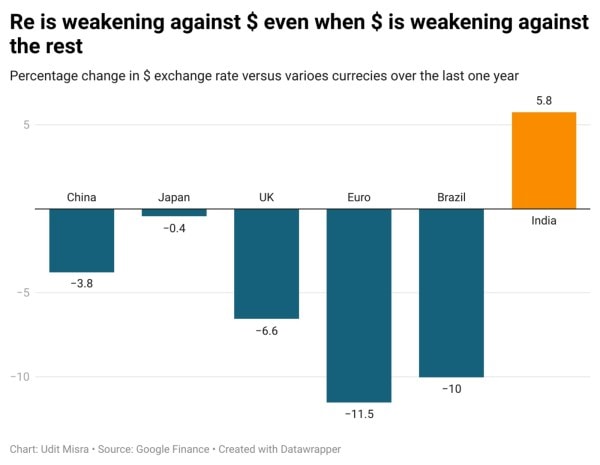 Chart 1
There are many factors why the rupee is weakening even when the rest of the established currencies in developed countries and emerging market economies are strengthening.
For one, India’s weakness in trade. If, in value terms, India imports more than what it exports, the relative demand for dollars is more than the rupee, and as such, the rupee’s relative value (the exchange rate) falls.
Two, trade weakness has been worsened by the US singling out India for some of the highest tariffs, which make your goods even more costly for foreign customers, and their demand falls. This, in turn, further reduces the demand for your currency (and its exchange rate); after all, why do you want rupees when you don’t want anything made in India?
Three, further worsening this situation is the fact that the India-US trade deal is hanging fire. Of course, the official stand is optimistic of resolving the knots in another 3-4 months, but that uncertainty, coupled with the diplomatic cold front that led to punitive tariffs in the first place, essentially wards off investors.
Four, a lack of investor interest can also be seen in the shape of the dip in capital flows. But US tariffs are just one part of this problem. The fact is that investors have largely shunned Indian markets and patronised all others (See CHART 2). As a study by Bank of Baroda shows, over December 2024, US indices are up by 17-23% while China has matched with 16-27% and Japan with 22-27%. FTSE is up 18% and if we look at Sensex, it is just 8%. The Euro area is up by 16%, and closer to us in Asia, Hong Kong is up by around 27% and Korea by 72%. Either the investors think Indian equities are overvalued, or they think Indian companies are unlikely to make enough profits.
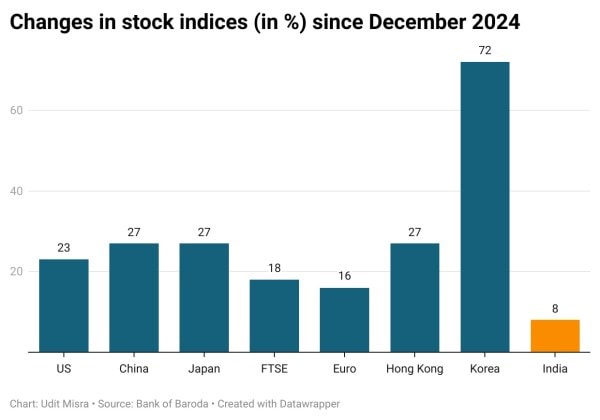 Chart 2
Lastly, one can’t discount the role of the central bank, as witnessed on Wednesday. RBI’s actions (especially its purchase and sale of dollars) can influence not just the interest rate one earns (and the interest rate businesses pay) but also the rupee’s exchange rate (regardless of the macroeconomic fundamentals).
The question is: Which of these factors are important when it comes to the movement in the exchange rate?
This is exactly what a recent BoB study focused on. It looked at monthly data from October 2020 to November 2025, and here are the results.
It found that three factors appeared to explain the rupee’s exchange rate the most:
1> RBI’s spot intervention in the forex markets
2> Change in RBI’s position in a forward contract (or a contract where one agrees to buy or sell a currency in the future at a specific level).
3> Foreign Portfolio Inflows into India.
Interestingly, “forwards have more significant role than spot intervention”. This means, RBI selling dollars in the forward market when the rupee is declining is a more effective option as there is strong messaging involved.
Oddly enough, the trade deficit did not really have a bearing on the changes in the rupee. “This could be because these numbers do not reflect the actual flows during the time period but merely the recording of transactions that may not necessarily lead to dollars moving in or out in the same period. In fact, exporters can keep their dollar earnings overseas for a stipulated period before remitting the same into the country,” explained the BoB research note
But none of the variables account for more than 13%-14% of the total variation in the currency change. “This means that there are factors beyond economics which have a role to play,” concludes the BoB study.
“The conclusion that may be drawn is that in the immediate run, FPIs have a major role to play.”
To know more about how the whole Balance of Payments works, read this edition of ExplainSpeaking.