The RBI’s Monetary Policy Committee had raised interest rates — more specifically, the repo rate or the interest rate that the RBI charges when it lends to the banking system — in each of its bi-monthly meetings since May last year in a bid to contain retail inflation. Increases in repo rate drag down economic growth.

Although the decision to pause was not entirely unexpected, it was surprising, given the fact that the last two readings of retail inflation in India have been well above the RBI’s comfort zone limit of 6%.
The decision can be viewed in two starkly different ways.
Some can view this as RBI surrendering in its fight against inflation, while others can characterise it as an astute, nuanced and well-timed policy move that ring-fences domestic financial stability, protects economic growth while keeping the door open to resume the fight against inflation in a few months’ time.
Prudent and well-timed?
In any economy, the main role of the central bank is to maintain price stability. In other words, the primary goal is to contain inflation.
The inflation rate for any period (month, quarter or year) is the rate at which the general price level has gone up. If the overall price level — typically calculated by an index (such as the Consumer Price Index) that has the prices of different commodities — in a particular month is 5% more than what it was in the same month last year, then inflation rate is said to be 5%.
Story continues below this ad
The targeted level of inflation varies from one country to another. In the US, this target is 2%. In India, the law demands RBI to target 4%. But apart from the exact target, the law also provides a comfort zone — 2% to 6% — within which the inflation can stray. These numbers are decided based on research that suggests the ideal rate of inflation most conducive to sustained economic growth.
The targeted level of inflation varies from one country to another. In India, the law demands RBI to target 4%.
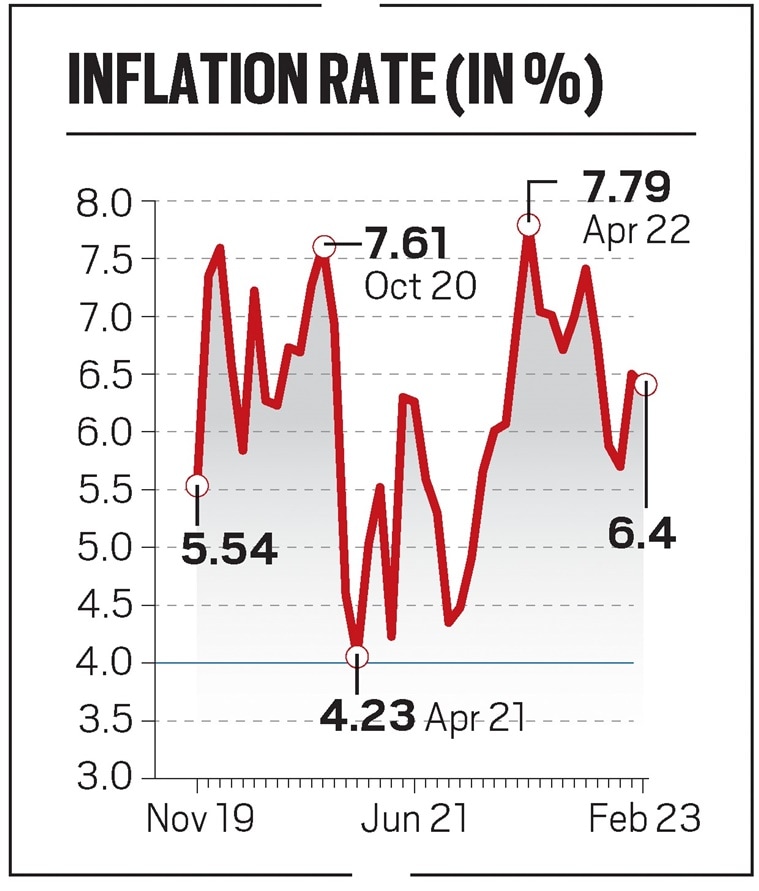
Data (Chart 1) shows that since late 2019, the RBI has rarely come close to the target rate. Worse still, the headline inflation has stayed outside the upper limit for the better part of the past 14 months.
More specifically, in the two inflation prints — 6.5% in January and 6.4% February — since the policy review have been significantly above the comfort zone.
Under the circumstances, especially since the RBI has repeatedly stated that it will be primarily driven by data, the decision to pause raises question marks on the RBI commitment to achieve the 4% target at the earliest. One reflection of this can be found in RBI’s own projections of inflation. According to the latest policy review, retail inflation is expected to average 5.2% in the current financial year (ending March 2024) and 4.5% in 2024-25.
Story continues below this ad
That means that starting late 2019, RBI would have missed the 4% target for a period of over five years on the trot.
And these are baseline projections for inflation. They do not include shocks to the system such as geo-political tensions driving up crude oil prices and disrupting supply chains or unseasonal weather changes causing a spike in food inflation, etc.
In other words, it can be argued that India’s central bank’s effective target is higher than 4%.
It is true that while announcing the policy, RBI Governor Das and his colleagues repeatedly reassured that the central bank would be vigilant against any inflation surprises; they said that “this pause is just for this policy”. But the fact of the matter is that if the RBI can decide to pause when inflation is still well above the 6% mark, then the bar for what will cause the RBI to raise rates in the future has been set quite high. In other words, this is the end of the rate hike cycle and the RBI expects everyone in the economy to live with higher inflation.
Story continues below this ad
To be sure, while a decision to go soft on inflation may help the stock markets and the financial system, this will come at the cost of the poor in the country who suffer the most due to high prices. Moreover, the RBI will find itself in a fix if the US Fed (in its bid to reach the 2% target) continues to raise rates and, in turn, puts pressure on the India rupee.
Abandoning the 4% inflation target?
The RBI has not abandoned its mandate. However, it has taken a prudent and timely pause to ensure that in its bid to reach the 4% target, it does not crash India’s economic growth.
At a growth rate of 8.9% in 2021-22, 7% in 2022-23 and a projected growth rate of 6.5% in the current financial year, India is unequivocally the rare bright spot in the global economy. In sharp contrast, just last week, the World Bank warned that the ongoing decade 2020-2030 has the makings of a “lost decade” for the world economy as even the most developed countries face risks of recession or stagflation and/or financial crises.
Story continues below this ad
Under the circumstances, the RBI has unveiled a nuanced policy stance, which, while continuing to contain inflation, gives it a chance to assess how its past repo rate hikes are impacting India’s underlying growth momentum. Since May 2022, RBI has relentlessly raised the repo rate (up by 250 basis points) and the effective interest rates have gone up even more sharply (up by 320 basis points). This is already showing results. RBI’s projection suggests that as things stand, inflation would have come down from 7.8% in April 2022 to 5.2% by the end of March 2024. This is well within the RBI’s comfort zone.
By pausing, the RBI is trying to ensure that India’s financial system does not suffer the kind of crises seen by banking collapses in the US and Europe.
Lastly, the RBI has also clarified that “this is a pause and not a pivot”. In other words, this is not a signal that it will start cutting interest rates from here onwards. More importantly, it means RBI will act if inflation starts trending the wrong way.


 7 min read



 The targeted level of inflation varies from one country to another. In India, the law demands RBI to target 4%.