Premium

On India’s GDP growth trajectory, compared to Pakistan, China and the US

In Explained’s new weekly column, titled ‘GDP: Graphs, Data, Perspectives’, Udit Misra looks at the size of India’s GDP growth in recent decades, in relation to a few other countries.

External Affairs Minister S. Jaishankar speaks during the 4th edition of Kautilya Economic Conclave, in New Delhi on Sunday.External Affairs Minister S. Jaishankar speaks during the 4th edition of Kautilya Economic Conclave, in New Delhi on Sunday. (ANI Photo/Sumit)

Even though a state of relative calm now prevails in US-India relations, the recent disruptions on the trade front, as well as the United States’ apparent proximity to Pakistan, led many analysts to conclude that India and Pakistan are again being hyphenated on the international stage.

Hyphenation is the practice of a country conducting relations with another by factoring in a third country. In this case, rather than dealing with India based on its own standing (called “de-hyphenation”), the US would see it through the prism of its own friendly ties with Pakistan.

In this context, India’s External Affairs Minister S Jaishankar recently said, “The best way of de-hyphenation is to outstrip the other party in terms of power and capability.” While military power is a key metric that defines a country’s capability, often the most dependable long-term marker is a country’s economic strength or output.

However, the question isn’t just where India stands, but also what India’s growth trajectory is relative to countries such as Pakistan, as well as China and the US.

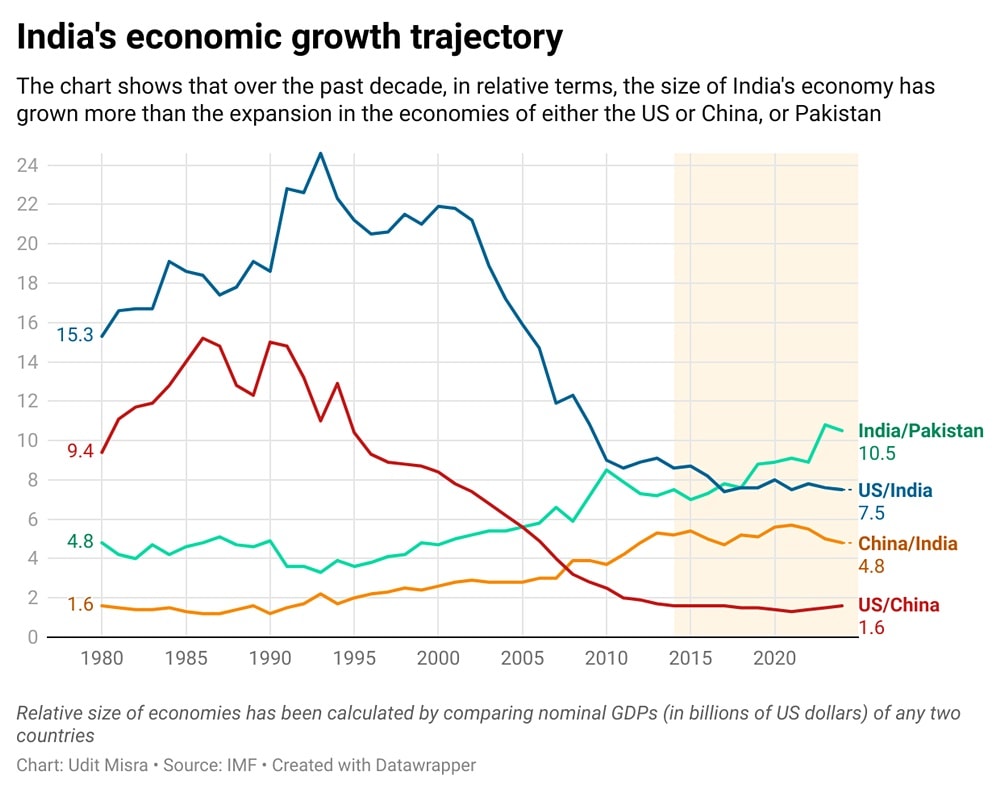
The CHART alongside tries to provide a glimpse of why India is truly an ascendant regional power. Even though India’s growth momentum has lost a step over the past decade, when compared to others, a very different picture emerges. The four lines here map the ratio of GDP (in current US dollars) between India and the other three countries. The vertical axis shows the number of times one economy is of another.

CHART on India Pakistan China US growth comparison CHART.

Here are the main takeaways:

1. The US’s economic momentum has been rather spectacular. The bigger an economy, the harder it is for it to maintain a fast growth momentum. Yet, as the lines mapping the US vs China and the US vs India trends show, the US economy has restricted its slide over the past decade.

Story continues below this ad

In fact, against China, it has improved post-Covid. These comparisons are in US dollar terms and, as such, account for changes in exchange rates. Still, relative to India, the US has lost ground over the past decade: from being 8.6 times India’s economy in 2014 to 7.5 times in 2024.

2. India, on the other hand, has kept pace with China’s growth and hasn’t allowed China to increase the gap in relative terms. If anything, the relative ratio has come down: China’s GDP was 5.4 times India’s in 2015 but only 4.8 times in 2024.

3. Against Pakistan, India’s economy has now extended the gap, helped by Pakistan’s persistent economic mismanagement. Be that as it may, just over the past decade, India’s economic size relative to Pakistan has gone from 7.5 times to 10.5 times.

Clearly, among these four economies, it is India and the US that show an upward trajectory, while China and Pakistan seem to be running out of steam at varying levels.

Udit Misra is Senior Associate Editor at The Indian Express. Misra has reported on the Indian economy and policy landscape for the past two decades. He holds a Master’s degree in Economics from the Delhi School of Economics and is a Chevening South Asia Journalism Fellow from the University of Westminster. Misra is known for explanatory journalism and is a trusted voice among readers not just for simplifying complex economic concepts but also making sense of economic news both in India and abroad. Professional Focus He writes three regular columns for the publication. ExplainSpeaking: A weekly explanatory column that answers the most important questions surrounding the economic and policy developments. GDP (Graphs, Data, Perspectives): Another weekly column that uses interesting charts and data to provide perspective on an issue dominating the news during the week. Book, Line & Thinker: A fortnightly column that for reviewing books, both new and old. Recent Notable Articles (Late 2025) His recent work focuses heavily on the weakening Indian Rupee, the global impact of U.S. economic policy under Donald Trump, and long-term domestic growth projections: Currency and Macroeconomics: "GDP: Anatomy of rupee weakness against the dollar" (Dec 19, 2025) — Investigating why the Rupee remains weak despite India's status as a fast-growing economy. "GDP: Amid the rupee's fall, how investors are shunning the Indian economy" (Dec 5, 2025). "Nobel Prize in Economic Sciences 2025: How the winners explained economic growth" (Oct 13, 2025). Global Geopolitics and Trade: "Has the US already lost to China? Trump's policies and the shifting global order" (Dec 8, 2025). "The Great Sanctions Hack: Why economic sanctions don't work the way we expect" (Nov 23, 2025) — Based on former RBI Governor Urjit Patel's new book. "ExplainSpeaking: How Trump's tariffs have run into an affordability crisis" (Nov 20, 2025). Domestic Policy and Data: "GDP: New labour codes and opportunity for India's weakest states" (Nov 28, 2025). "ExplainSpeaking | Piyush Goyal says India will be a $30 trillion economy in 25 years: Decoding the projections" (Oct 30, 2025) — A critical look at the feasibility of high-growth targets. "GDP: Examining latest GST collections, and where different states stand" (Nov 7, 2025). International Economic Comparisons: "GDP: What ails Germany, world's third-largest economy, and how it could grow" (Nov 14, 2025). "On the loss of Europe's competitive edge" (Oct 17, 2025). Signature Style Udit Misra is known his calm, data-driven, explanation-first economics journalism. He avoids ideological posturing, and writes with the aim of raising the standard of public discourse by providing readers with clarity and understanding of the ground realities. You can follow him on X (formerly Twitter) at @ieuditmisra           ... Read More


Latest Comment
Post Comment
Read Comments
Advertisement
Advertisement
Advertisement
Advertisement