Premium
This is an archive article published on October 24, 2022

ExplainSpeaking | The economic, political challenges awaiting new UK PM Rishi Sunak

From the credibility challenge facing the Conservative party to the economic crisis in the UK, we take a look at what awaits Rishi Sunak, set to become the new UK PM.

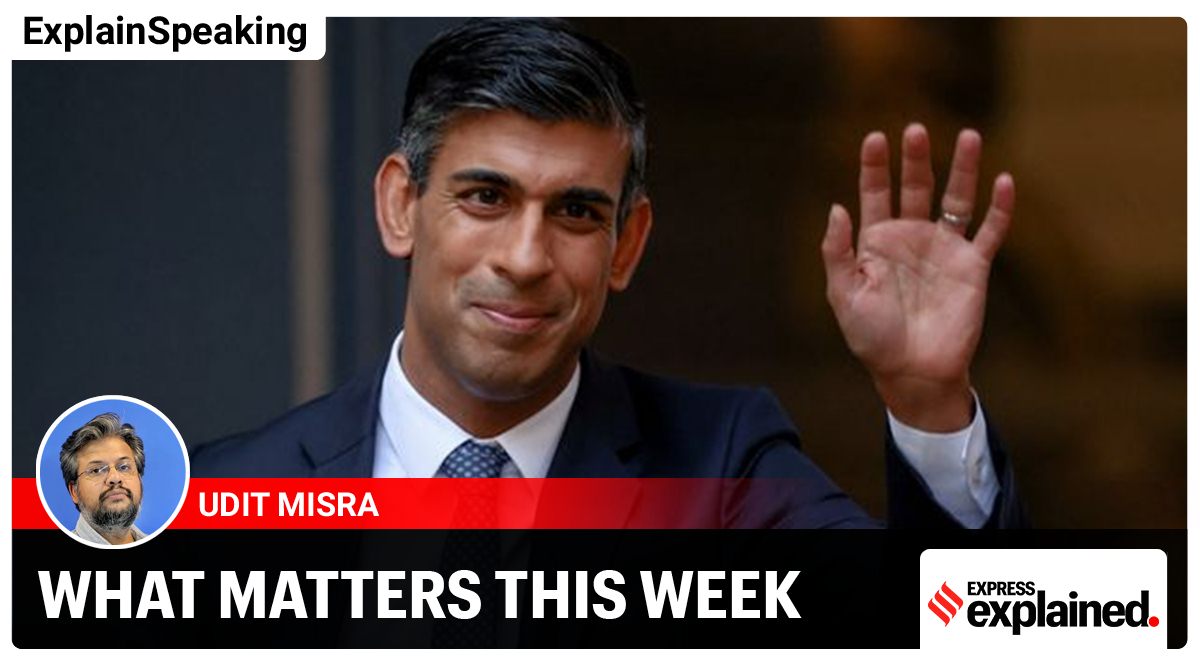
New leader of Britain's Conservative Party Rishi Sunak waves outside the party's headquarters in London, Britain, October 24, 2022. (Reuters Photo: Henry Nicholls)New leader of Britain's Conservative Party Rishi Sunak waves outside the party's headquarters in London, Britain, October 24, 2022. (Reuters Photo: Henry Nicholls)

ExplainSpeaking-Economy is a weekly newsletter by Udit Misra, delivered in your inbox every Monday morning. Click here to subscribe

Dear Readers,

Rishi Sunak will become Britain’s next prime minister after he won the race to lead the Conservative Party, defeating Penny Mordaunt, who failed to get enough backing from lawmakers to enter the ballot.

The UK, however, is likely to remain in the throes of a political and economic crisis.

How it started

It all started when the Liz Truss government presented its “mini-Budget”. In it, she and her chancellor (read finance minister) Kwasi Kwarteng — and it was strictly between them because she later admitted that she never involved the rest of the cabinet members — decided to follow through on a radical plan of increasing government spending and cutting government taxes in a bid to kickstart UK’s stagnant growth while also providing relief to people from high inflation.

However, the plan backfired — spectacularly. In fact, it almost created a financial meltdown in the UK. Read this, this, and this to know more.

As spectacular as the failure was, it was not altogether unexpected.

Rishi Sunak, the man Truss beat in the leadership battle to succeed Boris Johnson as the Prime Minister, had repeatedly warned against going for “unfunded” tax cuts and spending increases.

Story continues below this ad

“Borrowing your way out of inflation is not a plan; it’s a fairytale,” said Sunak during one of the debates.

Sunak was right. The only quibble one could have with him was to label it a fairytale because it turned out to be a nightmare. Such a dreaded one at that, that it not only cost Kwasi Kwarteng his job, but also nipped the Truss premiership in the bud; she is now the shortest-serving PM in the three centuries that the position has been formally held.

The nature of the political challenge

As of early Monday morning, India time, Boris Johnson, the disgraced PM who was booted out in July for attending a party during Covid lockdown in 2020 (and then lying about it), had decided to abort his bid to run against Sunak and Penny Mordaunt.

While Sunak is seen as a no-nonsense and competent economic policymaker — exactly the kind the UK needs right now — he is not white and, as this viral exchange over a UK radio channel suggests, there might be some reservations among the general public over his taking over as UK’s first non-white PM.

Not to mention the fact that he would be the second replacement to the PM’s post by the Tories in their bid to hold on to the 2019 election mandate, and that is seen by many in the UK as a farce on democracy; the Truss experiment clearly being the tragedy.

Story continues below this ad

In other words, even with Sunak’s win, the fate of the Conservative party is still on the line. That’s not just because of the economic crisis, which Truss set in motion, but also because of the political crisis of credibility (or the lack of it) that the Tories face.

Nature of economic crisis

Regardless of who becomes the PM, the nature of the economic challenge is quite daunting.

Here are some of the key findings of analysis done by the Institute of Fiscal Studies (in the UK):

1. In the near term, the key challenge facing the UK economy is the terms-of-trade shock – an increase in the price of imports relative to exports. These effects are boosting inflation, but crimping domestic income. We expect these effects to weigh heavily on demand across both the household and corporate sectors over the coming year… The key policy question is how this loss is allocated.

Story continues below this ad

2. For households, the looming cost shock will hit those least able to bear it…In the medium term, sharp increases in mortgage costs may push any consumer recovery into 2024.

3. The weakness on the supply side of the UK economy is now an urgent concern. While output is 2.6% short of its pre-Covid trend, we estimate current excess demand in the order of 1.4% of GDP.

4. Unemployment is expected to rise in the near term as demand falls.

5. Inflation is expected to rise further and, even though it is expected to fall from its peak (close to12%), it will likely stay high throughout 2023.

Story continues below this ad

But it is what the IFS report states towards the end that is most worrisome for any British policymaker.

“Policy faces a tricky trade-off steering between the risk of a self-propagating recession on the one hand and the risk of de-anchoring inflation on the other,” states.

Simply put, on the one hand, there is the cost of living crisis with retail inflation in double digits. On the other is the problem of stalled economic growth, which, in turn, leads to lower revenues and higher debts. The trouble is as the government curbs spending in a bid to contain inflation, it will further drag down economic growth. And any efforts to boost growth by keeping interest rates low and expanding government spending will likely worsen inflation and further reduce people’s purchasing power.

In the coming week, it would be interesting to see what policy response is chosen by Rishi Sunak.

Until next week,

Udit

Udit Misra is Senior Associate Editor at The Indian Express. Misra has reported on the Indian economy and policy landscape for the past two decades. He holds a Master’s degree in Economics from the Delhi School of Economics and is a Chevening South Asia Journalism Fellow from the University of Westminster. Misra is known for explanatory journalism and is a trusted voice among readers not just for simplifying complex economic concepts but also making sense of economic news both in India and abroad. Professional Focus He writes three regular columns for the publication. ExplainSpeaking: A weekly explanatory column that answers the most important questions surrounding the economic and policy developments. GDP (Graphs, Data, Perspectives): Another weekly column that uses interesting charts and data to provide perspective on an issue dominating the news during the week. Book, Line & Thinker: A fortnightly column that for reviewing books, both new and old. Recent Notable Articles (Late 2025) His recent work focuses heavily on the weakening Indian Rupee, the global impact of U.S. economic policy under Donald Trump, and long-term domestic growth projections: Currency and Macroeconomics: "GDP: Anatomy of rupee weakness against the dollar" (Dec 19, 2025) — Investigating why the Rupee remains weak despite India's status as a fast-growing economy. "GDP: Amid the rupee's fall, how investors are shunning the Indian economy" (Dec 5, 2025). "Nobel Prize in Economic Sciences 2025: How the winners explained economic growth" (Oct 13, 2025). Global Geopolitics and Trade: "Has the US already lost to China? Trump's policies and the shifting global order" (Dec 8, 2025). "The Great Sanctions Hack: Why economic sanctions don't work the way we expect" (Nov 23, 2025) — Based on former RBI Governor Urjit Patel's new book. "ExplainSpeaking: How Trump's tariffs have run into an affordability crisis" (Nov 20, 2025). Domestic Policy and Data: "GDP: New labour codes and opportunity for India's weakest states" (Nov 28, 2025). "ExplainSpeaking | Piyush Goyal says India will be a $30 trillion economy in 25 years: Decoding the projections" (Oct 30, 2025) — A critical look at the feasibility of high-growth targets. "GDP: Examining latest GST collections, and where different states stand" (Nov 7, 2025). International Economic Comparisons: "GDP: What ails Germany, world's third-largest economy, and how it could grow" (Nov 14, 2025). "On the loss of Europe's competitive edge" (Oct 17, 2025). Signature Style Udit Misra is known his calm, data-driven, explanation-first economics journalism. He avoids ideological posturing, and writes with the aim of raising the standard of public discourse by providing readers with clarity and understanding of the ground realities. You can follow him on X (formerly Twitter) at @ieuditmisra           ... Read More


Latest Comment
Post Comment
Read Comments
Advertisement
Advertisement
Advertisement
Advertisement